Athletes will always look for a competitive edge and 'natural' performance enhancements that can escape scrutiny are a frequent goal. Scientists have found that bovine colostrum can massively reduce gut permeability, otherwise known as 'leaky gut syndrome' and the results may also be applicable to sufferers of heatstroke.
Gut disorders induced by exercise are common in runners; the body's response to increased permeability is to clear the gut contents, giving rise to symptoms such as diarrhea to avoid toxins from gut organisms entering the bloodstream, as these lead to heatstroke which can result in damage to the internal organs.
Quantum physics and Einstein’s relativity theory, in theory as well as experiment, are extremely concerned with light and its photons. Why should fundamental science be obsessed with something so feeble? Well, it could not be any other way! Science is about what we can (experimentally) observe. As physics advances, it must be expected to be more and more concerned about the most reliable way to measure. It must investigate observation as such.
Meteorologists know weather but do they know anything about climate? Climate scientists may disagree but a new analysis by sociologists shows meteorologists don't think climate scientists know anything either; and they disagree more than ever after '
Climategate' - the release in late 2009 of e-mails between climate scientists in the U.S. and United Kingdom urging each other to bury contrarian studies and frame data to highlight warming trends - and it has undermined belief in global warming and possibly also trust in climate scientists.
Women in science get awards for teaching and service proportional to their numbers but not for research, according to a new Association for Women in Science study funded by the National Science Foundation.
"Using data in the public domain on 13 disciplinary societies, we found that the proportion of female prizewinners in 10 of these was much lower than the proportion of female full professors in each discipline," they write. Well, that doesn't really tell much of a story since it is a snapshot - but there is no equivalent Association for Men in Science to argue that men are blocked out of sociology.
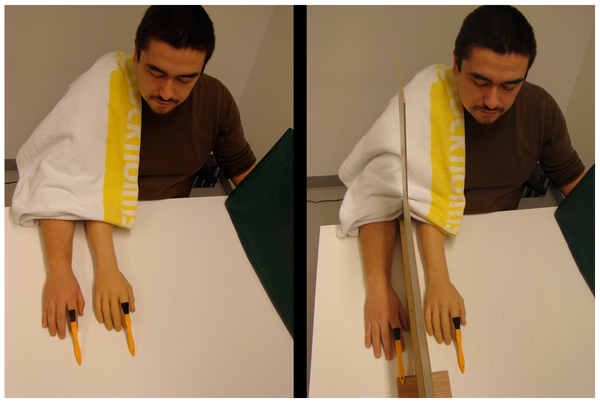
How do we 'experience' our own bodies? It has long been believed that our body image is limited by our innate body plan, so we cannot truly experience having more than one head, two arms and two legs but brain scientists at the Swedish medical university Karolinska Institutet say they have shown that it is possible to make healthy volunteers experience having three arms at the same time.
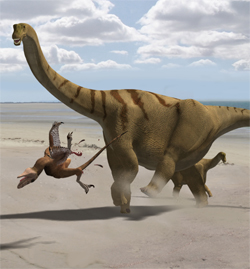
A new dinosaur named Brontomerus mcintoshi, 'thunder-thighs' to its discoverers because of its powerful thigh muscles, has been described in a paper in the journal Acta Palaeontologica Polonica.
A member of the long-necked sauropod group of dinosaurs which includes Diplodocus and Brachiosaurus, Brontomerus may have used its powerful thighs as a weapon to kick predators, or less interestingly, to help travel over rough terrain. Brontomerus lived about 110 million years ago, during the Early Cretaceous Period, and probably had to contend with fierce raptors such as Deinonychus and Utahraptor.
Patients with Hutchinson-Gilford Progeria Syndrome age eight to 10 times faster than the rest of us and rarely live beyond 13 years. Almost all of the patients die from complications of arteriosclerosis, the clogging or hardening of arteries or blood vessels caused by plaques, which leads to heart attack and stroke.
Research on Progeria is difficult because the disease is exceedingly rare and only 64 children living with progeria are known, making access to patients very difficult.
Think all Republicans are anti-science or religious people are stupid? You may look for data to rationalize your bias but a new study in Psychological Science says it may just be your own low self-esteem; when people are feeling badly about themselves, they're more likely to show bias against people who are different from them.
Jeffrey Sherman of the University of California, Davis, who wrote the study with Thomas Allen, used the Implicit Association Test (IAT), a task designed to assess people's automatic reactions to words and/or images, to investigate this claim.