After 50 years, laser technology is still advancing. Scientists at Yale University have announced the world's first anti-laser, in which incoming beams of light interfere with one another in such a way as to perfectly cancel each other out, a breakthrough that sounds academic but could pave the way for new applications in optical computing and radiology.
Conventional lasers, which were first invented in 1960, use a so-called "gain medium," usually a semiconductor like gallium arsenide, to produce a focused beam of coherent light—light waves with the same frequency and amplitude that are in step with one another.
Sometimes good things result from bad things. When scientists drilling near an Icelandic volcano hit magma, they had to abandon their experiments on geothermal energy but it turns out they may have discovered an alternative source of geothermal power.
When tested, the magma well produced dry steam at 750 degrees Fahrenheit , enough to generate up to 25 megawatts of electricity, which could power 25,000 to 30,000 homes. Fine, fine, but what does that mean? Only 5 to 8 megawatts are produced by a typical geothermal well, and Iceland already gets about one-third of its electricity and almost all of its home heating from geothermal sources, but this is a terrific new source.
The skeletal hormone osteocalcin also, boosts testosterone production to support the survival of the germ cells that go on to become mature sperm, say researchers writing in Cell.
Bone was once thought of as a "mere assembly of inert calcified tubes" but in the last ten years, scientists have gained a much more dynamic picture of bone as a bona fide endocrine organ with links to energy metabolism and reproduction.
Results of a survey in Analyses of Social Issues and Public Policy titled "How Much Is Enough? Examining the Public’s Beliefs About Consumption" showed no huge surprise, people think we should consume less, but how the authors interpret the results is.
After arguing against ‘higher consciousness’ or freedom evolving, let us go on to discuss consciousness inside computers. This is, maybe surprisingly so for some readers, closely connected with the non-existence of gods and in fact quantum theory.
Ironically (given what I wrote the last time), cyberspace and its breakneck speed evolution is still the big hope for some ill-defined freedom. Since cyberspace is all about information technology, should there not be higher consciousness after all? Maybe a ‘god2.0’ develops and grants us salvation in virtual reality, in a simulated matrix?
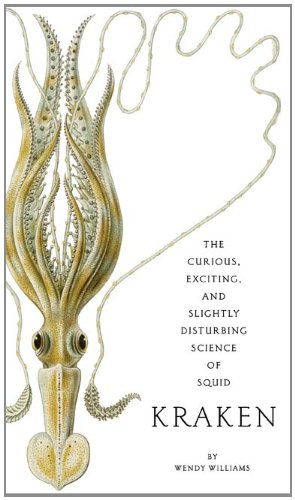
This a double whammy, a two-for-the-price-of-one, a joint review (for some value of the word
review) of two books with the same title:
Kraken.
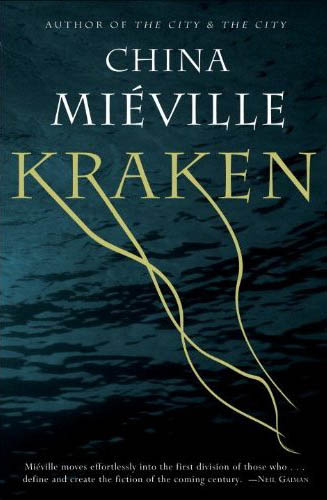
China Miéville's
Kraken is a New Weird novel that tracks the adventures of London Natural History Museum curator Billy Harrow. The inexplicable theft of his prize
Architeuthis specimen forces him into an other-London of magical knacks, squid cultists, gangsters, and impending Armageddon.
—A Critical Look at Recent Studies of Creativity and Insight—
"All this fires in my soul, and—provided I am not disturbed—my subject enlarges itself, becomes methodized and defined, and in the whole, though it be long, stands almost complete and finished in my mind, so that I can survey it, like a fine picture or a beautiful statue, at a glance..." —Wolfgang Amadeus Mozart
In the somewhat chronic angst over science understanding (more funding, more funding) one thing that gets lost is that it's really only 'fact-based' science, memorization, where American kids are behind those in Asia. That changes over time and, among adults, new results show science understanding has improved dramatically.
OK, by now everyone's familiar with "Watson", the IBM Jeopardy machine with all the hype and drama associated with Artificial Intelligence and what it means for the future of humanity. Is it HAL or Skynet? Not by any definition.
So what's the point? At present, as a proof of concept, "Watson" has demonstrated that it is possible to use algorithms to produce some understanding of natural human speech. I don't place much stock in "Watson" winning at Jeopardy since that seems as much a function of how quickly the buzzer can be pushed as it is in having an answer.