Imagine you are tasked to build the ultimate computer memory. You are provided with an unlimited budget and all the resources you need.
How big a memory capacity could you build?
Variations in the Earth’s atmospheric oxygen levels may be closely linked to the evolution of life, with feedbacks between uni- and multicellular life and oxygen, say scientists from Royal Holloway, University of London and from The Field Museum in Chicago. Writing in Nature Geoscience, they say over the past 400 million years, the level of oxygen has varied considerably from the 21% value we have today and the amount of charcoal preserved in ancient peat bogs, now coal, gives a measure of how much oxygen there was in the past.
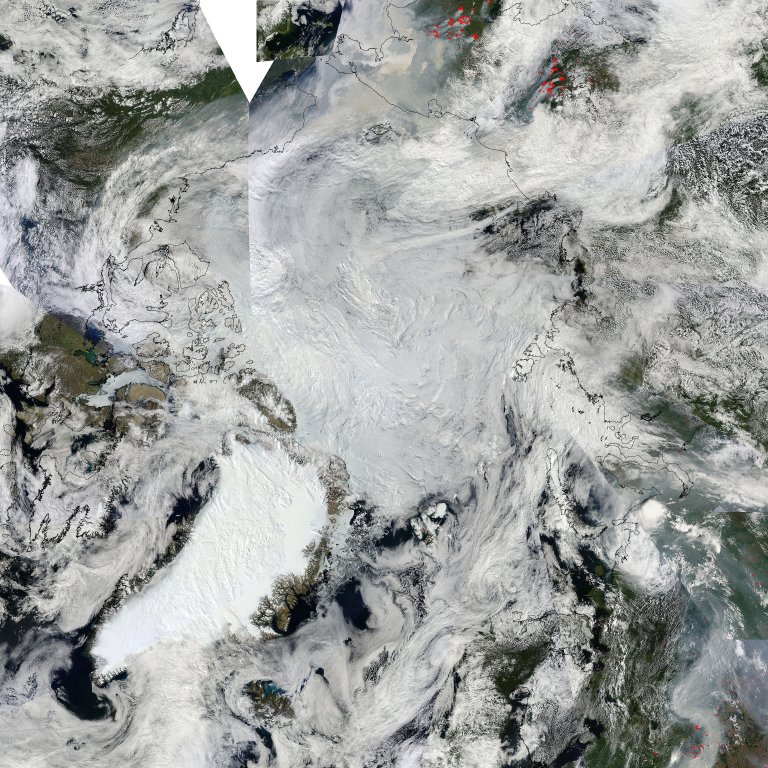
Arctic Ice August 2010Arctic warming and global warming.
The year up to July 31 has produced many examples of anomalous weather events globally. We have seen fires, floods, droughts and sandstorms on an immense scale. A
new report shows that 10 out of 10 indicators of global warming are trending in the direction predicted when global warming was merely a theory, rather than a self-evident fact.
After the issuing of new top mass results by the Tevatron experiments, it is time for another look at global electroweak fits of standard model observables. The
Gfitter group has produced new fits for the standard model in search of the most probable value of the Higgs boson mass, given the new measurements of top quark mass and other quantities, and the huge amount of existing information on sensitive observables from the standard model.
Unfortunately, I could find no update including the new Higgs search results yet. I guess such a fit will be ready in a few weeks... But the new released information is already interesting enough that we may meaningfully spend a few words around some figures here.
Researchers have reported the creation of pseudo-magnetic fields far stronger than the strongest magnetic fields ever sustained in a laboratory, just by putting the right kind of strain onto a patch of graphene.
Graphene is a form of carbon that consists of a single layer of carbon atoms. A carbon atom has four valence electrons. In graphene (and in graphite, a stack of graphene layers), three electrons bond in a plane with their neighbors to form a strong hexagonal pattern, like chicken-wire. The fourth electron sticks up out of the plane and is free to hop from one atom to the next. The latter pi-bond electrons act as if they have no mass at all, like photons. They can move at almost one percent of the speed of light.
What if assumptions of bias factored into test results to overcome social or cultural bias that prevents some people from achieving high test scores turned out to be flawed?
That's a messy sentence, right? Confusing sentences like that are what happens when 40 years of accepted practice in using tools to check tests of "general mental ability" for bias are themselves flawed. If it holds up, this finding from the Indiana University Kelley School of Business challenges basically throws out reliance on those exams to make objective decisions for employment or academic admissions.
A new corticosteroid hormone in the sea lamprey, an eel-like fish and one of the earliest vertebrates dating back 500 million years, may shed light on the evolution of steroid hormones.
Principal investigator and lead author David Close of the University of British Columbia's Department of Zoology andcolleagues at Michigan State University identified a corticosteroid hormone called 11-deoxycortisol in the sea lamprey that plays dual roles in balancing ions and regulating stresses, similar to aldosterone and cortisol in humans.
Aww. I cannot bring myself to enter the contest to win a month living in the Museum of Science and Industry in Chicago.The website
beckons: "Be the experiment. Eat. Sleep. Science."
But I am not proficient at editing or making videos, a prerequisite. The winner will emerge $10,000 wealthier for interacting with the public, doing experiments and documenting the
Month at the Museum experience, October 20 to November 18, 2010.
What a dream gig!
My
last post got me thinking a bit more about uncertainty and decision making. It reminded me of a podcast I had listened to a while back, on uncertainty, storytelling and hedge fund managers.
It is based on the work of
David Tuckett at University College London.
This is the line that I remembered. In the interview Tuckett said, “Fund managers have too much information but never enough; therefore [they] have to gain conviction for their actions by telling themselves stories.”
Tuckett is an economist turned psychoanalyst who has been studying the emotional underpinning of financial markets.
I have been working with scientists and engineers on explaining their research and other work to the general public for almost a decade. I've explained the science of many things and how they connect to the real lives of real people. But it occurred to me this morning that if you asked me to come up with a sentence or two on what an engineer's job is, I would struggle with it.
What exactly does an engineer do? How is he or she different from a scientist? What is their role in our world?
Did I mention that I am dating an engineer who works for a big local utility company, and I don't understand what he does either.