







The US Presidential candidates on fostering science and technology innovation:

For decades, the United States dominated the technological revolution sweeping the globe. The nation’s science and engineering skills produced vast gains in productivity and wealth, powered its military and made it the de facto world leader.

More than four in 10 parents with underweight and overweight children mistakenly believe their children are in the average weight range, according to University of Melbourne research.

The study also finds that different methods of assessing children's weight – such as BMI or waist circumference – result in different rates of children being identified as overweight or underweight. According to BMI, more children were classified as overweight, than compared to waist circumference.

While conducting a study about a link between breast size and heart cancer, Helena Jernström, an oncologist at Lund University in southern Sweden, discovered a gene that that about half of women possess is involved in breast cancer - and so is coffee.
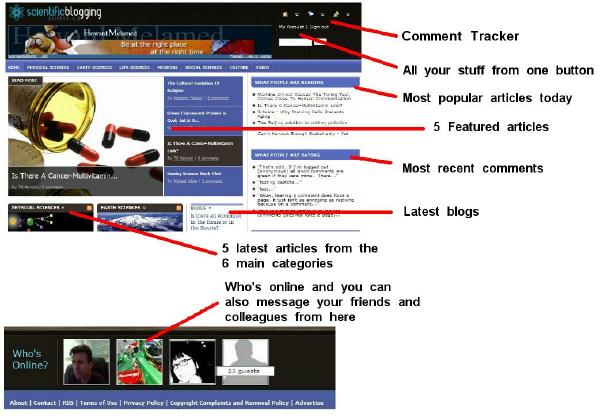
If you've been around Science 2.0 for a while, you may notice something different this weekend. We've gone through a bit of a makeover. 

After 21 months, some 30,000 articles and a difficult to guess number of tens of millions of readers, something more like we had originally intended is finally here. Why did it take so long? Well, if it isn't broken, you don't need to fix it and clearly people have come here for quality writing. Appearance is secondary to our sort of audience.

But at some level you want the appearance and 'ease of use' to reflect the same quality the writing has. Scientific Blogging, Science 2.0 v1, could do everything, you just had to know how to find it.  And it wasn't pretty.

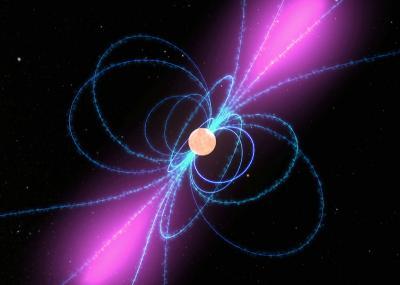
About three times a second, a 10,000-year-old stellar corpse sweeps a beam of gamma-rays toward Earth. This object, known as a pulsar, is the first one known to "blink" only in gamma rays, and was discovered by the Large Area Telescope (LAT) onboard NASA's Fermi Gamma-ray Space Telescope, a collaboration with the U.S. Department of Energy (DOE) and international partners.

"This is the first example of a new class of pulsars that will give us fundamental insights into how stars work," says Stanford University's Peter Michelson, principal investigator for the LAT. The LAT data is processed by the DOE's Stanford Linear Accelerator Center and analyzed by the International LAT Collaboration.
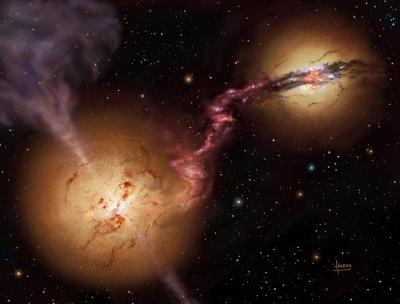
Astronomers think that many - perhaps all - galaxies in the universe contain massive black holes at their centers. New observations with the Submillimeter Array now suggest that such colossal black holes were common even 12 billion years ago, when the universe was only 1.7 billion years old and galaxies were just beginning to form. The new conclusion comes from the discovery of two distant galaxies, both with black holes at their heart, which are involved in a spectacular collision.

4C60.07, the first of the galaxies to be discovered, came to astronomers' attention because of its bright radio emission. This radio signal is one telltale sign of a quasar - a rapidly spinning black hole that is feeding on its home galaxy.

A unique, patent-pending collection of microbes that can be used both for cleaning up the environment and addressing our energy needs has earned the U.S. Department of Energy's Savannah River National Laboratory kudos from a newsletter covering the rapidly expanding field of nanotechnology. 

Nanotech Briefs awarded SRNL's BioTiger™ a spot on its fourth annual Nano 50™ list, described as the top 50 technologies, innovators and products expected to revolutionize the industry. Nanotech Briefs will present the awards during the National Nano Engineering Conference, Nov. 12-13 in Boston. For more information, visit www.techbriefs.com/nano.
Researchers at the University of Delaware have discovered that when the leaf of a plant is under attack by a pathogen, it can send out an S.O.S. to the roots for help, and the roots will respond by secreting an acid that brings beneficial bacteria to the rescue.

The finding quashes the misperception that plants are "sitting ducks"--at the mercy of passing pathogens--and sheds new light on a sophisticated signaling system inside plants that rivals the nervous system in humans and animals.


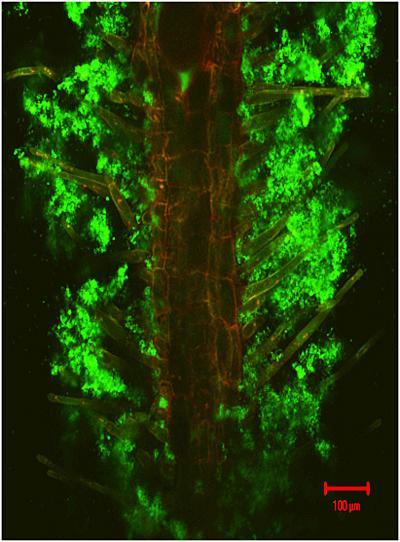
The green represents the beneficial bacterium Bacillus subtilis, which has formed a biofilm on the Arabidopsis root surface.  Photo Credit: University of Delaware/Thimmaraju Rudrappa
A single molecule in the intestinal wall, activated by the waste products from gut bacteria, plays a large role in controlling whether the host animals are lean or fatty, a research team, including scientists from UT Southwestern Medical Center, has found in a mouse study.

When activated, the molecule slows the movement of food through the intestine, allowing the animal to absorb more nutrients and thus gain weight. Without this signal, the animals weigh less. 

The study shows that the host can use bacterial byproducts not only as a source of nutrients, but also as chemical signals to regulate body functions. It also points the way to a potential method of controlling weight, the researchers said.

According to a report by the UN Scientific Committee on the Effects of Atomic Radiation in 2000, patients are exposed to about 200 times more ionizing radiation than medical workers. In some countries, this figure can be nearly 500 times.

In the quest to discover the root of illnesses, patients have to undergo an increasing number of scans and tests that may involve the use of ionising radiation to detect the source and scope of an ailment. However, this practice could also put patients at risk.

"There has been concern that new technologies are not providing the amount of patient protection that medical professionals had expected.

