

In the May 1st issue of Genes & Development, Drs. Yong Sun Lee and Anindya Dutta (UVA) reveal that microRNAs can function as tumor suppressors in vitro.

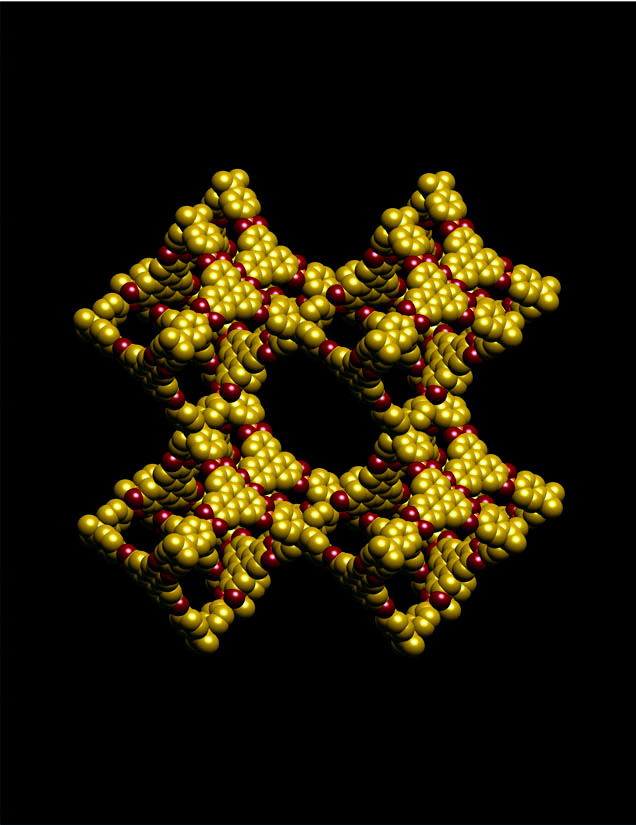
Chemists at UCLA have designed new organic structures for the storage of voluminous amounts of gases for use in alternative energy technologies.

The research, to be published on April 13 in the journal Science, demonstrates how the design principles of reticular chemistry have been used to create three-dimensional covalent organic frameworks, which are entirely constructed from strong covalent bonds and have high thermal stability, high surface areas and extremely low densities.


The image shows the crystal structure of COF-108. Synthesized only from light elements (H,B,C,O) COF-108 is the lowest-density crystal ever produced (0.17 g/cubic cm). (Credit: José L. Mendoza-Cortés)

Scientists have found one of the largest fields of seafloor vents gushing super-hot, mineral-rich fluids on a mid-ocean ridge that, until now, remained elusive to the ten-year hunt to find them.

"The discovery of the first active vents ever found on an ultraslow-spreading ridge is a significant milestone event," said Jian Lin, leader of a team of Woods Hole Oceanographic Institution (WHOI) scientists who participated in a Chinese expedition to the remote Southwest Indian Ridge in the Indian Ocean in February and March.

This week in Science, Yale researchers present “roadmaps” showing that shared protons, a common loose link between two biological molecules, simply vibrate between the molecules as a local oscillator, rather than intimately entangling with the molecular vibrations of the attached molecules.

Led by Professor Mark A. Johnson in the Department of Chemistry, the new data reveal distinct, isolated vibrational patterns, solely associated with the bridging proton, that change dramatically according to the chemical properties of the tethered molecules.


Two oxygen atoms on different molecules are connected by their mutual attraction to an extra proton, shown as a fuzzy ball between them.

A drug under study to treat various cancers selectively kills cancer cells because of its affinity for a modified version of a critical heat shock protein they contain, researchers have found.

They found in cancer a modified version of heat shock protein 90, or hsp90, which like most heat shock proteins, promotes cell survival.

Research by Renee Theiss, Jason Kuo and C J Heckman, which has just been published in The Journal of Physiology, throws light on how information is processed in the Central Nervous System (CNS) to drive movement. The findings are relevant to understanding mechanisms underlying movement and disorders such as spinal cord injury and motor neurone disease (ALS).

The controversial idea that one cause of high blood pressure lies within the brain, and not the heart or blood vessels, has been put forward by scientists at the University of Bristol, UK, and is published this week in the journal Hypertension.

Dr. Hidefumi Waki, working in a research group led by Professor Julian Paton, has found a novel role for the protein, JAM-1 (junctional adhesion molecule-1), which is located in the walls of blood vessels in the brain.

Researchers have successfully applied X-ray scattering techniques to determine how dissolved metal ions interact in solution.

These findings will help researchers better understand how metal ions, such as those found in nuclear waste and other industrial processes, behave in the environment.


Researchers at the Department of Energy's Argonne National Laboratory and the University of Notre Dame have successfully applied X-ray scattering techniques to determine how dissolved metal ions interact in solution. Credit: Argonne National Laboratory

A new theoretical thermometer built from heavy-duty mathematics and computer code suggests that the surfaces of certain neutron stars run significantly hotter than previously expected. Hot enough, in fact, to at least partially answer an open question in astrophysics -- how to explain the observed frequency of ultra-violent explosions known as superbursts that sometimes ignite on such stars' surfaces?


Neutron star accreting matter from a red giant star. The red giant (on the upper right) is expanding and dumping material onto the neutron star. This material forms a disk and then finally falls to the neutron star surface. Credit: Tony Piro, U.C. Berkeley

Human bone marrow has been used to create early-stage sperm cells for the first time, a scientific step forward that will help researchers understand more about how sperm cells are created.

The research published in the academic journal Reproduction: Gamete Biology, was carried out in Germany* by a team of scientists led by Professor Karim Nayernia, formerly of the University of Göttingen but now of the North-east England Stem Cell Institute (NESCI), based at the Centre for Life in Newcastle upon Tyne.


How Prof Nayernia and his team cultured from human bone marrow. Credit: Newcastle University, England

