




Yesterday the Italian newspaper "Il Manifesto" featured two pieces written by yours truly on the discovery of the Higgs boson. I was delighted to have a chance to write for that newspaper, which has an illustrious history and is totally independent (and on the verge of being shut down). By the way, I must thank Peter Woit who suggested the reporters of the newspaper to contact me for the piece.

The articles are in Italian, but I can make an effort at translating them for you here.

Eurartesim(R) - dihydroartemisinin piperaquine (DHA-PQP) - the first artemisinin combination therapy (ACT) has been approved by the European Medicines Agency (EMA) for the treatment of uncomplicated malaria. Eurartesim was developed collaboratively by Sigma Tau Group, Italy, and the not-for-profit research foundation Medicines for Malaria Venture (MMV). 

 Eurartesim is now ready for delivery to Cambodia, the first malaria endemic country to place an order for the newly approved treatment. Cambodia prioritized the use of DHA-PQP as a first line drug and was awaiting EMA approval to allow procurement of this product using international donor funds. 

Dark matter and dark energy is thought to account for up to 80% of the matter in the universe. Does it exist? Well, it has to, we just can't see it. So what is it? We better know what it isn't.
I stayed up late (California) to watch the Higgs announcement and posted various thoughts of my own, and comments from the presentations, on my Twitter feed. 
Living in the guts of worms are seemingly innocuous Photorhabdus luminescens bacteria that contribute to the worms' survival. Yet with a flip of a genetic switch, those same bacteria transform from harmless microbes into deadly insecticides.

How the 
photorhabdus bacteria  and a single promoter inversion switches it from an upstanding community member in the gut microbiome to deadly killer in insect blood is the subject of a new study. The bacteria in question are bioluminescent insect pathogens. In their mutualistic state, they reside in the intestines of worms, growing slowly and performing other functions that aid nematode's survival, even contributing to reproduction.
Aerosols from relatively small volcanic eruptions can be boosted into the high atmosphere by weather systems such as monsoons and affect global temperatures, according to a new study. 

The Superconducting Super Collider (SSC) was not too big to fail. Although it was a massive opportunity for the United States to maintain its primacy in high-energy physics and basic research, the SSC was not sufficiently big on the federal funding list back in the early 1990s even to get built.

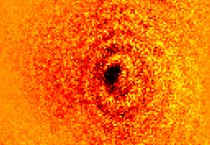
Researchers have been able to photograph the shadow of a single atom for the first time.

And this absorption imaging took five years of work. They basically wanted to investigate how few atoms are required to cast a shadow and they found it takes just one. At the heart of the effort is a super high-resolution microscope, which makes the atom's shadow dark enough to see. 

People still use optical microscopes in research?  Apparently so.  And the 
Griffith University team claims no other facility in the world has the capability for such extreme optical imaging. They did it by isolating it in a chamber and immobilizing it in free space using electrical forces. 

Although boredom very rarely escapes the notice of those suffering from it, constructing a purely technical instrument for reliably recognising boredom in humans is currently rated as a non-trivial task.

But recently, a team from George Mason University, the University of North Carolina, the Georgia Institute of Technology and the Naval Research Lab, Washington, DC have between them devised a provisional system for doing just that.

