




A new study suggests that your next hotel room stay may come with a bonus - someone else's fecal matter.

Katie Kirsch, an undergraduate student at the University of Houston, presented the work at the 2012 General Meeting of the American Society for Microbiology.  The study was designed as the first step in applying the Hazard Analysis and Critical Control Points (HACCP) system to hotel room cleanliness. Originally developed by NASA, HACCP is a systematic preventive approach that identifies potential physical, chemical and biological hazards and designs measurements to reduce these risks to safe levels.
Soitec, part of Euronext Paris, has announced that the U.S. Department of Energy (DOE) is giving them a SUNPATH award in the amount of $25 million to support its new North American solar manufacturing facility in San Diego, California.

SUNPATH, which stands for Scaling Up Nascent PV At Home, is part of the U.S. governments controversial efforts to increase America's manufacturing competitiveness in the solar market.

I’ve seen this article several times now, and I meant to address it the first time, but then I got distracted by something shiny…er I mean work?

Society is in a tough spot. Drug companies are culturally vilified and routinely sued when things go bad - all in return for only a few years of profitability before anyone can make the new drugs they develop - the FDA is constantly under pressure to expedite new drugs to respond to patient needs and governments are increasing pressure and regulation.

 Small wonder there are fewer early stage drug companies and drug shortages.  The situation is even worse in Europe, both in their cultural resistance to modern science and anti-business climate.

Life-threatening allergic reactions in children, such as anaphylaxis, have increased 7-fold in the last decade and a third of all allergic shocks in children occur for the first time at school with teachers largely unprepared.

Two studies in Nature applied DNA blood testing using the BEAMing technology to detect drug resistance mediated by KRAS mutations in colorectal cancer patients months before treatment failure was observed. 

 The group led by Alberto Bardelli, Ph.D., of the University of Torino, Italy describes the development of secondary resistance mutations to the anti-EGFR monoclonal antibody cetuximab (Erbitux(R)) in patients with metastatic colorectal cancer (mCRC) [Misale S. et al., Nature Epub 13 June 2012].The second group led by Luis Diaz, MD and Bert Vogelstein, M.D. from Johns Hopkins University reached similar conclusions after studying mCRC patients treated with a monotherapy of panitumumab (Vectibix(R)) [Diaz Jr LA et al., Nature Epub 13 June 2012]. 

Heliatek GmbH, a technology company in the field of organic photovoltaics, has announced that its transparent solar films could be used to be integrated between the glass sheets of double glazed windows. These windows would look like tinted glass as the unique vapor deposition technology for the solar films allows for a homogeneous coating of the solar layer without any distracting patterns or irregularities.  

Results Presented at the 17th Congress of the European Hematology Association by Bristol-Myers Squibb Company and Otsuka Pharmaceutical Europe Ltd., said six-year follow-up results from a Phase 3 randomized, open-label, dose-optimisation study of SPRYCEL(R) (dasatinib) in Philadelphia chromosome-positive (Ph+) chronic-phase chronic myeloid leukaemia (CP-CML) adult patients resistant or intolerant to Glivec(R) (imatinib). 

The six-year data shows progression-free survival of 49.3% and an overall survival of 71% for patients randomized to dasatinib 100 mg once daily (n=167), with 6% of patients (n=10) progressing to accelerated or blast phase on study at six years of follow-up.[1] 

Higgs News ?!

Higgs News ?!

Jun 17 2012 | comment(s)

While Higgs rumors are appearing in blogs of the usual suspects, I cannot comment on those -and I decided it is better if I do not even link them here (I have grown wary of oversensitive reactions in my colleagues).

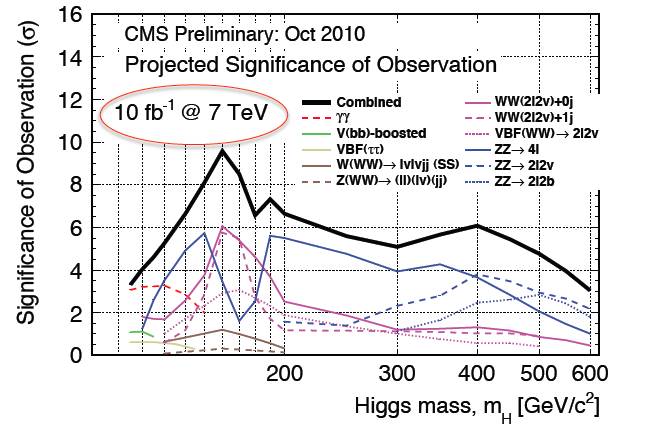
The only thing I think I can discuss with you here now is the predictions on the Higgs boson significance level produced by CMS in October 2010 - a couple of geological eras ago, that is. Those predictions can be trusted because 2011 data showed to be perfectly in line with them, both for the 95% CL limits and for the significance -of course the former are valid in the full mass range and provide more verification power than the single significance number, which is only valid if the Higgs boson exists and has a particular mass.
With the approach of Summer conferences -most notably, ICHEP, which alone has set a make-or-die deadline for the LHC experiments- physicists in ATLAS and CMS are frantically producing their results with data collected in 2012.

