




A team of Australian scientists has identified new genes that show identifiable changes in the blood of people with bowel cancer.

The discovery has the potential to underpin a new cost-effective blood test that would signal the early stages of bowel cancer. This test could potentially save thousands of lives by supplementing existing screening programs and encouraging those at risk to have a colonoscopy.

The research presented today is the result of over five years of scientific collaboration between Australian biotechnology company Clinical Genomics, CSIRO and the Flinders Centre for Innovation in Cancer at Flinders University in Adelaide, lead by senior investigator Professor Graeme Young.

ET Solar Group Corp. of China has announced completion of two ground-mounted PV power plants in Germany, with total installed capacity of over 9.6MW.

The plants are ground-mounted and are 4MW and 5.6MW by size and are located in Oberröblingen, 100 kilometers west of Leipzig, and Rätzlingen, 100 kilometers from Hamburg respectively. ET Solutions AG, ET Solar's wholly owned subsidiary, performed full engineering, procurement and construction tasks with all PV modules sourced from ET Solar's China plant.

A cap and trade system for carbon dioxide has been a terrific flop; even proponents are leery that it is just another layer of bureaucracy and the only economic benefits have been of the economic voodoo kind, similar to a federal stimulus package that went primarily to state and municipal union employees were called 'jobs saved' in a brilliant bit of marketing.

Why would anyone want to export that fiasco to another environmental issue?  It's academic.  Sometimes academic is obviously a good thing; basic research, for example.  And sometimes 'academic' connotes 'out of touch with reality', like people in the humanities who try and argue that communism really works, it's just that no one has really tried it.

Rockets are powerful stuff, and satellites and astronauts experience tremendous G-forces pushing down on them during launch.  For picosatellite work, it is necessary that your design be able to withstand forces equivalent to perhaps 10 times Earth gravity-- 10Gs.  To test this, the easiest way is to build a centrifuge.

Think of the spinning bucket gimmick.  If you tie a bucket to a rope and fill it with water, you can make the bucket swing in a loop-the-loop over your head and not spill, as long as it is spinning fast enough.  You need enough spin to counteract the 1G of the Earth's pull, so you need a spinning centrifuge of at least >1G.

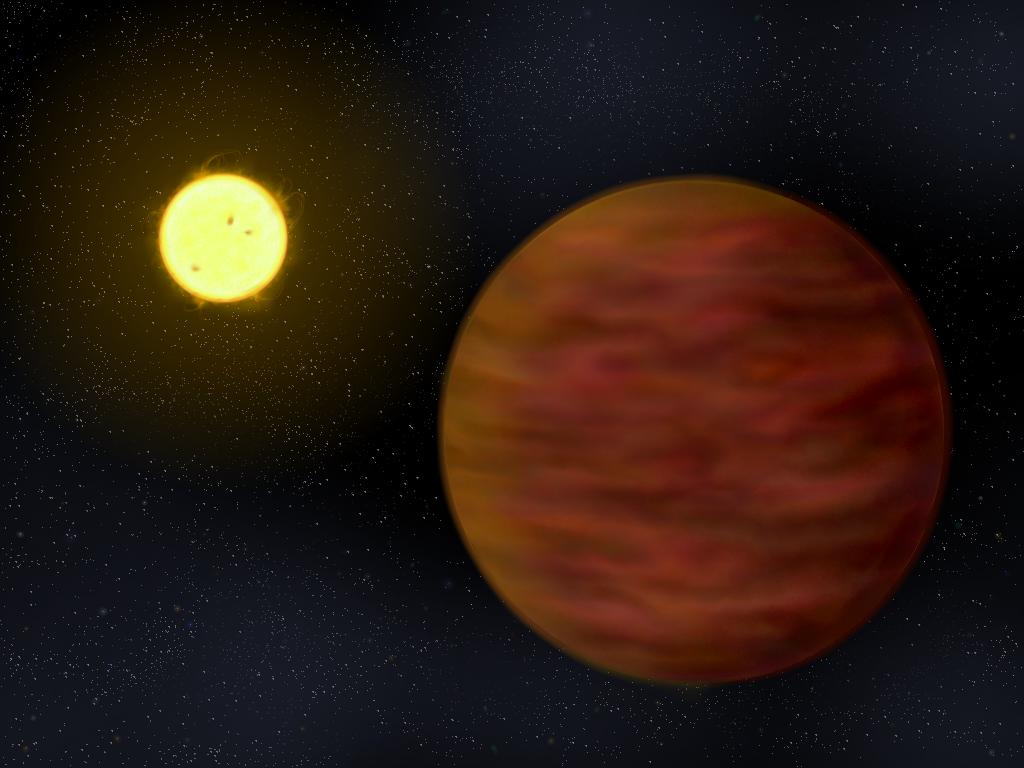
Giant planets have diverse chemistry; Jupiter, for example, first formed as a large solid core and then then accreted gas from the disk around it, which led to a different chemistry in its outer layers. When the Galileo spacecraft entered Jupiter’s atmosphere in 1995, it found the proportion of heavier elements (astronomers call these ‘metals’) to be three times higher than in the Sun.

Brown dwarfs, around the same size, are instead star-like objects with insufficient mass to ignite hydrogen fusion in their cores. Over time they cool to temperatures of just a few hundred degrees. Like stars, they formed from the collapse of a giant molecular cloud a few hundred light years across.
Polar bears are evolutionarily older and genetically more distinct than believed. This largest Arctic carnivore evolved as early as 600,000 years ago, five times older than previously recognized. 
What do diamonds and chocolate have in common?  Well, urban legend says girls love them both.  Maybe we can add volcanoes if we are using correlational woo.

A previously unrecognized volcanic process similar to one used in chocolate manufacturing is important in the dynamics of volcanic eruptions. 'Fluidised spray granulation'  is a type of gas injection and spraying process used to form smooth coatings on confectionaries but it can also occur during kimberlite eruptions to produce well-rounded particles containing fragments from the Earth's mantle - most notably diamonds. 
End-of-year academic stress getting you down? Here’s a spirit-lifting tip: Open your browser and Google “Heartland billboard.”

You’ll quickly find The Heartland Institute’s latest propaganda piece: a mugshot of Ted Kaczynski next to the words, “I still believe in Global Warming. Do you?” Heartland’s not-so-subtle subtext: If you think the climate is changing, you’re no better than terrorists like the Unabomber.

The billboard, which appeared alongside a Chicago highway, was the first in a series that, Heartland said, would have included other standout characters like Osama bin Laden and Charles Manson.
Garra rufa - "doctor fish' - are now trendy in some fish pedicure places.  The pedicuree dips their feet (see? I don't specify a gender or make any judgments, I am not Manny Pacquiao) into water containing the fish and the little critters exfoliate you by basically eating the dead skin from your toes.
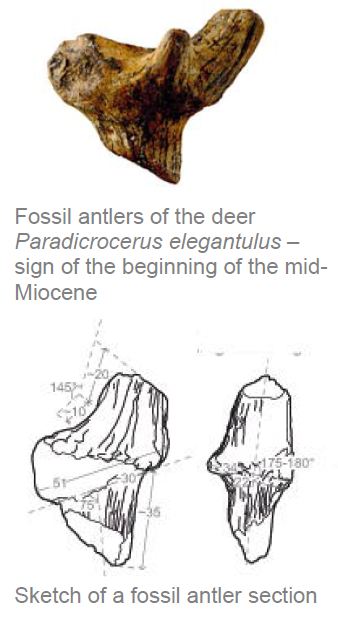
Based on new fossil evidence, the age of the Rhine river is five million years older than previously believed.

The famous Rhine of song and legend flows through Switzerland, Austria, Germany and the Netherlands on its way to the North Sea. The catchment area of the Rhine, around 1,200 kilometers of it, draws from Luxembourg, Belgium, France, Lichtenstein and Italy. As widely known as the river is, its original age has remained a science puzzle.

