How can basically honest scientists using a rigorous methodology have different data? Numerical models are tricky business and while climate scientists are rapidly becoming experts in statistics and creating better models, that was not always the case.
One vital component of getting clean models is accurate calibration. Calibration is life, in science. A satellite temperature record put together by the University of Alabama in Huntsville in 1989 has often been cited by climate change skeptics as evidence of doubt that models showing the impact of greenhouse gases on global warming are accurate.
Last week, word came from Prudhoe Bay that sent chills through me as surely as if I’d been standing in the Alaskan North Slope drilling outpost myself. The United States Department of Energy – in collaboration with energy giant ConocoPhillips and the Japanese nationalized minerals corporation – reported success from a month-long test extraction of methane gas tucked into an icy lattice below the permafrost.
Type Ia supernovae are important for measuring the universe because they're bright enough to be seen across large distances and similar enough to be a reference, an an object of known luminosity - but astronomers still don't know what star systems make Type Ia supernovae.
Two very different models might explain the possible origin of Type Ia supernovae and different studies support each model. Some new evidence says both models are correct because some supernovae are produced one way and some the other.
A new paper by Natural Resources Defense Council says hydraulic fracturing (fracking) generates massive amounts of polluted wastewater in in the Marcellus Shale that threatens the health of drinking water supplies, rivers, streams, and groundwater - and that federal and state regulations have not kept pace with the dramatic growth of fracking and must be strengthened to reduce the risks of health issues throughout the Marcellus region.
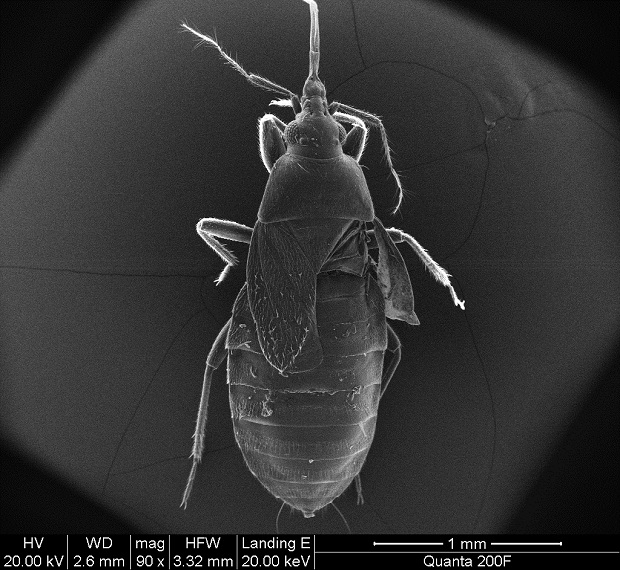
If bugs have their own Tori Amos, she is likely writing about sexual conflict and how reproduction exists at all given that it can be so costly, especially to females. One aspect of this conflict concerns how females respond to increased mating events that are of more benefit to males than to themselves.
New work discusses how some males, instead of mating conventionally, take the awkward step of piercing and penetrating their mate through her body wall. This mating behavior is known as traumatic insemination and it potentially comes at a great physiological cost to the female.
Many proteins and other functional molecules in our bodies display a striking characteristic: They can exist in two distinct forms that are mirror images of each other, chirality or "handedness", like your right hand and left hand, and each of our bodies prefers only one of these molecular forms.
Researchers have been exploring how and why chirality arises, and new findings on the physical origins of the phenomenon were published in Nature Communications.
Pentamodes, proposed in 1995 by Graeme Milton and Andrej Cherkaev, have been purely theoretical but three-dimensional transformation acoustics ideas, for example inaudibility cloaks, acoustic prisms or new loudspeakers, could become reality in the near future.
The mechanical behavior of materials like water (or even gold) is expressed in terms of compression and shear parameters. For examples, water as an incompressible fluid that can barely be compressed in a cylinder is described through the compression parameter, but that it can be stirred in all directions using a spoon is expressed through the shear parameters.
The Office of Naval Research (ONR) wants to develop a solid-state laser weapon prototype that will demonstrate multi-mission capabilities aboard a Navy ship, officials announced May 8.
In case you were worried that America was only 25 years ahead of the rest of the world in military capability, this is good news.
The proposed solid-state laser weapon would help sailors defeat small boat threats and aerial targets without using bullets. So, people who hate bullets will be thrilled.
ONR will host an industry day May 16 to provide the research and development community with information about the program. A Broad Agency Announcement is expected to be released thereafter to solicit proposals and bids.
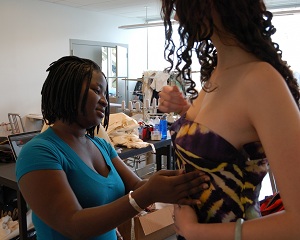
Poor people in developing nations have been caught in a cultural tug-of-war over how to best keep them from dying of Malaria. What they need to break the impasse between anti-science acolytes who think "Silent Spring" had any science in it and corporate chemical manufacturers is...a fashion show.
Frederick Ochanda, postdoctoral associate in Cornell's Department of Fiber Science&Apparel Design and a native of Kenya, teamed up with Matilda Ceesay, a Cornell apparel design undergraduate from Gambia, to create a hooded bodysuit embedded at the molecular level with insecticides for warding off mosquitoes infected with malaria, a disease estimated to kill 655,000 people annually on the continent.
Here's a pretty good kickstart for a science resume; inventing a disease-fighting, anti-aging compound using nano-particles from trees at age 16.