


Mask-Bot, which looks somewhat like a real person (your uncanny valley sense notwithstanding) is actually the prototype of a new robot face that a team at the Institute for Cognitive Systems (ICS) at TU München has developed in collaboration with a group in Japan.

Mask-Bot can reproduce simple dialog. When Dr. Takaaki Kuratate says "rainbow", for example, Mask-bot flutters its eyelids and responds with an elaborate sentence on the subject: "When the sunlight strikes raindrops in the air, they act like a prism and form a rainbow". And when it talks, Mask-bot also moves its head a little and raises its eyebrows.

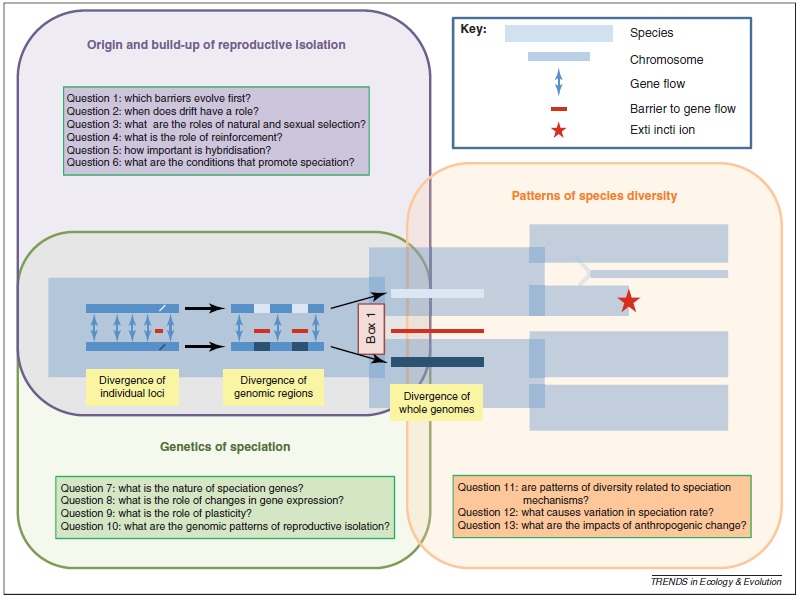
How do new species arise? This question is still being vigorously researched in evolutionary biology. New technologies, such as genomics, provide intriguing new opportunities to investigate the matter, but they also show that some of the previous ideas were not as satisfactory as once thought. So, where does the research go from here?

The members of the Marie Curie SPECIATION Network have recently published a list of what they perceive to be key questions on the topic of speciation, as a guide for future studies. These questions were divided into three main research areas:

These days I am preparing a three-hour course of statistics for particle physicists which I will give at a winter school in a couple of months. This stimulating task forces me to find nice and simple examples of good and bad applications of basic statistics. Stuff with high didactical value, and hopefully also entertaining.
It is approaching fast. And it is big. The next NEO (Near-Earth Object) encounter that is. This Tuesday, a 400 m (1,300 ft) diameter rock, known as 2005 YU55, will pass by earth at a distance that is from astronomical perspective truly minuscule: 0.00217 AU. In a solar system that stretches more than 80 AU in diameter, that is less than a hair width. Such close encounters for objects of this size are expected to occur no more than a few times per century. 


Earth, keep starboard - we are going to pass!

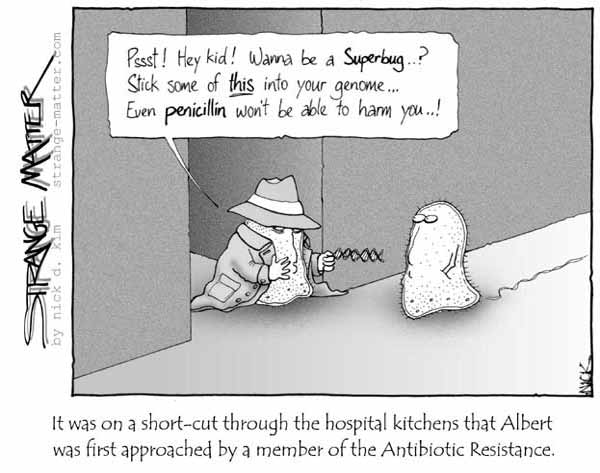
Antibiotic resistance is a huge problem. More and more resistant strains of microbes are appearing. Needless to state that this has a huge human and economic cost. Combining this with the increasing globalization, the threat of a global outbreak of an infection caused by a multidrug-resistant bacterium looms over our heads as Damocles’ sword. This perhaps sounds too ominous, but it speaks for itself that research into the development of antibiotic resistance could prove very useful.

To explore this problem, a group of scientists gathered in Cold Spring Harbor, NY at the Banbury Conference Centre to address the issues involved and identify key steps in dealing with this threat. Seven actions that urgently need to be undertaken were identified:


My recent article  on the relationship between Einstein's Theory of Relativity and superluminal neutrinos has triggered a series of comments. Some of them were reasonable, some others not. Among the reasonable doubts on this topic, there is a possible concern about the meaning of "limiting velocity", i.e. velocity that cannot be exceeded in the context of the theory. Could it be that we have found a new limiting velocity-  the one of neutrinos- and the theory still stands up with a new value for a fundamental constant c? Could it be that the speed of light is not well measured?

The biodiversity of the ecological community may impact whether a species can evolve to survive climate change, according to a numerical model that simulates the effect of climate change on plants and pollinators.

The study in Evolutionary Applications seeks to address a looming concern; whether species that have survived large climatic change in the past can survive future climate change. In the study, researchers used computer simulations to examine the effect of climate change on populations of flowering plants and their insect pollinators. 

Insects who can scale walls are able to do so because of the thousands of tiny hairs that cover their feet and legs. The hairs have flattened tips that can splay out to maximize contact, even on rough surfaces. 

The ability of insects to run up walls and hang from ceilings have fascinated humans for centuries. Scientists from the Zoological Institute at the University of Kiel, in Germany, have created a dry tape similar to the hairs on insects that can be repeatedly peeled off without losing its adhesive properties. They presented their work at the AVS Symposium held last week in Nashville, Tenn.

Old-fashioned 'leatherhead' football helmets from the early 1900s were as effective, and sometimes better, than modern football helmets - at least when it comes to injuries during routine, game-like collisions.

The study in the Journal of Neurosurgery: Spine compared head injury risks of two early 20th Century leatherhead helmets with 11 top-of–the-line 21st Century polycarbonate helmets. 

Varices, commonly called varicose veins, are a cosmetic problem if they occur as spider veins but in their advanced stage they pose a real health threat. In those patients, the blood is no longer transported to the heart unhindered but instead pools in the veins of the leg because the vessel walls or venous valves no longer function adequately.

