





For millenia, science and technology have been mobilized toward a Utopian dream; making food so plentiful and cheap poor people could afford to be fat.

Well, they can, and because we have freedom (sort of - some states ban trans fats for your own good) a lot of people are fat; so fat some advocates even insist we should go back to making food too expensive for poor people to eat.  Others contend people should just eat less and keep government out of it.

For people who seek a third alternative, there is the awesome power of science.  Maybe taking a pill would do the trick. 

How do we learn best? 


It depends on the individual! In the video below, Salman Khan is demonstrating what those of us in psychology, education, and intelligence research already knew: Everyone learns at a different pace, in different ways. And I'm not reducing this to 'visual learner' versus 'kinesthetic learner', etc. I mean linear versus non-linear, and all stages in-between. 


A personal story...

Rats exposed to the antidepressant citalopram, a serotonin-selective reuptake inhibitor (SSRI), just before and after birth showed substantial brain abnormalities and behaviors, according to a new study. The long-distance connections between the two hemispheres of the brain showed stunted growth and degeneration and the animals also became excessively fearful when faced with new situations and failed to play normally with peers – behaviors reminiscent of novelty avoidance and social impairments seen in autism.

The abnormalities were more pronounced in male than female rats, just as autism affects 3-4 times more boys than girls.

When domesticated agriculture was invented, it took off and revolutionized human expansion but a study of ceramic pots from 15 sites dating to around 4,000 B.C. shows humans may have undergone a gradual rather than an abrupt transition from fishing, hunting and gathering to farming. The researchers analyzed the cooking residues preserved in 133 ceramic vessels from the Western Baltic regions of Northern Europe to establish whether these residues were from terrestrial, marine or freshwater organisms. 

The research team found that fish and other aquatic resources continued to be exploited after the advent of farming and domestication, with pots from coastal locations containing residues enriched in a form of carbon found in marine organisms.

While the incidence of colon cancer has not dropped since 1978, deaths have.  Earlier diagnosis, better treatment?

Perhaps healthier hot dogs.
 
2011 data from the SEER Cancer Statistics Review from the National Cancer Institute shows colon cancer is still out there but the addition of ascorbate (vitamin C) or its close relative, erythorbate, and the reduced amount of nitrite added in hot dogs, mandated in 1978, was recently linked to the decreased death rate.   

Does yoga help with chronic back pain?  Yes it does, but so does stretching.  Either is better than handing people a book, according to the largest U.S. randomized controlled trial of yoga to date. 

In the trial, 228 adults in six cities in western Washington state were randomly assigned to 12 weekly 75-minute classes of either yoga or stretching exercises or a comprehensive self-care book called "The Back Pain Helpbook". Nine in 10 of them were primary-care patients at Group Health Cooperative and participants in the trial typically had moderate, but not severe, back pain and relatively good mental health. Most had been at least somewhat active before the trial started. 

Teens who drink more than five cans fizzy soft drinks per week - less than one per day - are significantly more likely to commit violence or carry weapons, suggests research in Injury Prevention, part of the British Medical Journals.  

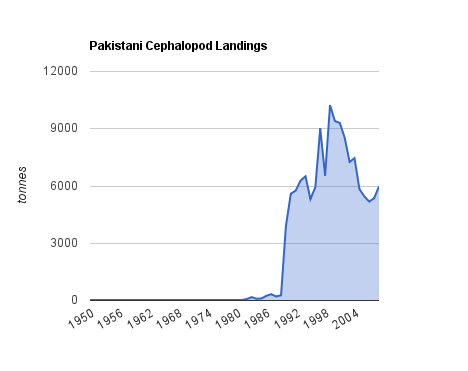
South Korea isn't the only place fishermen are worried about losing their squid. According to a recent article in Pakistan's The News

This article eliminates the need for the Higgs.

The quaternionic equation of motion of an elementary particle is in fact a continuity equation in which another quaternionic flavor ψʸ of the transporting field ψˣ is coupled with that transporting field via a source term. The coupling factor acts as the mass of the corresponding particle.

This fact comes into the foreground when the Dirac equation is converted from its spinor based form to the much cleaner quaternionic form. After stripping away the matrices and reducing the spinors to a single element, the quaternionic Dirac equation for a free particle runs:

  ∇ψ = m ψ*

or

  ∇*ψ* = m ψ

A derived equation is

  ∇(ψ ψ) = m (ψ ψ*) = 2 m|ψ|²

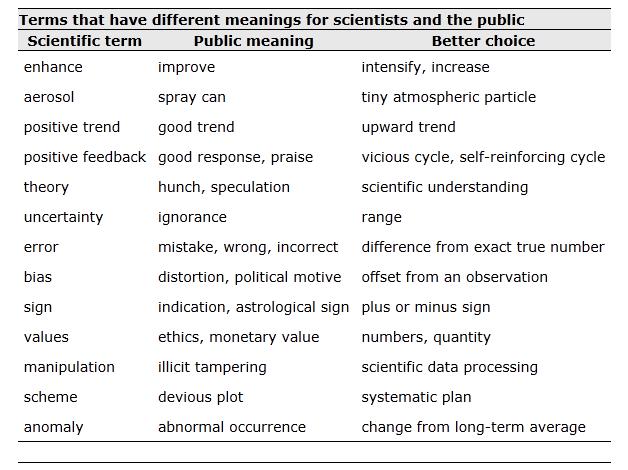
This morning I read with interest a paper on Physics Today, titled "Communicating the Science of Climate Change", by R. Somerville and S. Hassol. In it, there is a table worth pondering about. Here it is:


