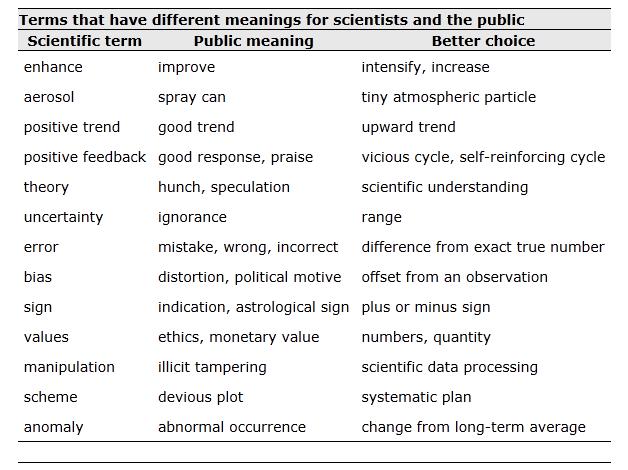


This morning I read with interest a paper on Physics Today, titled "Communicating the Science of Climate Change", by R. Somerville and S. Hassol. In it, there is a table worth pondering about. Here it is:


Donna Laframboise’s book “The Delinquent Teenager Who Was Mistaken for the World’s Top Climate Expert: An Expose of the IPCC” is out. Negative reviews on amazon are very helpful. Forget the positive ones; they are seldom useful. Reviews that give the writer a low score are the most revealing. Often, they are witness of an informed person who has spend time on a charitable reading but who found the work nevertheless lacking for good reasons. In this case however, the negative reviews are lightning fast reactions of well known people (Scott A. Mandia, Peter Gleick) who have obviously not read the book before writing their “review”.

So what is the deal with this 'cosmic speed limit'? Is it really unthinkable that neutrinos move faster than light? 
October is passing and the neutrino saga continues to make headlines here and there, but I know that the excitement is bound to slowly dampen, as the preprint claiming superluminal speeds ages in the Arxiv without being sent to a scientific magazine.

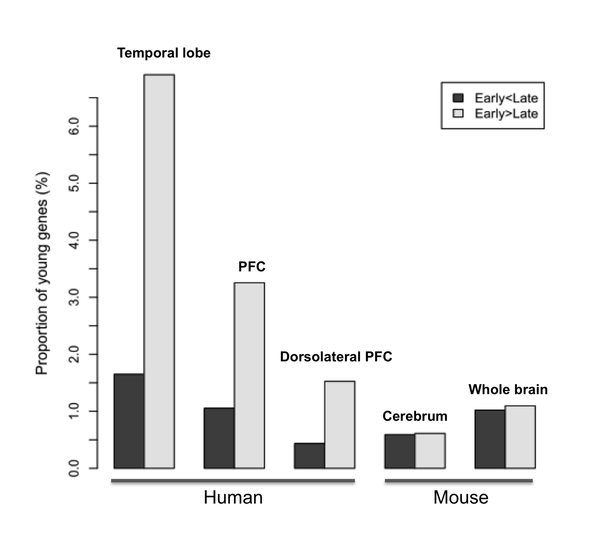
The evolution of the human brain is the topic of a lot of research. This shouldn’t be surprising since it is so well-developed in human beings, and, as many believe, it is one of the main traits that sets us apart from our close evolutionary relatives. The seat of consciousness, culture, science, technology, and so on, exerts a great desire upon people to understand it, and to understand how it could have evolved. In order to study this question, a new study, published in PLoS Biology, investigated the occurrence and activity of evolutionary young genes in human brain development.

The researchers, from the University of Chicago, grouped their findings into four lines of evidence:

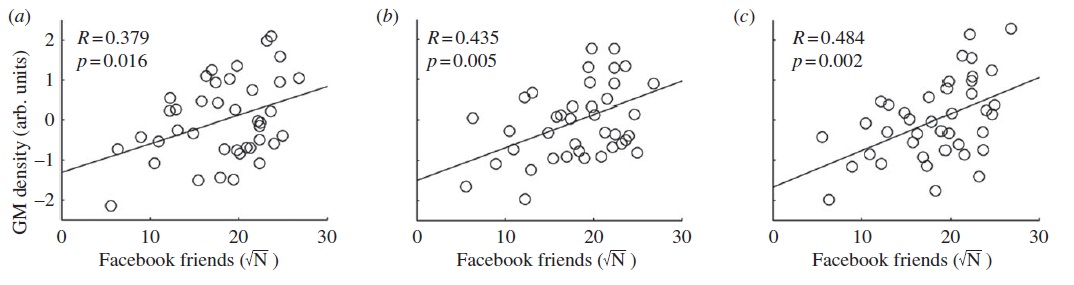
Social networks on the internet have grown greatly in the past few years. None more than the near ubiquitous Facebook, with over 800 million active users, half of which log in on any given day. Yet, there is great variability in the size of the online social networks of individual people. Is this correlated with the real-world networks of people? Does this have a neural basis? It are exactly these questions that were investigated in a new study, published in the Proceedings of the Royal Society B.

By collecting MRI scans of 125 healthy volunteers (independently replicating the experiments in a second dataset of 40 people) and having these people fill in a questionnaire, the researchers that authored the study had a look at both aforementioned questions. 

“Siri” is the personal assistant application on the newest iPhone. Now it is not exactly news that Apple products are overpriced and of relatively low quality - do not drop the new iPhone; it is fragile. Apple aims for those who ‘are easily parted from their money’ (translation at Pocket English Idioms).

A lot of the ships fishing for squid off the Americas come from China, Korea, and Japan. If they're willing to cross the Pacific to feed their squid habit, you can bet they're not overlooking the resources in their own backyard. 

Squid fishing is a huge industry in Asia--and, as always, it's a bit tricky to divvy up the catch. 
Using a single-step process, researchers recently developed a technique to cause M13 phages to become building blocks for materials with a wide range of properties.

These benign viruses self-assembled into hierarchically organized thin-film structures, with complexity that ranged from simple ridges, to wavy, chiral strands, to truly sophisticated patterns of overlapping strings of material. Each film presented specific properties for bending light, and several films were capable of guiding the growth of cells into structures with precise physical orientations.

Just can't stand the thought of having another daughter, or even a first one?  People in Europe and the Middle East who can rationalize they want to "balance" their family or minimize the risk of certain genetic diseases have a new option: MicroSort preconception sex selection technology is now available in Cyprus at North Cyprus IVF Clinic - one of only three countries in the world where you can openly and legally get sperm sorting.

