



To PhD or not to PhD? It seem this is a question many students face. Perhaps the results of the first Eurodoc Survey can help some of them with their decision. Eurodoc, or the European Council of Doctoral Candidates and Junior Researchers, is an international federation of 34 national organizations of doctoral candidates, founded in Girona (Spain), and, since 2005, it has its seat in Brussels (Belgium).

From December 2008 until April 2009, Eurodoc concucted a survey among doctoral candidates in 12 European countries. The final report summarizes the answers of over 7500 respondents from Austria, Belgium, Croatia, Finland, France, Germany, the Netherlands, Norway, Portugal, Slovenia, Spain and Sweden.


Sample Profile


Scientists want more children.  Seriously, that's not my headline, that's the conclusion reached by Ecklund and Lincoln back in August in the online PLos ONE journal.  Put simply, science as a career is not very kid-friendly, so older scientists feel regret over not having as many kids, and younger scientists make plans to leave science in favor of better work-life balance.
I'm nostalgic tonight. The reason ? The Tevatron has finally stopped running, for good.

It's strange to find out one can mourn the shutdown of a synchrotron just as the passing away of an old friend, but that's more or less how I feel like tonight. And I am not even among the ones who can claim to have been around for the full duration of the machine's lifetime, like Giorgio Chiarelli - as Giorgio recounted here, he was there in the CDF control room when the first proton-antiproton beams collided the first time, in 1985.
Question: Quick, what is the fastest way to make the term "false equivalence" appear?

Answer: Contend that whatever side of the political spectrum the person you are talking to is on is more anti-science than the other side.  Or even equal.

The Left is More Anti-Science than the Right 


Watching almost any episode of FX's Sons of Anarchy, you can’t help but notice that Jax, the young biker protagonist, is a bit of a stud. There's always some vixen falling for his patched,  faded, hairy, tattooed charms. He’s handsome, but not wealthy or powerful, and he's a criminal and murderer who would, in real life, probably spend years behind bars. Hard to imagine him as the ideal mate.

With scientific research becoming increasingly interdisciplinary, many researchers find themselves dealing with issues they are not prepared for. A good example of this is how biologists in several fields come to rely on computer programs, and are occasionally ‘forced’ to write their own programs. Vice versa, many computer scientists, interested in bioinformatics, need background information about the biological processes underlying their topic of interest.

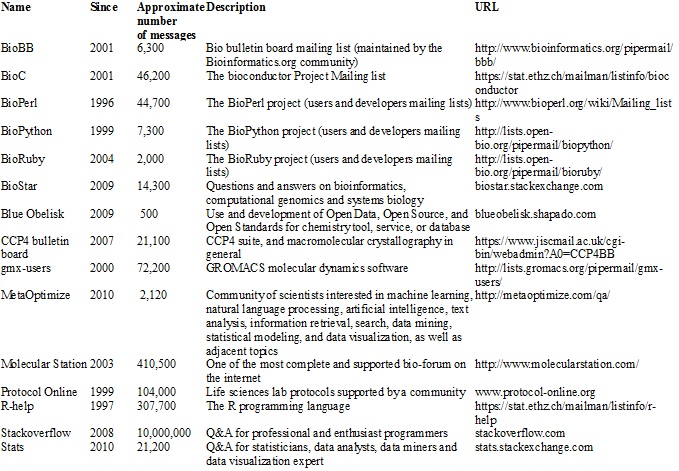
Luckily, the internet comes to the rescue. Web forums, mailing lists and online communities of scientists (for some examples of bioinformatics- and biology-related online communities, see table 1) allow researchers from different fields to contact each other easily.


In claims about math performance among females, and the sociological implication that unknown  cultural pressure in schools made the mentally malleable fairer sex believe they couldn't do math even if they could, there was always one inconvenient truth  - in America, over 70% of teachers are women, so if there was sexism women were doing it.

A study at the University of the Basque Country finds a more pervasive link between the sexist attitudes of mothers and that of children - and gender and the family's socio-economic and cultural level to sexism. Mothers teach more gender than discrimination than fathers.

Imagine if a journalist sent their story to former Republican Vice-President Dick Cheney to 'check the facts' - what would the outcry sound like from other journalists and the public?

Although I went on record that the reportedly faster than light neutrinos from CERN to OPERA will likely go away as mere systematic error, and although my very own resolution of the EPR paradox rejects superluminal phenomena even in non-local quantum entanglement, it is nevertheless quite possible that speeding particles are here to stay and perhaps expected (especially with neutrinos) for a number of reasons.

Nothing says science like a beetle humping a beer bottle - and it earned Professors Darryl Gwynne and David Rentz a coveted Ig Nobel prize.

If you have been living under the science equivalent of a rock, you may not know the Ig Nobel prizes are parodies of the Nobel kind and are presented annually by the Annals of Improbable Research.