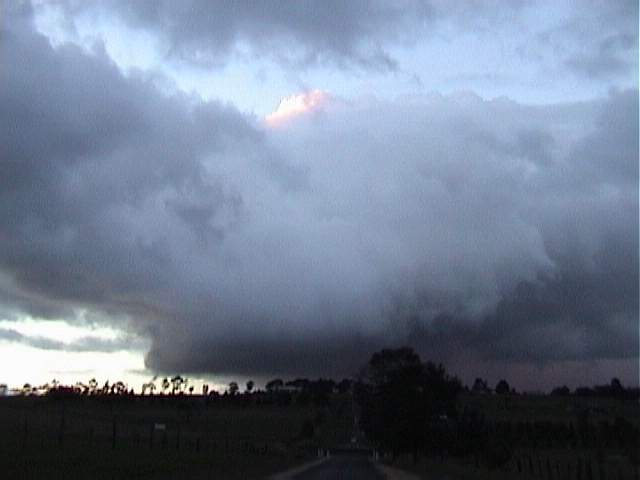







Never 'heard' of thundersnow?  It's a rare sort of thunderstorm but the precipitation is snow rather than rain and because the snow dampens the sound so while you might  thunder from a typical storm miles away  the boom of thundersnow can only be heard for a few hundred yards.

Patrick Market, associate professor of atmospheric science at the University of Missouri, is chasing storms in the dead of winter in order to release weather balloons that will produce data about the little-known phenomenon of thundersnow and he says it can teach us a lot about predicting weather.
Researchers at Rensselaer Polytechnic Institute say their new polarization-matched type of light emitting diode (LED)  has significantly improved lighting performance and energy efficiency.
Sometimes we talk about a water shortage but it's really more of an energy shortage.    Less than 2% of the water on Earth can be consumed but with cheaper energy the water availability, even in remote areas, is unlimited.   

But if cheap energy isn't on its way any time soon, energy efficient water purification is a good interim step.     Engineered osmosis could be a key to addressing the global need for affordable clean water, according to two Yale researchers.
 

TORONTO, Canada, January 13 /PRNewswire/ --

- Amorfix Demonstrates vCJD Test can be Used Routinely to Test Blood Donations

Amorfix Life Sciences, a company focused on treatments and diagnostics for brain wasting diseases, today announced it has tested 10,000 blood donations in France using its EP-vCJD(TM) test as part of a large-scale study to demonstrate the feasibility of routine testing of blood donations for vCJD

A 2000-year-old painted statue is being restored to her original glory by scientists from Warwick Manufacturing Group (WMG),  an academic department of the University of Warwick, along with the University of Southampton and the Herculaneum Conservation Project.

A recent article in Discover Magazine was titled “A Universe Built For Us.”  The premise of the article is that the laws of the universe are exquisitely tuned for life - any small variations from the way things are, and life would not have been able to arise “Short of invoking a benevolent creator....”.  The article went on to explain that we live in a universe that seems ap

Individuals who get less than seven hours of sleep per night appear about three times as likely to develop respiratory illness following exposure to a cold virus as those who sleep eight hours or more, according to a report in the January 12 issue of Archives of Internal Medicine, one of the JAMA/Archives journals.

Studies have demonstrated that sleep deprivation impairs some immune function, according to background information in the article. Research indicates that those who sleep approximately seven to eight hours per night have the lowest rates of heart disease illness and death. However, there has previously been little direct evidence that poor sleep increases susceptibility to the common cold.
Two new studies show that commonly prescribed forms of postmenopausal hormone therapy may slightly accelerate the loss of brain tissue in women 65 and older beyond what normally occurs with aging. 

The studies' findings appear as companion papers in the Jan. 13 issue of Neurology. Both papers report on analyses from the Women's Health Initiative Memory Study, a substudy of the National Institutes of Health's (NIH's) landmark Women's Health Initiative (WHI) hormone therapy clinical trials.

Keep Britain Tidy today has named McDonald's as the most littered fast food brand in the country, meaning the people who litter are more likely to be throwing their wrappers on the streets than any other fast food brand.  It's no surprise, given McDonalds is the top fast food brand.

It's super-sized shame for the residents of ten city centers and suburbs/out-of-town locations across England.  But McDonalds isn't alone.   They made up more than a quarter of all fast food litter (29%), mostly burger wrappers, condiment packets and plastic straws.

In second place, as a group, were local chippie or kebab shops: Keep Britain Tidy found a huge amount of unbranded chip wrappings and packaging in all locations (21%).

The term 'invasive species' itself connotes very bad things but conservationists recently got an expensive lesson in the one thing they claim to understand; ecology is a system and making too many changes can have devastating repercussions.

Removing an invasive species from sub-Antarctic Macquarie Island, a World Heritage Site, has caused environmental devastation that will cost more than A$24 million to remedy, ecologists have revealed. Writing in the new issue of the British Ecological Society's Journal of Applied Ecology, they warn that conservation agencies worldwide must learn important lessons from what happened on Macquarie Island.

