In 1943 the eminent physicist Erwin Schrodinger gave a series of lectures in Dublin that were later published in book form under the title What Is Life? Its success was considerable as it kick-started the new field of molecular biology, but Schrodinger deliberately avoided an investigation into a definition of life, believing that the time was not ripe.
Can you tell why this passage comparing Darwin's finches and humans is wrong?
Many paths lay open when the finches first arrived, and the smallest flights and trials of their descendants were rewarded. That is why they have traveled in more directions than any other creatures on the islands, that is why they have evolved farther and faster than any other creatures: because they got here early.
Our own line is now radiating farther, faster, and in more directions than any other single species in the history of the planet - and for a similar reason. We are the first creatures to arrive in the strange territory we now occupy. We stumbled into our new niche before any other creatures on the planet. We discovered it.
In his book, Wonderful Life: The Burgess Shale and the Nature of History, Stephen Jay Gould speculated about an experiment of ‘replaying life’s tape’, wherein one would go back in time, let the tape of life play again and see if ‘the repetition looks at all like the original.’ Evolutionary biology tells us that it wouldn’t look the same; the outcome of evolution is contingent on everything that came before. Scientists at the Instituto Gulbenkian de Ciência (IGC) in Portugal, New York University and the University of California Irvine say they have provided the first quantitative genetic evidence of why this is so.
If you're a mouse and you like fatty foods, we have good news for you. Researchers at the University of California, Berkeley have identified a new enzyme that helps control the breakdown of fat and the mice that have had this enzyme disabled remained lean despite eating a high-fat diet and losing a hormone that suppresses appetite.
The enzyme in the spotlight, adipose-specific phospholipase A2 (AdPLA), is found in abundance only in fat tissue. AdPLA sets off a chain of events that increases levels of a signaling molecule called prostaglandin E2 (PGE2), which suppresses the breakdown of fat. Mice that have no AdPLA have lower PGE2 levels and a higher rate of fat metabolism.
How did life begin? A pair of Scripps Research Institute scientists say they have taken a significant step toward answering that question because they have synthesized RNA enzymes that can replicate themselves without the help of any proteins or other cellular components - and the process proceeds indefinitely.
Is gardening one of your interests? If so and you live in central or northern Europe the 'killer slug' is probably one of your personal enemies. The slug, which attacks your herbs and vegetables relentlessly, seems immune to control measures.
The killer slug, suffocating lobster, globe trotting televisions and dangerous air particles are just some of the topics featured in EEA Signals 2009, a new annual publication from the European Environment Agency, launched today in Prague by Czech Environment Minister Bursik and Executive Director of the EEA, Professor Jacqueline McGlade.
The EEA, in partnership with its network of 32 member countries, monitors the environment across Europe.
No one can draw a connection between meteorite impacts and massive volcanic activity but the one certain instance where it has been confirmed, at the Cretaceous-Tertiary boundary, was the catastrophic event thought to be responsible for the extinction of the dinosaurs 65 million years ago.
Crucial breakthroughs in the treatment of many common diseases such as diabetes and Parkinson's could be achieved by harnessing systems biology, according to scientists from across Europe. In a Science Policy Briefing released today by the European Science Foundation, they provide a detailed strategy for the application of systems biology to medical research over the coming years.
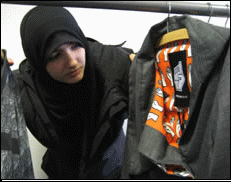
London South Bank University designer Sarah Elenany says there is a lack of fashionable clothing that meets Islamic cultural requirements so she has launched an eponymous clothing line that unites urban chic with Islamic culture. Elenany, 24, calls her new label ‘Elenany’ and says she has drawn inspiration from Islamic art and combined it with contemporary styling for a truly innovative brand.
Cocaine is one of the most abused illicit substances in the United States. According to the National Institute on Drug Abuse (NIDA), there are 35.3 million people in the US age 12 or older that have used cocaine and there were 977,000 new users of cocaine in 2006.