Post-Holocaust Noble Savages
With an increasing trend toward what marketing groups call 'natural' food, some companies have reduced preservatives. A common preservative, acetic acid, is used to stop bacterial growth in dressings, sauces, cheese and pickles, but new research shows that a reduced amount of acetic acid may be worse than none at all – it increases the amount of toxin from the harmful bacteria in the food.
Using two of the world’s largest telescopes, the Very Large Telescope (VLT) in Chile and the Gran Telescopio Canarias (GTC) on La Palma in the Canary Islands, an international team of astronomers have found evidence of a collision between galaxies driving intense activity in a highly luminous quasar, SDSS J0123+00.
Several types of galaxies, known as active galaxies, emit enormous amounts of energy from their central region or nucleus, with the most luminous objects known as quasars. Many scientists argue that quasars contain a central black hole, with a mass of at least several million Suns.
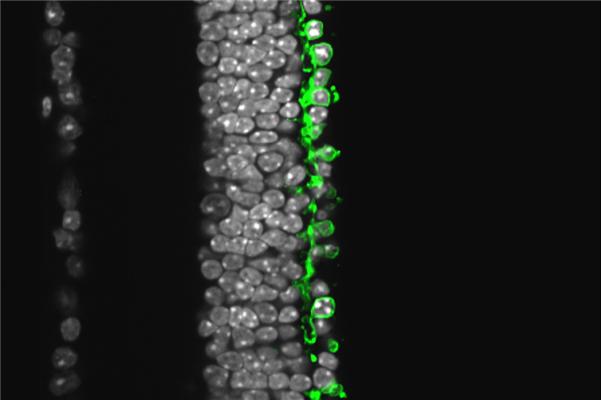
Retinitis pigmentosa are a diverse group of hereditary diseases that lead to incurable blindness and affect two million people worldwide. Though the causes are diverse, the manifestation of the disease is similar: highly sensitive rod photoreceptors, which allow us to see at dusk, die first and the cones that operate during daylight and are responsible for high-resolution color vision follow.
Imagine you wanted to predict when sheep would chew. (Don't ask why...just imagine.) Here's how you would do it: attach speakers to the tops of sheep heads to broadcast chewing sounds. Collect chewing sounds and their times in a massive database. Feed these data into a neural net, which would recognize input (times) and output (chewing or not chewing) and eventually learn to predict when one leads to the other.
This is what neural nets do: they predict the future by quantifying the past.
This is what your next doctor's visit will sound like after you get your genome sequenced:
Theories of physics rest on fundamental assumptions and those assumptions are based on how the real world works, and often produce amazingly precise predictions.
The most comprehensive theory of elementary particles to-date, Quantum Field Theory, explains nature's electromagnetic, weak and strong nuclear forces (though not gravity).
An international team of scientists say a new technique could turn pulsars into superbly accurate time-keepers.
A pulsar is the spinning, collapsed core of a massive star that ended in a supernova explosion and was first discovered in 1967. A pulsar weighs more than our Sun but can be the size of New York City and produces beams of radio waves which sweep around the sky hundreds of times a second. Radio telescopes receive a regular train of pulses as the beam repeatedly crosses the Earth so that the object is observed as a pulsating radio signal.
Introduction
The use of non-human animal models has allowed the fast progression of scientific discovery over the last several centuries. These experiments have lead to great discoveries that have allowed for the alleviation of suffering, sickness, and disease in both humans and animals. Over the years there have been changes in the way we view the rights of animals that have lead to better treatment of models, and discoveries of methods that reduce the need for experimentation on animals. However, we have not yet reached the point that their use is not necessary. If the use of animals in experimentation is to continue, there are many ways of limiting and minimizing suffering while maximizing the benefit from their use.
One balmy July afternoon, when the fresh-faced optimism from having completed my PhD had seriously begun to wear off, I went to lunch with a famous scientist. This jovial, moustached man did something to really surprise me; he told me the truth about this career path I had chosen: a life in science.