Last week I had a shocking cold. Blocked nose, sore throat, and feeling poorly. This made me think about the countless vitamins and supplements on the market that promise to ease symptoms of a cold, help you recover faster, and reduce your chance of getting another cold.
When it comes to the common cold (also called upper respiratory tract infections) there is no magic cure (I wish) but some supplements may deliver very minor improvements. Here is what the latest research evidence says.
Vitamin C
For the average person, taking vitamin C does not reduce the number of colds you get, or the severity of your cold.
The International Agency for Research on Cancer (IARC) is part of the World Health Organisation, which is part of the United Nations, but it is really its own agency that shares little in common with WHO. Whereas WHO wants to save lives, IARC has taken to using statistics to scaremonger trace chemicals by conflating hazard and risk. So if high doses, 10,000 exposures of a chemical all at once, might be linked to cancer by looking at statistics, their flawed methodology, where five orders of magnitude are considered equal, will cause them to declare even 1 exposure a hazard.
And though they do not calculate risk, they frequently talk about risk in their media kits for journalists, which leads to confusion in media and therefore the public.
It was one of these extremely rare days of calms seas far north in the world. When visiting the
Arctic coasts of Norway, I often joke and say that the climate here is the same all year around, low temperatures, windy and in general very unpredictable weather. You can have blue skies one minute and rain pouring down almost horizontally! within the next minute.
But this was not the case on this day, the 23rd July 2018. The temperature was reaching a whopping 32 Celsius and there were almost no movements of the air. In fact it was so hot, that the only livable place to be for a northerner was out in the open ocean.
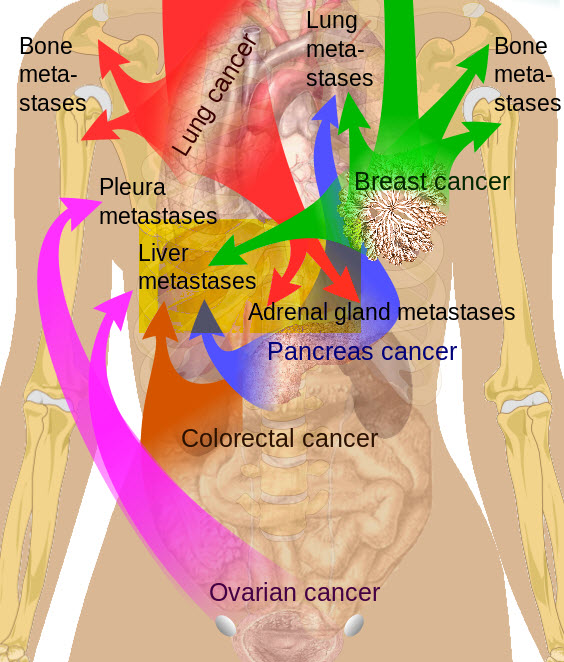
Metastasis is the formation of secondary tumors and a leading contributor to deaths related to cancer. The exact mechanism for how cellular function becomes broken in cells far removed from a cancer’s primary tumor have been unclear.
But it's been pondered for almost a hundred years. It was postulated that metastatic cells spontaneously caused secondary tumors by fusing their cellular material with regular cells and re-establishing their errant gene expression, but spontaneous is not a concept scientists like, so the search for the real causes has been ongoing.
For
years it would not have been possible to use the word “silence” in the same
sentence with BPA (bisphenol A). The safety of BPA has been a long-running,
robust controversy, in particular regarding concerns that BPA might cause
health effects at exposure levels in the very low range that we as consumers
might experience every day.
Ground sharks (Carcharhiniformes) are the most diverse shark group living today, with over 200 different species, and they are one of the major groups that survived the Cretaceous–Palaeogene mass extinction which is why we have the Tiger, Hammerhead, and Blacktip Reef sharks and lamniforms by the Great White and Mako sharks.
Before the mass extinction that killed-off non-bird dinosaurs and marked the end of the Cretaceous period and the Mesozoic era 66 million years ago, dinosaurs dominated terrestrial environments and Mackerel sharks (Lamniformes) were the dominant shark forms of the sea.
What is chance? Or better, does the word "chance" really have an absolute meaning? I believe this is not an idle question. We tend to use that word to describe phenomena which we cannot trace back to an explanatory cause by a cause-effect relation. But words are important: labeling an event as due to chance has a direct impact on our perception of reality, as the statement that something "happened by chance" constitutes a final verdict, which labels the event as something not liable to be scrutinized in more depth.
In the journal
Monthly Notices of the Royal Astronomical Society and in a presentation at the European Week of Astronomy and Space Science in Liverpool, a team announced one of the largest 3D maps of the infant Universe.
And along with it almost 4,000 early galaxies, many of which will have evolved into galaxies like our own Milky Way.
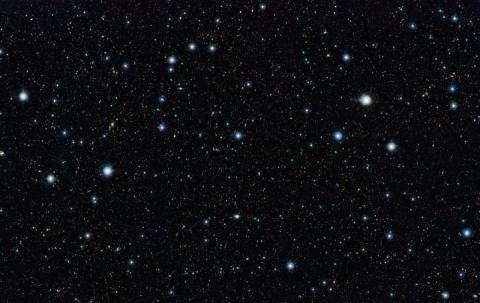 The COSMOS field in the constellation of Sextans, seen in infrared light. Credit: ESO/UltraVISTA team. Acknowledgement: TERAPIX/CNRS/INSU/CASULooking back in time: 16 different epochs between 11 and 13 billion years ago
If you have seen a face in the clouds or you have been part of a phenomenon called "pareidolia" - a willingness to recognize a non-face object as a human face.
Humans sometimes perceive an inherently meaningless object such as a pattern, landscape or object as another object, one that has meaning. It's why alternative science proponents, the Jeffrey Smith's and Pete Myers of the world, believe in spirit photographs.
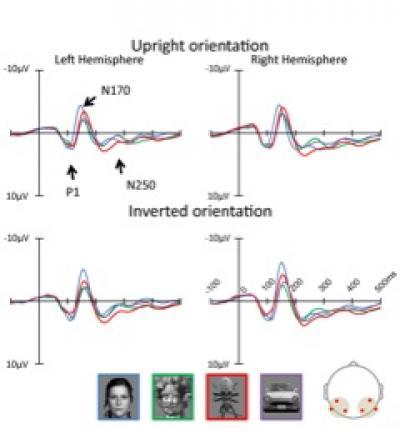
Some have even argued that pareidolia occurs in relatively low-level visual processing, and a new paper examines the relation between behavior when a face-like object is viewed and brain activity to reveal the level of visual processing at which face-likeness is recognized.
Bumblebee safety alert; don't put holograms in that meadow or near the urban beehive you probably regret buying. A new study shows that bees, which are already confounded by lots of different things, are mystified by iridescent colors, colors that seem to change based on the angle you view them from. Like bubbles do.