A new imaging system uses walls, doors or floors as 'mirrors' to gather information about scenes that it can't see, even though those objects are not reflective.
Yes, it could ultimately lead to imaging systems that allow emergency responders to evaluate dangerous environments or vehicle navigation systems that can negotiate blind turns, among other applications, but spying on people sounds like more fun.
Time is relative, of course, but we still hate to be late for appointments. So there has always been research on making our keeping of time a little more accurate.
A new clock tied to the orbiting of a neutron around an atomic nucleus could have such unprecedented accuracy that it neither gains nor loses 1/20th of a second in 14 billion years - basically, you wouldn't have needed to reset your watch yet even if you had been around at the beginning of the Universe.
Whenever I try to explain something about particle physics to a layman, I run into the problem of mass/energy units. A Giga-electronVolt is not something you may expect people to be familiar with, and on the other hand it is not appealing to explain directly how it is defined: "if you take an electron and accelerate it by passing it through a potential difference of one billion Volts, that's the energy it has at the end: one GeV": this distracts the listeners by forcing them to focus on electrostatics, with the potential outcome that the conversation may diverge due to additional questions, like "Does the electric field need be uniform ?" or even, "What is a potential difference ?".
CAMBRIDGE, England, March 20, 2012 /PRNewswire/ --
The idea for this blog was dead simple. In my second blog at Science 2.0, "Quaternions for a Third Grader", I showed of my clay and pipe cleaner model of quaternion multiplication. A few months ago, David Halliday and I started talking about the finite group Q8, which over the real numbers becomes the quaternions. David pointed out my tetrahedron was half the cube it needed to be to represent Q8. That was the idea for the blog: make a cube to represent that finite group.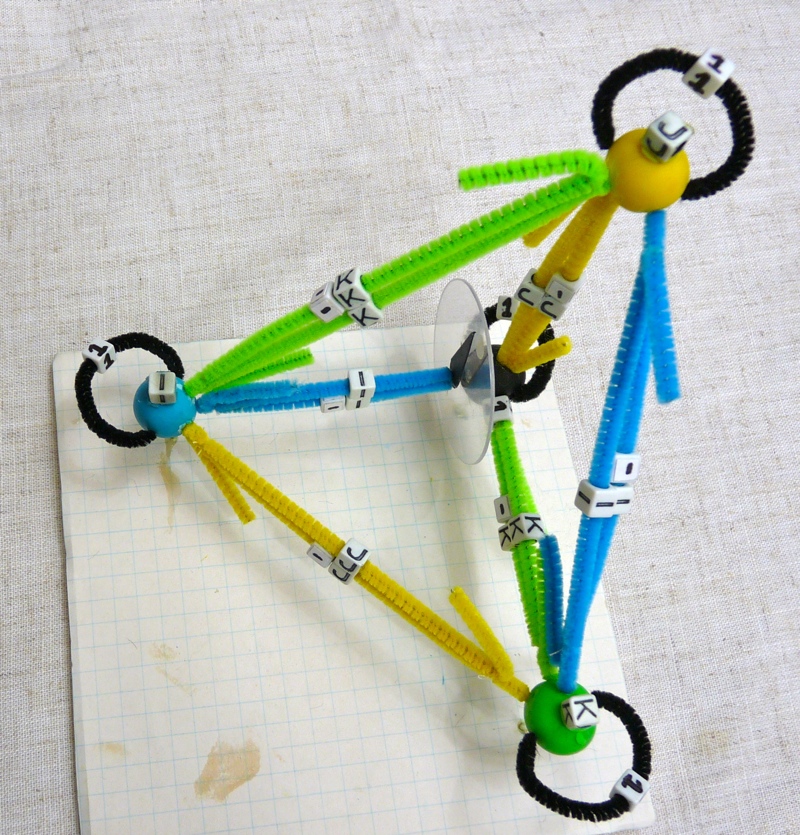
A study by Indiana University researchers on "coregasm" says it has confirmed anecdotal evidence that exercise can lead to female orgasms.
Good news for health clubs everywhere? Maybe. But it's been darn hard to pin down reliable data on it. It makes the media rounds -
and of course, this site - every few years.
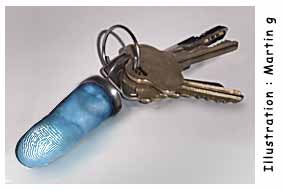
It may have been predictable, but shortly after the introduction of automated fingerprint recognition systems came the invention of fake fingers.
As
this research paper from May 2009 explains, fake fingers made from gelatine soon appeared, quickly followed by
Play-Doh™. The authors review the
“…state-of-the-art of fake finger materials and disclose the power of a, let’s say, brand new material in this field: Glycerin.“
Mus musculus, the common mouse, can happily live wherever there are humans. When populations of humans migrate the mice often travel with them and apparently that has long been the case. New research used evolutionary techniques on modern day and ancestral mouse mitochondrial DNA to show that the timeline of mouse colonization even matches that of the Viking invasions.
During the Viking age (late 8th to mid 10th century) Vikings from Norway established colonies across Scotland, the Scottish islands, Ireland, and Isle of Man. They also explored the north Atlantic, settling in the Faroe Islands, Iceland, Newfoundland and Greenland. They intentionally brought horses, sheep, goats and chickens but also unknowingly carried pest species, including mice.
Food stamps are not food stamps now, they are the Supplemental Nutrition Assistance Program (SNAP) benefits - and record numbers of Americans are receiving them.