





The gap between atheists and the religious seems at times to be an impossible divide, almost as if believers and non-believers come from different species. What separates the secular from the sacred? An "Ask the Brains" question on the Scientific American site recently inquired as to any differences between the brain of an atheist and the brain of a religious person. Andrew Newberg, the director of research at the Myrna Brind Center of Integrative Medicine at Thomas Jefferson University and Hospital in Philadelphia, responded that, yes, in fact, there are some small but perceptible differences between the brains of believers and non-believers.
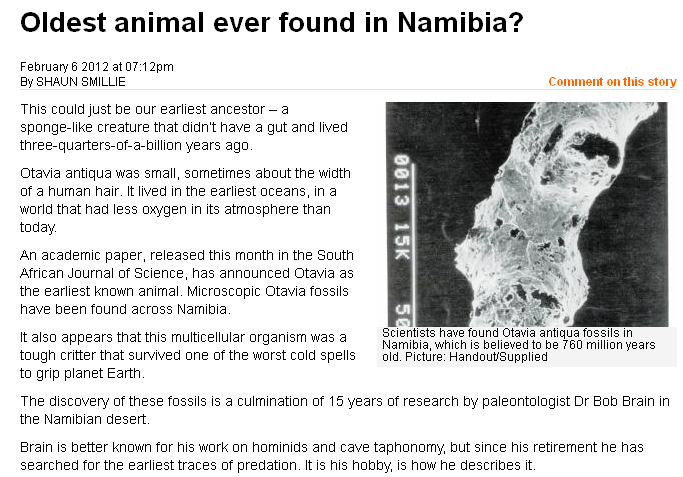
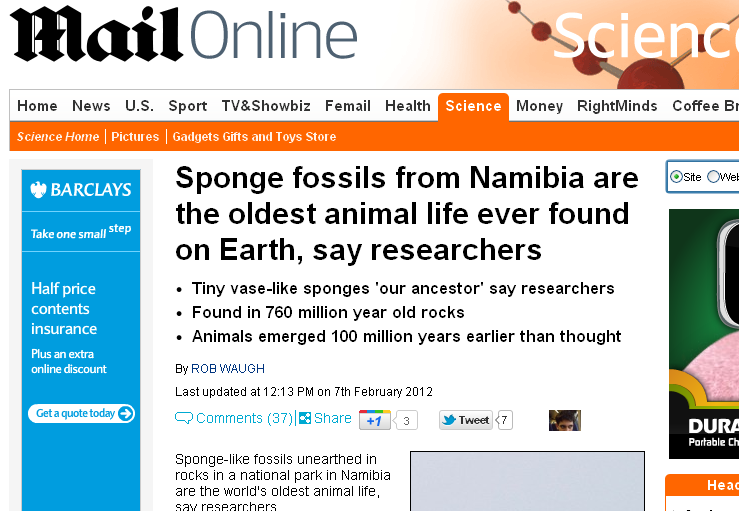
Every 6 months or so these days it feels like we find the earliest animal life. More often than not, said life is something ugly that turns up in a bucket after dissolving rocks in acid.

Well, it's been a while, but here is the latest candidate:


Accessing the absolute latest in scientific communications directly by the independent amateur or citizen scientist has been a financially daunting prospect for decades; practically impossible.

"Sex education is failing to reduce adolescent birthrates in conservative states, according to a new study" begins a somber Livescience piece. Oooh, that's juicy.  We all want to talk about how dumb conservatives are. And if it's a study - and it is, the writer says it right there - they are not injecting any personal bias.


Perfluorinated Polar Bears!

 
No, this is not an exasperated exclamation by Captain Haddock, but might well be a shout of surprise at learning that Canadians have been searching for compounds of that nature in these snowy animals.  But why should Scott Mabury and his group at the University of Toronto be looking for them?
 
The simple answer is that they are terribly persistent in the environment.  Bit odd, one might link, considering that Fluorine is the most reactive of all the elements in the periodic table.  So reactive[1], in fact, that
 
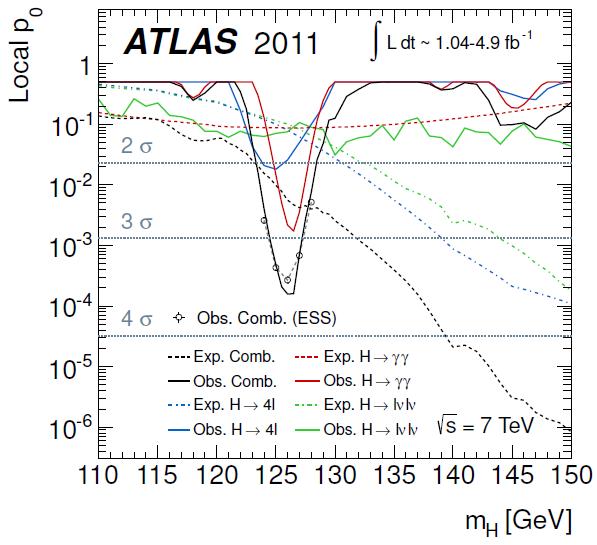
You have seen it already two months ago, but those were "preliminary" results. Now both CMS and ATLAS have produced full-fledged documents (CMS here, ATLAS here) describing their respective combinations of different Higgs boson searches, using data collected in 2011 by the two experimental apparata at the CERN Large Hadron Collider.
After reading Sascha's excellent article [Robopocalypse Now] regarding the effect and direction of robotic/AI development and its coevolutionary influences, it occurred to me that perhaps a shift in how we view such developments could promote a more intuitive understanding of what is occurring.
Last week I was introduced to an intriguing little brain game that could very well prevent Alzheimer's disease, with the nice side effect of helping to save the world.  The game was demonstrated no less than three times by a commenter on a previous article reading between the lines of some recent science-related news.

If you are reading this then the recent research by Brian Pasley and colleagues in which speech sounds are reconstructed from measured brain activity has probably already come onto your neuro-radar. It's certainly drawn a lot of media coverage, with some great commentaries including this from Mo Costandi in the Guardian.

Hey, you got simulation in my roleplay! Hey, you got roleplay in my simulation! Wait, it's two great tastes that taste great together!

Thus my students surprised me when they tossed in a role-based stance into what I thought was a straightforward systems engineering analysis. Herein lies the tale.

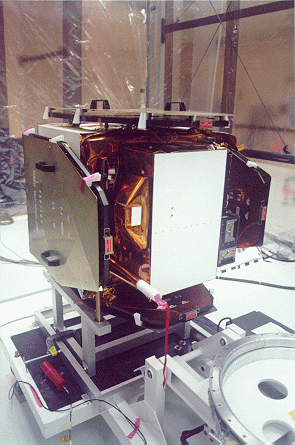
Background: I'm teaching a course in space mission operations that focuses heavily on scenario analysis. I presented them with a case where they had to balance risk versus success for a space-borne telescope. In rocket science, risk is never something you can eliminate, no matter how much money or resources you toss at it. That's part of what makes it rocket science. Risk can be reduced, mitigated, or even accepted, but never eliminated.


