



If you are reading this then the recent research by Brian Pasley and colleagues in which speech sounds are reconstructed from measured brain activity has probably already come onto your neuro-radar. It's certainly drawn a lot of media coverage, with some great commentaries including this from Mo Costandi in the Guardian.

Hey, you got simulation in my roleplay! Hey, you got roleplay in my simulation! Wait, it's two great tastes that taste great together!

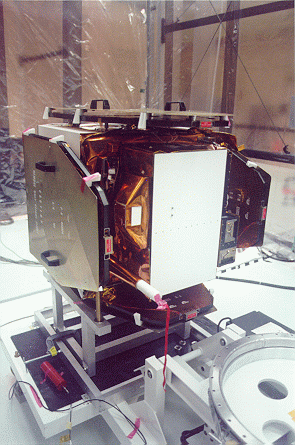
Thus my students surprised me when they tossed in a role-based stance into what I thought was a straightforward systems engineering analysis. Herein lies the tale.

Background: I'm teaching a course in space mission operations that focuses heavily on scenario analysis. I presented them with a case where they had to balance risk versus success for a space-borne telescope. In rocket science, risk is never something you can eliminate, no matter how much money or resources you toss at it. That's part of what makes it rocket science. Risk can be reduced, mitigated, or even accepted, but never eliminated.

The problem, in a word, is language.
Carl Zimmer’s recent article Can Life Be Defined in Three Words raised just that issue.
He referred to the many attempts that have been made by scientists to define what life is, and in doing so, unwittingly exposed some of the main problems in reaching a definition of life.
He described Radu Popa’s study in which Popa went to the trouble of counting the definitions of life, and gave some of the definitions. For example, “Some scientists define life as something capable of metabolism.”

Can you see the problem with that approach?

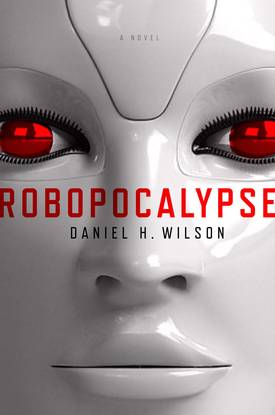
Robopocalypse, see also here on Boing Boing, is a novel by roboticist Daniel Wilson, who foretells a global apocalypse brought on by artificial Intelligence (AI) that hijacks automation systems globally and uses them to wipe out humanity.


Computers and now also robots make amazing progress these years and out-compete humans in everything but snakes and ladders. Many fear that humans will soon be the robot overlords’ Neanderthals.

Peru is at the cutting edge, the forefront--nay, Peru is a veritable trendsetter, trailblazer, and spearheader--because Peru, alone in the world, has decided to set a quota for Humboldt squid.

Before you go off in a huff about how ridiculous I'm being*, let me explain why this is kind of a big deal. First, the Humboldt squid fishery is the biggest squid--the biggest invertebrate--fishery in the world. Second, no single country (or group of countries, for that matter) has ever set a quota for Humboldt squid before. That means fishermen have, by and large, been free to catch as many as they can.
The deadliest mass extinction that we know of, 252 million years ago at the end of the Permian period,  took a long time to kill most of Earth's life, and it killed in stages. It wasn't superior to sudden extinctions just because it was gradual.

By the end of the Permian period, Earth was almost a lifeless planet. Around 90 percent of all living species disappeared then, in what scientists have called "The Great Dying." Chemical evidence buried in rocks formed during this major extinction can tell science part of what happened.
Bacteria can multiply rapidly, potentially doubling every 20 minutes in ideal conditions but this exponential growth phase is preceded by a period known as lag phase, where no increase in cell number is seen. Lag phase was first described in the 19th Century, and was assumed to be needed by bacteria to prepare to exploit new environmental conditions - they are basically Zombies. Beyond this, surprisingly little is known about lag phase, other than bacteria are metabolically active in this period. But exactly what are bacteria doing physiologically during that time?

As you know, 74 people were killed this Wednesday when Egyptian soccer fans stampeded into a bottleneck after a 3-1 hometown upset win. While certainly tragic, it’s far from irrational: it turns out the behavioral economics were stacked against them.

Take the link between football and domestic violence. In2011 economists Gordon Dahl and David Card showed that when a home team loses, domestic violence in the home city increases by 10- percent. On police reports, you can see reports start to rise in the final quarter as a loss looks likely. Then reports peak an hour after the game and return to normal a couple hours later.

What is actually happening in the brain when one person looks at another? 

For people with prosopagnosia, an inability to recognize faces, information processing - the stages that our brains go through to recognize a face - is breaking down. 
A new study in Nature shows that Santorini may have reactivated roughly a century before the Minoan "super-eruption", a lot quicker than had previously been thought.  How is it possible to time this awakening?

I have written on here before about magma chambers, and how people initially thought that the chambers of the largest eruptions grew through the slow, incremental process of fractionation

