



"How big is the squid?" the fifth-graders demanded when I showed up in their classroom with a cooler on Monday.

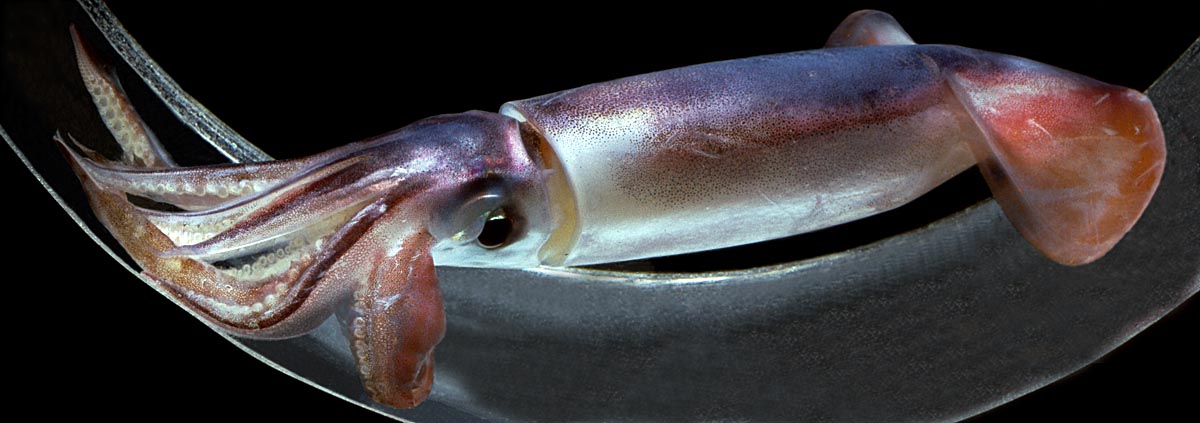
"Humboldt squid can get up to five feet long--about as big as me," I told them. "But this one is small. It's only a couple of feet."

Fortunately, they weren't disappointed. A two-foot squid was quite exciting enough to keep the class going for two hours, pummeling me with questions as we carefully observed the outside and then the inside of the squid. The visit was part of the outreach program Squids4Kids, and the squid had been donated by sport fishermen just couple of months ago.
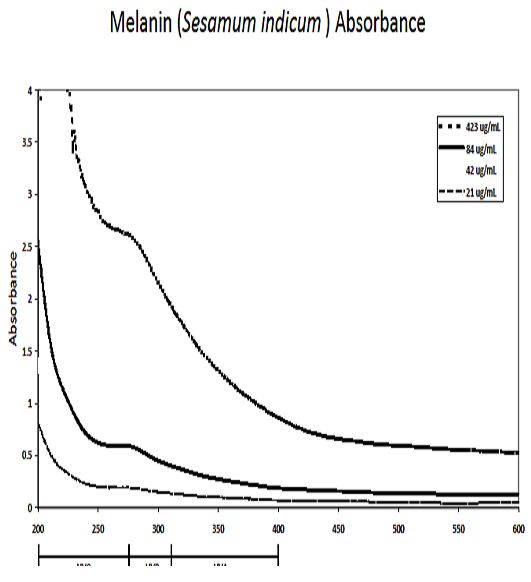
Solar ultraviolet {UV} radiation is largely comprised of UVB (280-320 nm) and UVA (320-400 nm) wavelengths. UVB radiation has been associated with sunburn, immunosuppression, photoaging, skin cancers and DNA lesions. The latter include cyclobutane pyrimidine dimers and 6,4 pyrimidine pyrimidone. UVA radiation which represents 95% of the total UV received at ground level, is less energetic than UVB. It has also been associated with immunosuppression, photoaging, and mutagenesis [1].
I really enjoy getting squid stories from around the world in my daily google news alert. Keeps me from getting too obsessed with the Humboldt and market squid of California. Here's the latest: ICAR scientists detect deep sea squids in Arabian Sea.

ICAR is the Indian Council of Agricultural Research, whose mandate has no doubt been expanded to include fisheries since it was named. And just who is "this largely unexploited deep sea squid which inhabits at depths ranging between 1,000 and 4,000 meters"? The article doesn't specify, but I would lay odds on Sthenoteuthis oualaniensis.
Researchers have pinpointed the cancer-fighting potential in the bat plant, or Tacca chantrieri.

Susan Mooberry, Ph.D., leader of the Experimental Development Therapeutics Program at the University of Texas Health Science Center at San Antonio, has been working to isolate substances in the plant in hopes of finding a new plant-derived cancer drug with the potential of Taxol. Taxol, the first microtubule stabilizer derived from the Yew family, has been an effective chemotherapy drug, but patients eventually develop problems with resistance over time and toxicity at higher doses. Researchers have long been seeking alternatives.
Nearly anything can be rationalized if the value is subscribed to an intangible like 'good will.' The Olympic Games are big business and generate substantial amounts of revenue for the International Olympic Committee (IOC) through lucrative television contracts and corporate sponsorship - yet they lose money for the hosts.

There is a widespread misconception which is repeated often these days in the aftermath of the OPERA collaboration’s confirmation of faster than light neutrinos. The misconception is easily stated:


“Tachyons, if they actually exist, have imaginary mass, … blah blah blah … therefore OPERA is wrong!”


Let us explain what this means in layman’s terms, then see how this argument fails, and afterward discuss that it is one example for a common logical fallacy that basically underpins all the arguments against the OPERA results that we encountered recently.

I am sure it is old news to most if not all of Science 2.0's readers that NASA recruited Vint Cerf to help adapt Internet technology to space mission communications in 2000; and that they successfully tested a new protocol in 2008. I have no doubt that the engineers can put together a pretty reliable interplanetary network.

As I review journals and articles dealing with clinical trials I have found the most glaring problem that, I am sure, no one will address. Namely; quoting data "from the book."

So, what am I talking about? Specifically about researchers, I mean the real researchers, not "re-inventing the wheel" but being satisfied just pulling the data from a "trusted" source and running with it.

Best explanation I can give uses an example. In a clinical trial looking at the impact of ascorbic acid on tumor growth, the researching group, (medical team), noted the milligrams of dose given, adjustment for weight&sex, and then ran the trial.
For you today here is a test of whether you shoud trust your intuition when confronted with an apparently simple problem. Incidentally, this article is the answer to the "Guess The Plot" riddle I posted a few days ago here.

Suppose you are given two measurements of the same physical quantity. Make it something easy to visualize, such as the length of a stick. They tell you that when measured with method 1 the result was x1=10 cm, with a estimated uncertainty s1=0.1 cm, and when measured with method 2 the result was x2=11 cm, with estimated uncertainty s2=0.5cm. Here is a question for you today: What is your best guess of the length of the stick ?

