

The image of a stoner always having the munchies is a stereotype because it's true - and it's true, say researchers, because it has a basis in biology.

Daniele Piomelli, Nicholas DiPatrizio and colleagues found that fats in foods like potato chips and french fries trigger a biological mechanism - and that is driven by natural marijuana-like chemicals in the body called endocannabinoids.

In their study, they discovered that when rats tasted something fatty, cells in their upper gut started producing endocannabinoids but sugars and proteins did not have this effect.

Many Worlds by Splitting a Wiener Sausage is extremely simple as far as models go. Before we can resolve the Einstein-Podolsky-Rosen paradox with it however, we need to understand what is still wrong with it.

It is “wrong” for a simple reason that I wrote about in several other posts, and anybody who understands the EPR problem to some degree should know the correct answer, regardless of whether they trust Bohm, or “believe Copenhagen”, or subscribe to locality, non-locality, many-worlds, objective state collapse into one world, whatever!

It never fails--I take some time off, and a giant squid shows up!

A few years ago, it was a half-eaten carcass found floating in Monterey Bay. Every teuthologist dreams of a giant squid sighting in her backyard, but Fate's wicked sense of humor had me taking a summer course in Friday Harbor when my dream came true. So while I was playing with worms, my labmates back home were eagerly dissecting the largest giant squid ever seen in Monterey Bay.

Not that I'm bitter or anything.
Astronomers tend to suffer from gigantomania; we relate to and prefer astronomical dimensions. Always. I, being not only an astronomer but also a sucker for celebrations, will not miss this opportunity to congratulate the American nation with its Independence Day 4th of July accordingly. With a celebration of astronomical proportions that, obviously, suits a superpower!

Here's a question. In many millions of years time, is it possible that future geologists - be they our distant descendants, or an alien race that has since conquered Earth - will be able to look at the sequence of rocks corresponding to the present period, and recognise the moment when humans became the dominant species on the planet? If so, what time will this horizon represent, and how will it be recognised?
The DZERO collaboration has just produced an update of their analysis of the dimuon charge asymmetry using 9.0 inverse femtobarns of proton-antiproton collisions. The new result confirms the previously reported effect, raising the discrepancy with the Standard Model prediction to over four standard deviations.
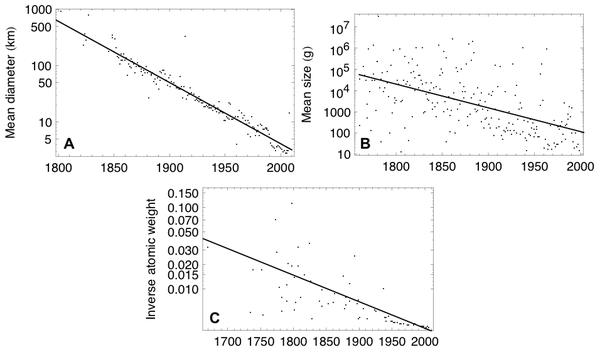
Studying science quantitavely has often taken the form of studying publications, such as citation counts, or identifying author networks. But now, Samuel Arbesman and Nicholas Christakis (2011) argue that there are two fairly recent developments that would enable a new approach to the study of scientific discoveries:

1) Vast computational resources and storage capacity, and

2) Automated science.

This new appraoch would offer potential for a new field that concerns itself with the study of scientific discoveries. In the words of the authors:
Superfund Me

Superfund Me

Jul 03 2011 | comment(s)

Scattered across Santa Clara County — home during our tenure at Stanford — are 23 parcels of land so polluted that they’ve been targeted for government intervention.

These “Superfund sites,”numbering more than 1,250 across the United States and its territories,are contaminated by heavy metals, organic solvents and petroleum residues. Some are at risk of contaminating the drinking water of hundreds of thousands of people; others already have. Some sites are sopolluted that their very soil must be scraped away; others will not befit for human habitation for generations.

Cancer cells, like normal cells, begin to perish as soon as the temperature hits 43°C. So, the obvious challenge is to find out how cancer cells can be heated up without affecting the normal, healthy cells. One idea to deal with it, is known as magnetic hyperthermia. This involves injecting magnetic nanoparticles into the targeted tumors (For another nanoparticle approach to cancer, click here). Subsequently, the patient is put into a magnetic field that reverses direction several thousands of times each second. This excites the nanoparticles, heating them. Since the magnetic particles are only found in the tumors, the healthy tissue is exempt from the damaging heat.

