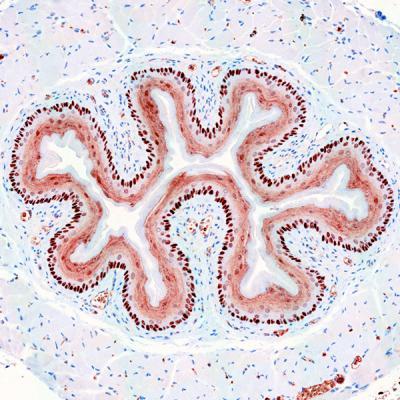







New research has discovered that NANOG, an essential gene for embryonic stem cells, also regulates cell division in stratified epithelia, which form part of the epidermis of the skin or cover the oesophagus or the vagina in developed organisms. This factor could also play a role in the formation of tumors derived from stratified epithelia of the oesophagus and skin.

Pluripotency factor NANOG is active during just two days before implantation of the embryo in the uterus, from day 5 to day 7 post-fertilization. At this critical period of development, NANOG contributes to giving embryonic stem cells the extraordinary capacity to make up all of the tissues that become the adult organism, an ability known as pluripotency. 

New York City residents think everything is about New York City. A NYC storm automatically becomes a Super Storm, the population between the Hudson River and the San Francisco Bay bridge are assumed to be mutant church Republican zombies, they even think it's hotter in the city than everywhere else.

On that last part, they may be right. There has long been a belief in the "urban heat island" (UHI) effect, which makes the world's cities warmer than the surrounding countryside. In an analysis of 65 cities across North America, researchers found that variation in how efficiently urban areas release heat back into the lower atmosphere — convection — is the dominant factor in the daytime heat island effect. 

Feelings are personal and subjective, just like all of psychology, but the human brain turns them into a standard code that objectively represents emotions across different senses, situations and even people, according to a new paper.

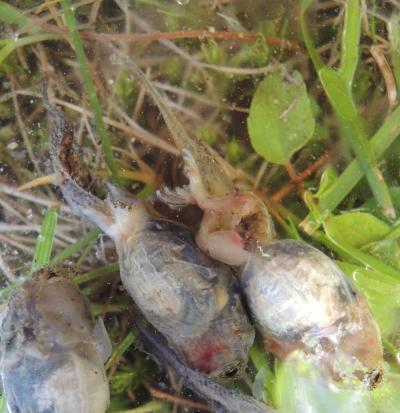
In some parts of the world, amphibian numbers are in decline. Activists are quick to blame everything from fracking to pesticides for reduced numbers of some frogs, but scientists have linked it to an emerging fungal disease called chytridiomycosis.

New research from the National Institute for Mathematical and Biological Synthesis (NIMBioS) findss that another pathogen, ranavirus, may also contribute. In a series of mathematical models, researchers showed that ranavirus, which causes severe hemorrhage of internal organs in frogs, could cause extinction of isolated populations of wood frogs if they are exposed to the virus every few years, a scenario that has been documented in wild populations.

Each year, roughly 250,000 people in the United States require hospital care for
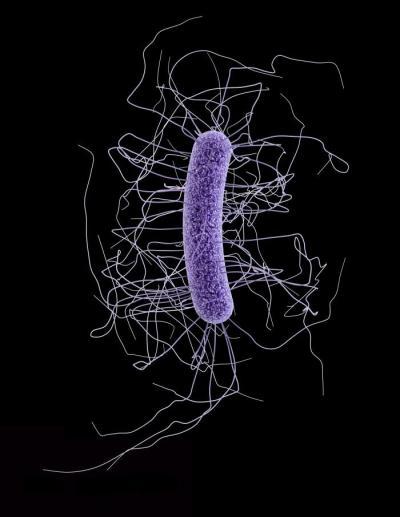
Clostridium difficile (C. difficile) infection and at least 14,000 people die from it, according to the U.S. Centers for Disease Control and Prevention (CDC). As a result, the CDC identified C. difficile as an urgent public health threat in its 2013 report on antibiotic resistance.

The National Institute of Allergy and Infectious Diseases (NIAID) has launched an early-stage clinical trial of CRS3123, an investigational oral antibiotic intended to treat C. difficile infection.  CRS3123 (previously known as REP3123) is a narrow-spectrum agent that inhibits C. difficile growth while sparing normal intestinal bacteria.

The warm beauty of amber has been captivating and inspiring people since ancient times.

Even today, some secrets remain locked inside the fossilized tree resin. Some of the oldest recovered samples predate the rise of dinosaurs — and could outlast even the most advanced materials that science can make today. That extreme durability has made amber's internal structure so difficult to understand. 

Millions of years ago, this resin exuded from trees and then fossilized over time and techniques to probe the inner molecular architecture of amber seemed to destroy evidence of certain relationships between compounds. 

When you see an article about geckos and their ability to sit upside down, Spider-Man references are sure to follow. And if the topic is that sticky ability in spiders, you will get Spider-Man references and a picture.

Yet even geckos have limits - that's just plain nanophysics.

The fact is, sooner or later the grip is lost, no matter how little force is acting on it. But knowing the limits can have considerable benefits, for instance in the production of graphene - because graphene consists only of one layer of atom, and which must be easily detached from the substrate.

250 miles above Earth, in the  International Space Station, ESA astronaut Alexander Gerst has recently shared some incredible views - some is the usual stuff, Hurricane Arthur on the US East coast, beautiful auroras.

And then there was Super Typohoon Neoguri. This was not Superstorm Sandy, a hyped up tropical storm that benefited from dumping rain on media companies in midtown Manhattan, this was a true super typhoon, with winds of 150 miles per hour and an eye, the center of the typhoon, that was 40 miles wide. One third of Okinawa was evacuated. Nago, Okinawa had over 17 inches of rain in the last 24 hours. 

It's the strongest storm of the season so far and it hasn't even hit mainland Japan yet.
If global warming is causing extinction, it isn't happening to Adélie penguins in the Southern Ocean.

Adélie penguins have long been considered a key indicator species to monitor in order to understand the effects of climate change and fishing in the Southern Ocean. New evidence shows that the population is 3.79 million breeding pairs - 53 percent larger than previously estimated.  

Molecular microbiologists have discovered that mice lacking a specific component of the immune system are completely resistant to sepsis, a potentially fatal complication of infection.

The immune system is the body's first line of defense against infection. The system, however, can also injure the body if it is not turned off after the infection is destroyed, or if it is turned on when there is no infection at all. Scientists do not yet fully understand how the immune response is turned on and off and continue to study it in hopes of harnessing its power to cure disease.

In this study, scientists have found that a component of the system, HOIL-1L, is necessary for formation of the NLRP3-ASC inflammasome signaling complex.

