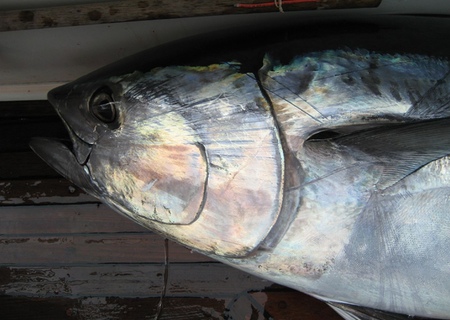





Fish is good for you and has been growing in popularity. 

Atlantic Bluefin Tuna is a much sought after delicacy, though the International Union for Conservation of Nature (IUCN) lists it as endangered. So far, farming of this species in the Mediterranean area involves capturing medium-sized specimens and fattening these in farms, which still depletes the wild stocks - but a sustainable solution may be available.
Skeletal remains uncovered near the site of a Roman villa in Dorset are likely the five skeletons of the owners and occupants of the villa – the first time in Britain that the graves of villa owners have been found in such close proximity to the villa itself.

The five skeletons were two adult males, two adult females and an elderly female – with researchers postulating that they could be the remains of three generations of the same family, who all owned the villa. The bones are thought to date from the mid-4th Century (around 350 AD).
A new study addresses the relationship between personality and heart attacks.

Distressed (type D) personality (TDP), characterized by high negative affectivity and social inhibition, along with depression, anxiety and other negative affects (such as demoralization, hopelessness, pessimism and rumination) have been implicated as potential risk factors for coronary artery disease. While some evidence suggests that the negative affectivity dimension of Distressed (type D) personality overlaps at least partially with depression, other studies underline how ‘TDP refers to a chronic, more covert form of distress that is distinct from depression'.
Researchers at the Center for Research and Advanced Studies (Cinvestav) in Mexico have developed a cDNA microarray chip that allows detection of the RNA strand of the dengue fever virus.

The genetic information pinpoints the exact serotype of malaria that an infected person or mosquito is carrying  and allows analysis of the complementary strand of DNA (cDNA) obtained from the dengue fever virus being carried by the infected patient. The cDNA is covalently linked to a slide (substrate) that can be a glass or paper.
A new study analyzed the long-term effects of psychotherapy on borderline personality disorder. Authors report the effect of  Dialectical Behavior Therapy (DBT) versus treatment-as-usual (TAU) on inpatient service use, and a follow-up 6 months after the end of treatment.

Data on psychiatric hospitalization were collected by interviewing patients at two monthly intervals using the Client Service Receipt Inventory, which was then triangulated with data from electronic patient records. In the year prior to treatment, 24 patients had been hospitalized with the number of inpatient days ranging from 0 to 365 (mean 20.5, SD 63.1).

A breakthrough discovery into how living cells process and respond to chemical information could help advance the development of treatments for a large number of cancers and resistant to therapy.

Researchers have unlocked the secret behind the activation of the Ras family of proteins, one of the most important components of cellular signaling networks in biology and major drivers of cancers that are among the most difficult to treat.

A small tree or shrub found in mountainous Central and South American rainforests has a most unusual relationship with the birds that pollinate its flowers, according to a new study - the plant known as Axinaea offers up its male reproductive organs as a tempting and nutritious food source for the birds.

As the birds seize those bulbous stamens with their beaks, they are blasted with pollen by the flowers' complex "bellows" organs. The birds then deliver that pollen to receptive female floral organs as they forage on.

Food bodies situated on male reproductive organs are otherwise only known from beetle-pollinated flowers. There is no other known example among plants of such a precise and anatomically distinct bellows organ.

A newly discovered planet now named OGLE-2013-BLG-0341LBb
in a binary star system located 3,000 light-years from Earth is expanding astronomers' notions of where Earth-like—and even potentially habitable—planets can form. And how to find them.

At twice the mass of Earth, the planet orbits one of the stars in the binary system at almost exactly the same distance from which Earth orbits the sun. However, because the planet's host star is much dimmer than the sun, the planet is much colder than the Earth—a little colder, in fact, than Jupiter's icy moon Europa.

Astronomers search for exoplanets by measuring shifts in the pattern of a star's spectrum - the different wavelengths of radiation that it emits as light.

These "Doppler shifts" result from subtle changes in the star's velocity caused by the gravitational tugs of orbiting planets, but Doppler shifts of a star's absorption lines can also result from magnetic events like sunspots originating within the star itself -- giving false clues of a planet that does not actually exist.

Researchers at the Royal Veterinary College have identified a highly specialized ligament structure that is thought to prevent giraffes' legs from collapsing under the immense weight of these animals.

"Giraffes are heavy animals (around 1000 kg), but have unusually skinny limb bones for an animal of this size" explained lead investigator Christ Basu, a PhD student in the Structure&Motion Lab. "This means their leg bones are under high levels of mechanical stress."