



Everyone has heard of the Cuban Missile Crisis, a stand-off over missiles off the shores of America. It's considered a highwater mark during a Cold War culture that was concerned about mutual assured destruction.

Outside testing, nuclear weapons have not been detonated since 1945 but there have been ‘disturbing near misses in which nuclear weapons were nearly used inadvertently’ owing to miscalculation, error or sloppy practices. 

Not once, but nearly 13 times since 1962 - and the risk of nuclear weapons being detonated today is higher than people know.

A team of scientists has found that the woody growth of forests in north Borneo is half as great again as in the most productive forests of north-west Amazonia, an average difference of 3.2 tons of wood per hectare per year.

The new study, published today in the Journal of Ecology, examined differences in above-ground wood production (one component of the total uptake of carbon by plants) which is critically important in the global cycling of carbon.

Trees are taller for a given diameter in Southeast Asia compared with South America, meaning they gain more biomass per unit of diameter growth, and this in part explains the differences observed.

A genomic investigation by University of British Columbia researchers has revealed that a lethal parasite infecting a wide range of insects actually originated from pond scum, but has completely shed its green past on its evolutionary journey.

A team led by UBC Botany Prof. Patrick Keeling sequenced the genome of Helicosporidium – an intracellular parasite that can kill juvenile blackflies, caterpillars, beetles and mosquitoes – and found it evolved from algae like another notorious pathogen: malaria.

A comparison of the genomes of polar bears and brown bears reveals that the polar bear is a much younger species than previously believed, having diverged from brown bears less than 500,000 years ago.

Patients whose lost red blood cells are recycled and given back to them during heart surgery have healthier blood cells compared to those who get transfusions of blood stored in a blood bank, according to the results of a small study at Johns Hopkins.

To recycle the blood, a machine known as a cell saver is used to collect what a patient loses during surgery, rinse away unneeded fat and tissue and then centrifuge and separate the red cells, which are then returned to the patient if thy need it. Disposable parts of the cell saver, which can be used to process multiple units of blood, cost around $120, compared to $240 for each unit of banked blood.

If someone fails to meet an obligation, you probably feel a little betrayed, but do you not appreciate it if they exceed expectations?

Humanities scholars think that is the case and they use the timely example of Mother's Day flowers. If they don't arrive on time, you will likely feel betrayed by the sender for 'breaking their promise'. but if they arrive earlier, you are not going to be happier.

Obviously that is a timed event. Brides don't want the band to show up the day before their wedding either. But they believe that we place such a high premium on keeping a promise that exceeding it confers little or no additional benefit. So don't try too hard, do just enough.

After 20 years of grueling research, unimaginably effective drugs to treat hepatitis C are hitting the market. They are so good that cure rates (aka sustained virological response, or SVR)—defined as the absence of detectable hepatitis C virus (HCV) RNA six months following cessation of treatment—are approaching 100 percent. Even ten years ago this would have been regarded as science fiction.

These drugs are quite expensive. But, are they worth it? 

Some Ecuadorian tribes were famous for making mummified shrunken heads (click for the recipe) from the remains of their conquered foes. 

Perhaps they got the idea from nature. Field work in the cloud forests of Ecuador has resulted in the discovery of 24 new species of Aleiodes wasps - that mummify caterpillars.  24 new insect are species described by Eduardo Shimbori and Scott Shaw in ZooKeys and they don't mind glorifying celebrities in the naming.

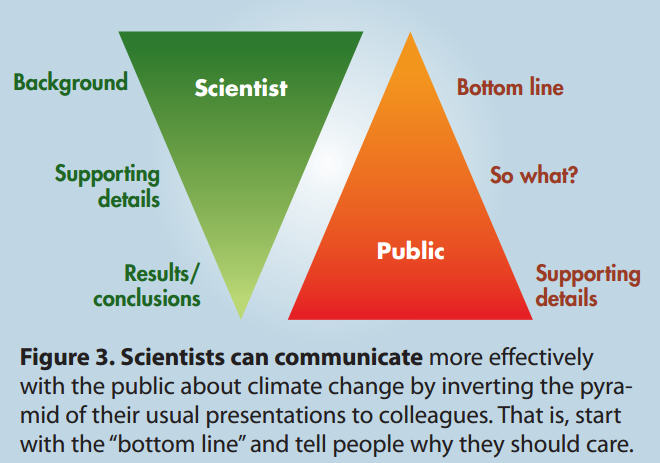
Richard Somerville and Susan Hassol have some recommendations for how to improve science communication.

There are about 9,700 known species of grasshoppers in the world. Now there is one more, and it has beeen named  Grammy-award winning singer and Mexican activist Ana Lila Downs Sanchez.

Locals called the creature the friar grasshopper because its head looks a bit like what a monk with his hood pulled back might look like and so the scientific name of the new grasshopper is Liladownsia fraile. In Spanish, "friale" means friar.  

The new species was discovered on the side of a mountain road near Oaxaca, Mexico. 
The men were doing fieldwork for another grasshopper study in a pine-oak forest of the Sierra Madre del Sur Mountain Range in Oaxaca, Mexico, when they came across their discovery in 2011.


