

Methane hydrates are ice-like solid fuel composed of water and methane. And they are fragile.  In some areas, such as in the North Atlantic off the coast of Svalbard, scientists have detected gas flares regularly and the reasons for their occurrence were unclear. They seem to only be stable at high pressure and low temperature. 

If so, global warming might cause the dissolution of gas hydrates, according to an analysis led by scientists from GEOMAR Helmholtz Centre for Ocean Research Kiel who say that it is very likely that methane hydrate gas flares are caused by natural processes. 

littleBits are color coded electronic modules that connect together magnetically to create simple electronic circuits. They are designed for ages 8 and up so hobbyists, designers, makers, and artists, and can add light, sound, and motion to their crafts and projects. Since they connect up magnetically (no need for circuit boards, breadboards, or solder), you can’t accidentally connect them the wrong way. With littleBits you can quickly build electronic circuits in a matter of minutes.

The color coded modules are divided into four categories. Blue, for power, currently includes three modules—the power module to which you connect the 9 volt battery, a coin battery module, and a USB power module.

An interdisciplinary group has called on scholars, government granting agencies, journal editors and reviewers to adopt stringent and transparent standards in order to give social science research credibility, substance and impact. 

The authors note that vague methodologies and suspect conclusions has contributed to a distorted body of research that tends to exaggerate the effectiveness of programs that deal with important issues affecting millions of people including health, agriculture, education and environmental policy.

Learning about ancient civilizations used to mean hand-drawn maps and clunky tomes; now anyone can do it, using Google Earth and some idea of where to look and what to look for.

And Google Earth has helped create a map of an ancient Syrian trade route that shows how one city's political sway extended farther than believed. It still takes old-fashioned digging by others to have found the artifacts in the first place, but for visualization and understanding, the future is here.

You've seen advertisements on television for websites like Lumosity and claims that games that will 'train' your brain to be better.

Well, they sort of work, it's not total snake oil, though they work mostly at teaching your brain to solve the puzzles in those websites and games, which is not really improving anything. Elliot T. Berkman, a professor in the Department of Psychology at the University of Oregon and lead author on a new paper, says that training for a particular task does heighten performance, but that advantage doesn't necessarily carry over to other things. So if solving puzzles in apps is going to be your career, great. Otherwise, save your money.

Open Collaboration, defined in a new paper as "any system of innovation or production that relies on goal-oriented yet loosely coordinated participants who interact to create a product (or service) of economic value, which they make available to contributors and non-contributors alike" brought the world Wikipedia, Bitcoin and, yes, even Science 2.0.

But what does that mean, really? That's the first problem with vague terms in an open environment. It is anything people want it to be and sometimes what people want it to be is money, but hidden behind a guise of public weal.

The Obama administration finally managed to replace a stagnant economy and unemployment as the top worry of Americans in the latest Associated Press—NORC Center for Public Affairs results.

The problem for his legacy is that it was replaced by the Obamacare fiasco. 

The new results do fine one surprising trend, that may benefit the US over the long term; the public's policy priorities and feelings about the role of government to solve major problems has become more jaded and they are looking more toward institutions other than government to show leadership.

A few years ago, politicians introduced us to a new metric for performance; estimates about what might have happened became real numbers that were shown as proof of success. Instead of touting actual economic benefits from tax spending, we were treated to the economic losses the spending avoided. No one knew if the numbers were real because they hadn't happened, they were only estimated by the same political groups interested in promoting their success.

It was dizzying, and it worked in the mainstream media, and so it was only a matter of time before other agenda-based groups adopted the same technique.

An international team of scientists predicts that seafloor dwelling marine life will decline by up to 38 percent in the North Atlantic and over five percent globally over the next century, due to global warming. The changes will be driven by a reduction in the plants and animals that live at the surface of the oceans that feed deep-sea communities. As a result, ecosystem services such as fishing will be threatened. 

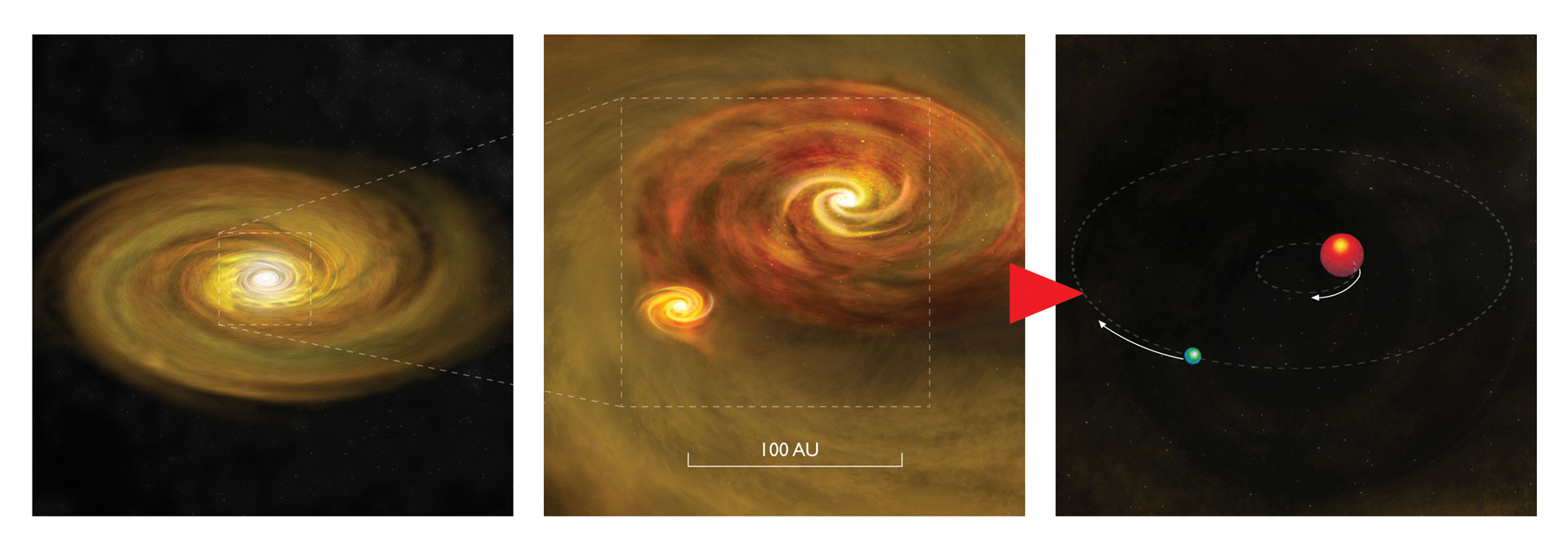
Using the new capabilities of the upgraded Karl G. Jansky Very Large Array (VLA), scientists have discovered previously-unseen binary companions to a pair of very young protostars, which gives strong support for one of the competing explanations for how double-star systems form.

Astronomers know that about half of all Sun-like stars are members of double or multiple-star systems, but have debated over how such systems are formed.

"The only way to resolve the debate is to observe very young stellar systems and catch them in the act of formation," said John Tobin, of the National Radio Astronomy Observatory (NRAO). "That's what we've done with the stars we observed, and we got valuable new clues from them," he added.

