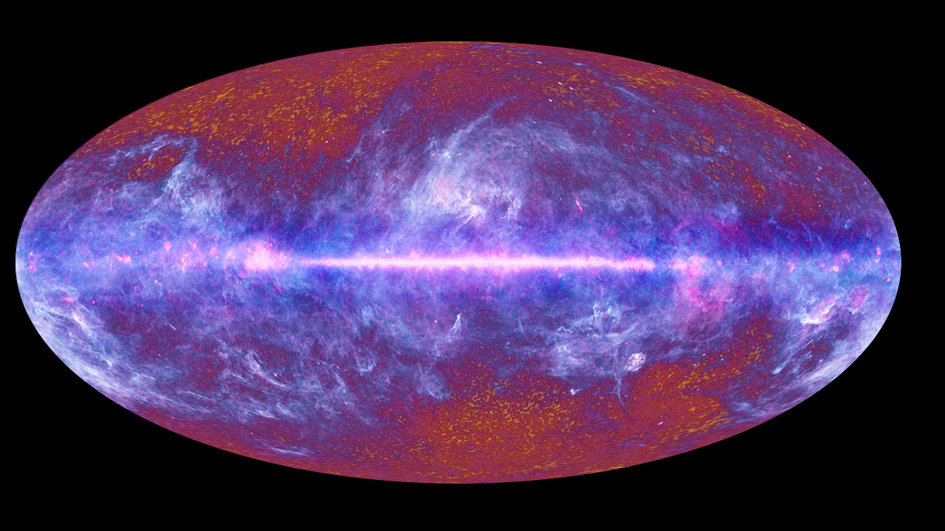



Detectives of both the amateur and occupational variety know that the best way to solve a mystery is to visit the scene where it began and look for clues.

Cosmological detectives do that too, by trying to peer as far back to the Big Bang as possible. A new analysis of cosmic microwave background (CMB) radiation data has taken the furthest look back through time yet – 100 years to 300,000 years after the Big Bang - and provided tantalizing new hints of clues as to what might have happened.

Steven Pinker has written a long essay in The New Republic embracing scientism. That's really too bad, because this way Pinker joins a disturbingly long list of scientists (and a few philosophers) who confuse a defense of good science with a knee-jerk reaction against sound criticism of science. [For a good, if partial, response to Pinker from the Left look here; for a far less convincing one, from the Right, look here.]
We're in a hyper-regulated society. Everyone wants to regulate other people while they claim to care about freedom and choice. If you claim to care about freedom and then want to ban marriage or IVF or food or medicine, I know how you vote.

As a hallmark of its presidency, the White House advocated and got passed the Affordable Care Act, which friend and foe alike call Obamacare.

An international team has found evidence of substantial overlap for genetic risk factors shared between bipolar disorder, major depressive disorder and schizophrenia and less overlap between those conditions and autism and attention deficit-hyperactivity disorder (ADHD).

The root causes of psychiatric illnesses are not known. Instead, for the past 125 years, clinicians have based diagnosis on a collection of symptoms observed in patients, something medical science has long left behind - and so the race has been on to find biological links.

A pre-emptive warning to the reader: the article below is too long to publish as a single post. I have broken it out in four installments. After reading the text below you should continue with part II, part III, and part IV (which includes a summary).

Here's a development that could have significant implications for electrochemistry, biochemistry, electrical engineering and many other fields: a Nature Materials paper is about computer simulations which find that the electrical conductivity of many materials increases with a strong electrical field in a universal way. 

Electrical conductivity is a measure of how strongly a given material conducts the flow of electric current and is generally understood in terms of Ohm's law, which states that the conductivity is independent of the magnitude of an applied electric field, i.e. the voltage per meter. This law is widely obeyed in weak applied fields, which means that most material samples can be ascribed a definite electrical resistance, measured in Ohms.

You have decided to start a graduate study in physics. Where should you apply? And how to decide which offer to take?

A diarrhea of lists attempt to rank "the world’s best universities". Mostly these lists are based on some aggregate of different metrics. Yet, for a postgraduate degree your focus should be on one and only one metric: you want to surround yourself with the best brains. If you're good, the place to hone your skills is there where you get the opportunity to learn from the best. There where you can join those that are making impact in their field of research.

What are the high-impact universities in physics?
What group has above average interest in systems and scores below average in empathy?

If you answered autistic people, you are correct. If you answered girls with anorexia, also correct.

Girls with anorexia nervosa show a mild echo of the characteristics of autism, suggests new research. At first glance, anorexia and autism seem very different, but they both share certain features, such as rigid attitudes and behaviours, a tendency to be very self-focussed, and a fascination with detail. Both conditions also share similar alterations in structure and function of brain regions involved in social perception.

I wrote before about the controversy involving the release earlier this year of a genome sequence of the HeLa cell line, which was taken without consent from Henrietta Lacks as she lay dying of ovarian cancer in 1950s Baltimore.

Now, the NIH has announced an agreement with Lacks’ descendants to obtain their consent for access to and use of the HeLa genome (the agreement applies only to NIH funded research, but the hope is that others will agree to it as well).

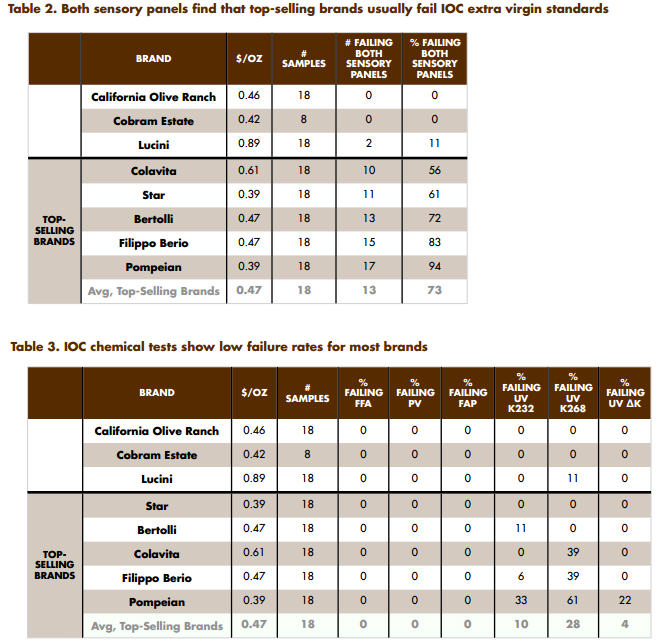
When I think of cheap knock-offs I think of things like a Rolex watch or a Gucci handbag, but apparently knock-off food is a $10-15 billion industry.

I don't even mean the faux organic stuff sold as such because some shell company in China claims it is organic and no one bothers to test it, actual food in real supermarkets is sometimes fake, or at least misleading, according to Shaun Kennedy, associate professor of veterinary population medicine at the University of Minnesota Director of the National Center for Food Protection and Defense.

