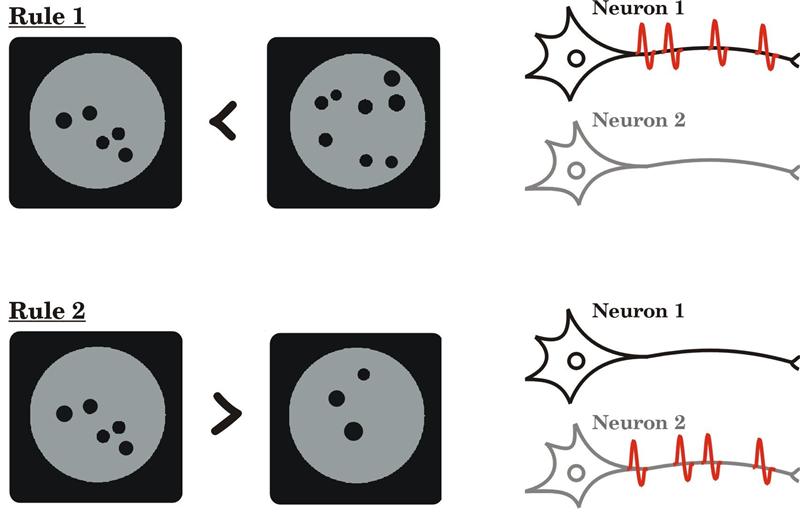
Children learn basic mathematical rules such as 'less than' and 'greater than' because they are the foundation of mathematical operations. As adults, intelligent behavior requires strategic processing of numbers and abstract quantity information, such as when we adopt a 'less than' strategy when shopping for a product to pay the smallest amount of money. When searching for a job our plan of action is 'greater than' and we strive to earn the largest sum of money.
Neurobiologists in the laboratory of Andreas Nieder at the University of Tübingen writing in Proceedings of the National Academy of Sciences (PNAS) (January 18.-24. 2010) say they have shown for the first time how brain cells process simple mathematical rules.
Iowa State University researchers say they have discovered how the Ebola Virus is able to elude the immune response of host cells that it invades. The problem has stumped scientists for many years, and in a new study published in Nature Structural and Molecular Biology, the Iowa team says that host cells can't recognize and respond to the virus because of a dirty little trick it plays.
When most viruses invade cells, they begin producing RNA in order to replicate. In response, the healthy host cells activate anti-viral defenses that halt replication and eventually help clear the viral infections
Stem cell-derived neurons can fully integrate into the brains of young animals, according to new research published in the the Journal of Neuroscience. Healthy brains have stable and precise connections between cells that are necessary for normal behavior, and the new study suggests that stem cells can be directed not only to become specific brain cells, but to link correctly. The finding may have long term implications for the treatment of spinal cord injuries and amyotrophic lateral sclerosis (ALS).
Hard workers who are motivated to achieve generally excel on specific tasks when they are reminded of the benefits of their hard work. But when a task is presented as fun, researchers report in a new Journal of Personality and Social Psychology study, the same hard-working individuals are often outperformed by those less motivated to achieve.
The findings suggest that two students may respond quite differently to a teacher's exhortation that they strive for excellence, said University of Illinois psychology professor Dolores Albarracín, who conducted the research with William Hart, of the University of Florida. One may be spurred to try harder, while another may become less motivated.