

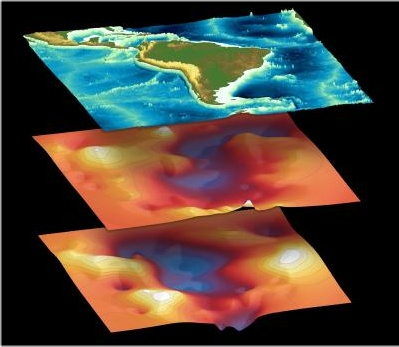






An essential component of the human immunodeficiency virus (HIV-1) molecular machinery responsible for infecting cells consists of functionally-specialized layers, according to a study by investigators at the University of California San Diego (UCSD) Antiviral Research Center (AVRC), published November 23 in PLoS Computational Biology.

The unprecedented genetic diversity and adaptability of HIV-1 has so far foiled the best efforts to eradicate the global HIV/AIDS epidemic. The surface of the HIV-1 particle is studded with protein spikes that allow the virus to enter human cells. This study examined an important component of the protein spike called the third variable loop (labeled “V3”).

There has recently been a huge growth in transnational English language television channels, with the launch in the UK of Al Jazeera English, Press TV (Iran), CCTV9 (China), France 24 and Russia Today. These join existing channels such as CNN International, Voice of America and BBC World TV. But what are the purposes of these channels? Who are they for and who is watching them? Do they constitute a global group of English speaking nations, an ‘Anglosphere’?

These were some of the questions debated by media professionals and academics at a workshop, sponsored by the Economic and Social Research Council (ESRC), entitled ‘Transnational TV News and Media Diplomacy: Al Jazeera English in Context.’

Researchers writing in BMC Genomics reveal that the grapevine's gene expression analysis reveals two distinct molecular and functional phases that correspond with the green and red grape stages.

Researchers have reported the first biochemical evidence that reactive oxygen species accumulate during the color transition. Stefania Pilati and fellow researchers from the IASMA Research Center, San Michele all'Adige, Italy, investigated ripening Pinot Noir grapes (Vitis vinifera L.) to identify fruit ripening genes and investigate seasonal influences.

They found a core set of more than 1,400 ripening-specific genes that fluctuated similarly across three growing seasons and a smaller gene group strongly influenced by climatic conditions.

An enormous submarine landslide that disintegrated 60,000 years ago produced the longest flow of sand and mud yet documented on Earth. The massive submarine flow travelled 1,500 kilometres – the distance from London to Rome – before depositing its load.

Details of the landslide and consequent sediment flow are reported online today in Nature by Dr Peter Talling from the University of Bristol, with colleagues from the National Oceanography Centre in Southampton and several other institutions.

Dr Talling said: “The volume of sediment transported by this flow in the deep ocean is difficult to comprehend. It was one of the largest movements of material ever to occur on our planet. This mass was ten times that transported to the ocean every year by all of the Earth’s rivers.

Astronomers have discovered white dwarf stars with pure carbon atmospheres. The discovery could offer a unique view into the hearts of dying stars.

These stars possibly evolved in a sequence astronomers didn't know before. They may have evolved from stars that are not quite massive enough to explode as supernovae but are just on the borderline. All but the most massive two or three percent of stars eventually die as white dwarfs rather than explode as supernovae.

When a star burns helium, it leaves "ashes" of carbon and oxygen. When its nuclear fuel is exhausted, the star then dies as a white dwarf, which is an extremely dense object that packs the mass of our sun into an object about the size of Earth.

In the first evidence of its kind to date, Yale researchers find that infants prefer individuals who help others to those who either do nothing, or interfere with others’ goals, it is reported today in Nature.

“This supports the view that our ability to evaluate people is a biological adaptation—universal and unlearned,” said the authors of the study.

The study included six-and-10-month-old babies whose preferences were determined by recording which of two actors they reached towards.

In the first experiment, infants saw a wooden character with large glued-on eyes known as “The Climber.” At first, the climber rested at the bottom of a hill.

Stanford University scientists say they can make wind power a steady, dependable source of electricity but it will require connecting wind farms throughout a given geographic area with new transmission lines, always a difficult sell for people who live in the affected area. The findings are published in the November Journal of Applied Meteorology and Climatology.

Wind is the world’s fastest growing electric energy source, say Cristina Archer and Mark Jacobson. but because it is intermittent it is not used to supply baseload electric power today. Baseload power is the amount of steady and reliable electric power that is constantly being produced, typically by power plants, regardless of the electricity demand.

Global cooling caused wars and migration in the past and global warming could do the same in the future, according to a study in Proceedings of the National Academy of Sciences (PNAS).

As temperatures decreased centuries ago during a period called the Little Ice Age, the number of wars increased, famine occurred and the population declined.

“Even though temperatures are increasing now, the same resulting conflicts may occur since we still greatly depend on the land as our food source,” said Peter Brecke, associate professor in the Georgia Institute of Technology’s Sam Nunn School of International Affairs and co-author of the study.

Remains of an ancient synagogue from the Roman-Byzantine era have been revealed in excavations carried out in the Arbel National Park in the Galilee under the auspices of the Hebrew University of Jerusalem.

The excavations, in the Khirbet Wadi Hamam, were led by Dr. Uzi Leibner of the Hebrew University’s Institute of Archaeology and Scholion – Interdisciplinary Research Center in Jewish Studies.

Dr. Leibner said that the synagogue’s design is a good example of the eastern Roman architectural tradition. A unique feature of the synagogue is the design of its mosaic floor, he said.


Mosaic floor found at site of newly discovered Galilee synagogue shows workman with woodworking tool.

Is there an objective biological basis for the experience of beauty in art? Or is aesthetic experience entirely subjective? This question has been addressed in a paper by Cinzia Di Dio, Emiliano Macaluso and Giacomo Rizzolatti. The researchers used fMRI scans to study the neural activity in subjects with no knowledge of art criticism, who were shown images of Classical and Renaissance sculptures.

The ‘objective’ perspective was examined by contrasting images of Classical and Renaissance sculptures of canonical proportions, with images of the same sculptures whose proportions were altered to create a comparable degraded aesthetic value.

