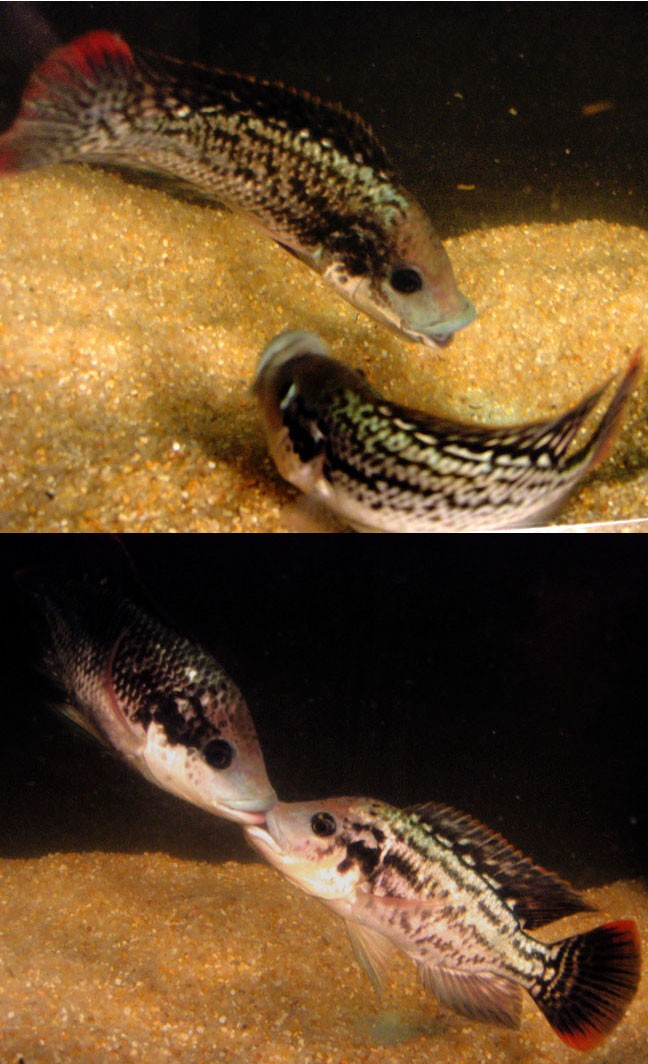






A gene has been found in male cichlid fish that evolved to lure female fish so that male cichlids can deposit sperm in the females mouths. A study in BMC Biology reveals that the gene is associated with egg-like markings on the fins of cichlid fishes and uncovers the evolutionary history of these markings, which are central to the success of the fishes' exotic oral mating behavior.

Walter Salzburger, Ingo Braasch and Axel Meyer reared 19 cichlid species at Konstanz University in Germany and identified a gene involved in producing yellow pigment cells in oval spots on the fishes' fins.


Cichild fish are lovers AND fighters.

Our brain is very good at picking up speech even in a noisy room, an adaptation essential for holding a conversation at a cocktail party, and now we are beginning to understand the neural interactions that underlie this ability.

An international research team reports in BMC Biology how investigations using neuroimaging have revealed that the brain's left hemisphere helps discern the signal from the noise.

In our daily lives, we are exposed to many different sounds from multiple sources at the same time, from traffic noise to background chatter. These noisy signals interact and compete with each other when they are being processed by the brain, a process called simultaneous masking.

The cells which thicken the womb wall during a woman's menstrual cycle contain a newly discovered type of stem cell, and could be used in the treatment of damaged and/or old tissue, according to research published in the Journal of Translational Medicine.

Dr Xiaolong Meng of the Bio-Communications Research Institute in Wichita, Kansas, led the research team consisting of scientists from the University of Alberta, University of Western Ontario and Medistem Laboratories (mdsm.ob). The team identified a new type of stem cell that can be reproducibly isolated from menstrual blood collected from healthy female subjects.

Researchers are closer to understanding why humans differ so greatly from chimpanzees in the way they look, behave, think, and fight off disease, despite having genes that are nearly 99% identical.

Innovative research from the University of Toronto’s Centre for Cellular and Biomolecular Research has uncovered potential new explanations for these glaring differences. In comparing brain and heart tissue from humans and chimpanzees, U of T Professor Benjamin Blencowe and his team, including graduate student researcher John Calarco, have discovered significant differences in the way genetic material is spliced to create proteins.

In a petition filed today with the U.S. Food and Drug Administration, an international coalition of scientists and doctors, including the Physicians Committee for Responsible Medicine, Association of Veterinarians for Animal Rights and In Defense of Animals, is seeking to compel the FDA to mandate the use of human-centered rather than animal testing methods when those alternatives exist.

Petition signatories include a plaintiff in a Vioxx lawsuit who refuses to accept the recently proposed settlement with Merck because she is concerned that misleading animal drug testing will continue to put consumers at risk. After taking Vioxx to cope with pain from a shoulder injury, Nancy Tufford was diagnosed with congestive heart failure.

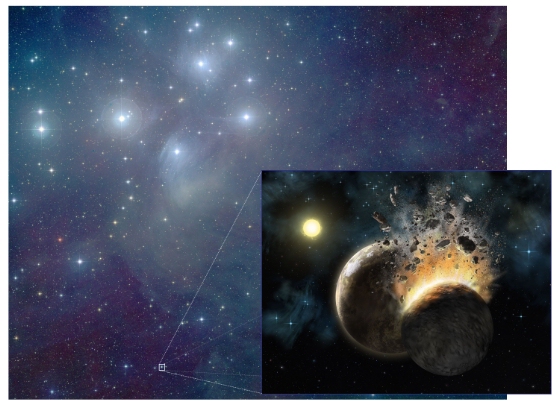
Rocky terrestrial planets, perhaps like Earth, Mars or Venus, appear to be forming or to have recently formed around a star in the Pleiades ("seven sisters") star cluster, the result of "monster collisions" of planets or planetary embryos.

Astronomers using the Gemini Observatory in Hawaii and the Spitzer Space Telescope report their findings in an upcoming issue of the Astrophysical Journal, the premier journal in astronomy.

In Bad For Carbon Offsets - Not All Trees Are The Same At Reducing Global Warming, scientists noted that planting new trees as an emotional panacea for greenhouse gas emissions - that means you, Burning Man Festival - didn't really do much good.

Now the single largest assessment of the biodiversity conservation value of primary, secondary and plantation forests ever conducted in the humid tropics adds new weight to the debate.

Working in the north-eastern Brazilian Amazon an international team of scientists funded by the UK Government’s Dar

Clinicians from the USC School of Dentistry have made the first epidemiological study of oral cancer in California and detailed a connection between the incidence of oral cancer and race and ethnicity.

Dr. Satish Kumar and Dr.Parish Sedghizadeh, clinical professors in the school’s Division of Diagnostic Sciences, went through 20 years of records from the California Cancer Registry (CCR)— the state’s cancer surveillance database — for the incidence rates of invasive squamous cell carcinoma, the most common form of oral cancer.

Up to two-thirds of oral cancers are caused by tobacco or alcohol use, according to the Oral Cancer Foundation.

When ancient retroviruses slipped bits of their DNA into the primate genome millions of years ago, they successfully preserved their own genetic legacy. Today an estimated 8 percent of the human genetic code consists of endogenous retroviruses (ERVs)--the DNA remnants from these so-called "selfish parasites."

Surprisingly, the infected hosts and their primate descendants also appear to have benefited from this genetic invasion, new evidence suggests. The ancient retroviruses--distant relatives of the human immunodeficiency virus (HIV)--helped a gene called p53 become an important "master gene regulator" in primates, according to a study published this week in the Proceedings of the National Academy of Sciences.

The first “State of the Carbon Cycle Report” for North America, released online this week by the U.S. Climate Change Science Program, finds the continent’s carbon budget increasingly overwhelmed by human-caused emissions.

North American sources release nearly 2 billion tons of carbon into the atmosphere each year, mostly as carbon dioxide. Carbon “sinks” such as growing forests may remove up to half this amount, but these current sinks may turn into new sources as climate changes.

“By burning fossil fuel and clearing forests human beings have significantly altered the global carbon cycle,” says Chris Field of the Carnegie Institution’s Department of Global Ecology, one of the report’s lead authors.

