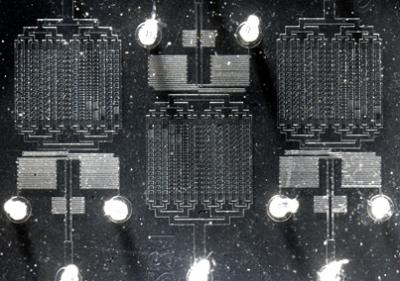









Using an innovative device with microscopic chambers, researchers have gleaned important new information about how bacteria survive in hostile environments by forming antibiotic-resistant communities called biofilms.

These biofilms play key roles in cystic fibrosis, urinary tract infections and other illnesses, and the researchers say their findings could help in the development of new treatments and preventive measures.

“There is a perception that single-celled organisms are asocial, but that is misguided,” said Andre Levchenko, assistant professor of biomedical engineering in The Johns Hopkins University’s Whiting School. “When bacteria are under stress—which is the story of their lives—they team up and form this collective called a biofilm.

Cranberry sauce is not the star of the traditional Thanksgiving Day meal, but when it comes to health benefits, the lowly condiment takes center stage. In fact, researchers at Worcester Polytechnic Institute (WPI) have found that compounds in cranberries are able to alter E. coli bacteria, which are responsible for a host of human illnesses (from kidney infections to gastroenteritis to tooth decay), in ways that render them unable to initiate an infection.

For the first time, the research has begun to reveal the biochemical and biophysical mechanisms that appear to underlie a number of beneficial health effects that have long been ascribed to cranberries and cranberry juice—in particular, the ability of cranberry juice to prevent urinary tract infections (UTIs).

There are wide-ranging predictions about the coming solar cycle peak in 2012 and its influence on Earth's warming climate and the $88 million Solar Radiation and Climate Experiment(SORCE) mission, launched in 2003 can help find answers, according to the chief scientist on the project.

Senior Research Associate Tom Woods of CU-Boulder's Laboratory for Atmospheric and Space Physics said the brightening of the sun as it approaches its next solar cycle maximum will have regional climatic impacts on Earth.

What is the fundamental creative force behind life on Earth? It's a question that has vexed mankind for millennia, and thanks to theory and almost a year's worth of number-crunching on a supercomputer, Rice University physicist and bioengineer Michael Deem thinks he has the answer: A changing environment may organize the structure of genetic information itself.

Deem's research is available online and slated to appear next month in Physical Review Letters.

"Our results suggest that the beautiful, intricate and interrelated structures observed in nature may be the generic result of evolution in a changing environment," Deem said. "The existence of such structure need not necessarily rest on intelligent design or the anthropic principle."

By adding a few modifications to their successful wastewater fuel cell, researchers have coaxed common bacteria to produce hydrogen in a new, efficient way.

Bruce Logan and colleagues at Penn State University had already shown success at using microbes to produce electricity. Now, using starter material that could theoretically be sourced from a salad bar, the researchers have coaxed those same microbes to generate hydrogen.

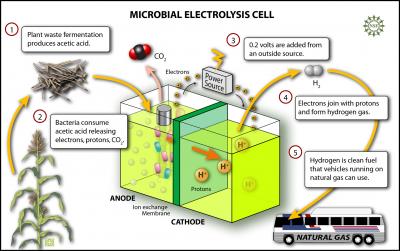
By tweaking their design, improving conditions for the bacteria, and adding a small jolt of electricity, they increased the hydrogen yield to a new record for this type of system.


This illustration shows how the new electrolysis cell functions.

New research reveals that the families of patients who died in the intensive care unit (ICU) had higher satisfaction of care ratings than families of patients who survived their time in the ICU.

The study in the November issue of CHEST shows that while the families of ICU survivors and nonsurvivors were equally satisfied with the treatment that their loved one received, the families of non-survivors were two to three times more likely to give higher ratings regarding family-centered aspects of care. In contrast, the families of ICU survivors were shown to be less pleased with their overall ICU experience.

“For several years, our research team has focused on improving the quality of care delivered to critically ill patients and their families.

Last week, this article, Kidney Transplants From Extended Criteria Non-Beating Heart Donors Double Risk Of Death In Elderly brought the issue of of the risks of extended criteria organs into focus. It sounds like a bad thing that a higher-risk organ would double the risk of death.

Not necessarily, says a new report from Wake Forest University Baptist Medical Center.

New research has found that a drug used to treat severe forms of acne, Roaccutane (Accutane in the US), reduces the availability of the chemical serotonin, low levels of which have been linked to aggression and clinical depression.

The researchers had previously reported that the drug caused depressive behaviour in mice but, until now, the mechanism by which this might happen was unknown.

Using cells cultured in a laboratory, scientists from the University of Bath (UK) and University of Texas at Austin (USA) were able to monitor the effect of the drug on the chemistry of the cells that produce serotonin.

Some people just don't express emotions. It used to be considered strictly cultural, a society's image manifested in physical expectations, but now true inability to express emotions (alexithymia) is thought to be hereditary.

The largest study so far has provided new data in the current issue of Psychotherapy and Psychosomatics. The role of genetic and environmental factors for developing alexithymia is still unclear, and the aim of this study was to examine these factors in a large population-based sample of twins.

The Toronto Alexithymia Scale-20 (TAS-20) was included in a mail survey of 46,418 individuals born between 1931 and 1982 and registered with the Danish Twin Registry. The response rate was 75.3%.

A diet low in carbohydrates may help stunt the growth of prostate tumors, according to a new study led by Duke Prostate Center researchers. The study, in mice, suggests that a reduction in insulin production possibly caused by fewer carbohydrates may stall tumor growth.

“This study showed that cutting carbohydrates may slow tumor growth, at least in mice,” said Stephen Freedland, M.D., a urologist at Duke University Medical Center and lead researcher on the study.

