




The characteristic blue glow from a nuclear reactor is present in radiation therapy, too. Investigators from Dartmouth's Norris Cotton Cancer Center, led by Brian W. Pogue, PhD, and PhD candidates Adam K. Glaser and Rongxiao Zhang, published in Physics in Medicine and Biology how the complex parts of the blue light known as the Cherenkov Effect can be measured and used in dosimetry to make therapies safer and more effective.

"The beauty of using the light from the Cherenkov Effect for dosimetry is that it's the only current method that can reveal dosimetric information completely non-invasively in water or tissue," said Glaser.

75 percent of movies released to theaters lose money, making the film industry even less able to pick winners in the private sector than the government. Surely there has to be a better method than greenlighting a movie because another studio is doing the same movie, or because someone has heard of M. Night Shyamalan.

A new study finds that brain activity visible through electroencephalography (EEG) could be a better barometer of success, at least if making money is the goal. 

Fossil "swim tracks," a type of vertebrate trace fossil gaining recognition in the field of paleontology, is  made by various tetrapods (four-footed land-living vertebrates) as they traveled through water under buoyant or semibuoyant conditions.

They occur in high numbers in deposits from the Early Triassic,  between the Permian and Jurassic 250 to 200 million years ago. Major extinction events mark the start and end of the Triassic but it is a but of a mystery why tracks from the period are so abundant and well preserved.


Tracy J. Thomson next to a block with numerous swim tracks in Capitol Reef National Park, Utah. 

Researchers in Australia have found that corals commonly found on the Great Barrier Reef will eat micro-plastic pollution - but there are obviously limits.

Microplastics are tiny fragments of plastic in the environment and are a widespread contaminant in marine ecosystems, particularly in inshore coral reefs. Corals are non-selective feeders and a new study shows that they can consume microplastics when the plastics are present in seawater, but obviously if it increases, corals could be negatively affected as their tiny stomach-cavities become full of indigestible plastic.

Despite the proliferation of microplastics, their impact on marine ecosystems is poorly understood.

Credit: Brill

In some ways, bonobos and chimpanzees are more similar to humans than they are each other and for that reason bonobos can provide an extremely powerful test of ideas about human uniqueness, as well as being crucial to determining the evolutionary processes by which cognitive traits evolve in apes.

A special issue of Behaviour includes twelve empirical studies focusing on the behavior and cognition of both captive and wild bonobos (Pan paniscus). The contributors believe that a renaissance in bonobo research is underway.

Rejected by a person you like? Just "shake it off" and move on, as music star Taylor Swift says. But while that might work for many people, it may not be so easy for those with untreated depression, a new brain study finds. The pain of social rejection lasts longer for them -- and their brain cells release less of a natural pain and stress-reducing chemical called natural opioids, researchers report in the journal Molecular Psychiatry.

The findings were made in depressed and non-depressed people using specialized brain-scanning technology and a simulated online dating scenario. The research sheds new light on how the brain's pain-response mechanism, called the opioid system, differs in people with depression.

Our brains generate a constant hum of activity: As neurons fire, they produce brain waves that oscillate at different frequencies. Long thought to be merely a byproduct of neuron activity, recent studies suggest that these waves may play a critical role in communication between different parts of the brain.

A new study from MIT neuroscientists adds to that evidence. The researchers found that two brain regions that are key to learning -- the hippocampus and the prefrontal cortex -- use two different brain-wave frequencies to communicate as the brain learns to associate unrelated objects. Whenever the brain correctly links the objects, the waves oscillate at a higher frequency, called "beta," and when the guess is incorrect, the waves oscillate at a lower "theta" frequency.

According to the public databases, there are currently approximately 1,900 locations in the human genome that produce microRNAs (miRNAs), the small and powerful non-coding molecules that regulate numerous cellular processes by reducing the abundance of their targets. New research published in the Proceedings of the National Academy of Sciences (PNAS) this week adds another roughly 3,400 such locations to that list. Many of the miRNA molecules that are produced from these newly discovered locations are tissue-specific and also human-specific. The finding has big implications for research into how miRNAs drive disease.

In a symposium on social psychology, psychologists are challenging the beliefs of other psychologists about the effectiveness of traditional strategies for encouraging healthy eating. 

A paper in the Journal of the American Medical Association observed whether or not photographs of vegetables on a school lunch tray had an impact on the amount of vegetables eaten. The study found that placing photos of carrots and green beans did increase the amounts of vegetables eaten during lunch, but it still was not at levels consistent with government-recommended dietary guidelines. 


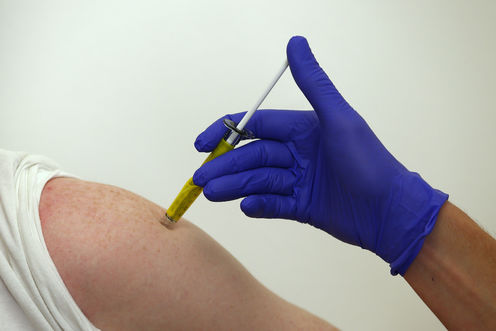
A volunteer receives a trial Ebola vaccine at the Centre for Clinical Vaccinology and Tropical Medicine in Oxford, southern England January 16, 2015. Eddie Keogh/Reuters

Recently, Phase II and III trials of two vaccines for Ebola started in West Africa. The development of possible vaccines is welcome news. Like most vaccine trials, the current Ebola trials are being conducted under ethical guidelines derived from US standards for clinical research in human beings.

