






Energy storage optimization takes a great deal of wisdom, such as the proper trade-offs between energy density or power density.   Batteries, which store energy by separating chemicals and are better for delivering lots of energy, while capacitors, which store energy by separating electrical charges, are better for delivering lots of power (energy per time).  

Life would be simpler if both were always available without high cost.  

At the AVS 57th International Symposium&Exhibition in Albuquerque, MIT reported on efforts to store energy in thin carbon nanotubes by adding fuel along the length of the tube - chemical energy, which can later be turned into electricity by heating one end of the nanotubes.

Is alcoholism genetic as well as behavioral?  Studies have suggested it in the past and scientists at Brookhaven National Lab say they have the first experimental evidence of it.

Their study compared the brain's response to long-term alcohol drinking in two genetic variants of mice. One strain lacked the gene for a specific brain receptor dopamine D2, which responds to dopamine, the brain's "feel good" chemical, to produce feelings of pleasure and reward. The other strain was genetically normal.

In the dopamine-receptor-deficient mice (but not the genetically normal strain), long-term alcohol drinking resulted in significant biochemical changes in areas of the brain well know to be involved in alcoholism and addiction.


Researchers say they have discovered a gene variant that may protect against alcoholism.   The variant, in a gene called CYP2E1, is associated with a person's response to alcohol. For the 10 to 20 percent of people that possess this variant, those first few drinks leave them feeling more inebriated than the rest of the human population, who harbor a different version of the gene.
As 2010 nears its end, the Tevatron experiments feel the monopoly of top quark physics being taken from their hands, due to the good news on the running of the Large Hadron Collider. The ATLAS and CMS experiments there have started to mine their datasets, now amounting to over 20 inverse picobarns and growing significantly by the day. These datasets contain as many top quark pairs as half an inverse femtobarn worth of Tevatron collisions, due to the 20-fold higher cross section of top pairs at the LHC.
Is stating 'DIY' and 'Craft' redundant?  Perhaps, but the main story is about the cooler, hipper NASA teaming up with Etsy.  The premise: make a NASA-y shuttle-related artwork or handicraft and you can both sell it and win prizes.  They even use a pun for the title:  "NASA and Etsy present the 2010 Space Craft Contest"

You can even sell your work... but then you have to be able to recreate it if you win the 'will fly it on the Space Shuttle' prize. There's over 360 submissions already, with all entries due by November 2, 2010. You don't have to have an Etsy shop (though you do have to live in the US), so it's very open.  Their spec:
I'm going to be honest here. I have a bone to pick with science.

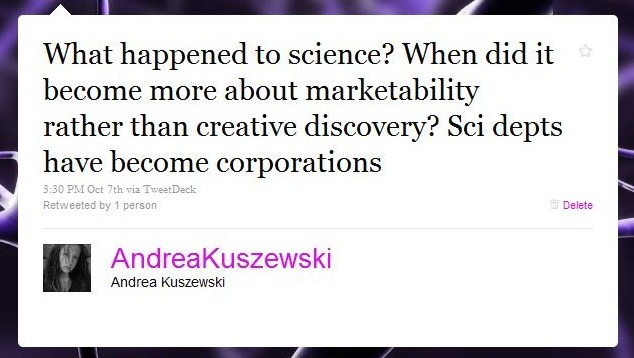
A week or so ago on Twitter, I tweeted this:

Based on some of the responses I got, I decided to probe a little further. I wanted to see if I was in the minority in my opinion, or if others felt the same way. Apparently, I'm not alone.
Energy (E) is a useful quantity. It has certain properties and connections with other such measures, like momentum p. E is paired with time t, much like momentum p and distance x are such a pair. This pairing is known from classical mechanics and it shows up in relativity: The merging of t and x into one entity, space-time, leads straight to such a melting also of E and p. In quantum physics, the uncertainty Δx ~ 1/Δp is important, and it translates into Δt ~ 1/ΔE. We do not think that momentum p is a substance!
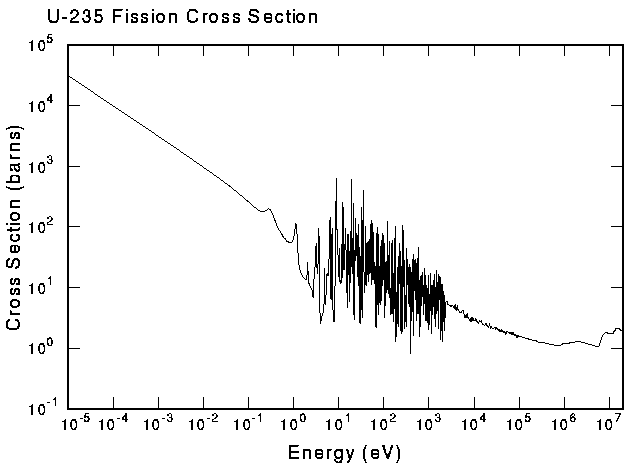
See Nuclear Reactions for Beginners to get an introduction to the basic concepts
A systematic review says there is a link between information provided to physicians by pharmaceutical companies and higher prescription frequency but what does that mean?   Are companies with new drugs marketing them more or are they better than previous drugs and thus get prescribed more?  

The authors analyze and describe the findings of 58 studies examining the relationship between exposure of physicians to information from pharmaceutical companies and subsequent prescribing behavior.   All but one of the studies suggested that


(a) no association was detected or

(b) exposure to pharmaceutical company information was associated with lower prescribing quality. 
Medical evidence is based on what is considered the strongest possible foundation, the placebo-controlled trial but a new paper in the Annals of Internal Medicine calls into question this foundation upon which much of medicine rests, by showing that there is no standard behind the standard – that is, there is no standard for the placebo.

The thinking behind relying on placebo-controlled trials is that to be sure a treatment is effective, it needs to compare people whose only difference is whether or not they are taking the drug. Both groups must think they are on the drug to protect against effects of factors like expectation. Study participants are allocated "randomly" to the drug or a "placebo" – a pill that might be mistaken for the active drug but is inert.

