Petermann Ice Island Revisited
Petermann Ice Island (2010) Calved on August 05 2010. The calving had been anticipated for some time and had been predicted to occur in summer 2010 by a number of people, including myself. The actual calving event was observed in near real-time images by a number of people - credits at the foot of this article.
I give here some more background to my observations and my predictions of the Petermann calving event in a wider context of mechanical forces which may act on glaciers.
Greenland under observation
If the freezing point of fish blood is -0.9 ° Celsius, how are Antarctic fish able to keep moving at a temperature like -1.8 ° C?
You're not the only one to ask, researchers have wondered for 50 years, and it known that fish in the Arctic have a special sort of antifreeze, similar to what we put in cars, but just how these special frost protection proteins work has been unclear.
Some 80-90 years ago, an unknown Californian guy named George A. Linhart, unlike A. Einstein, P. Debye, M. Planck and W. Nernst, has managed to derive a very simple, but ultimately general mathematical formula for heat capacity vs. temperature from the fundamental thermodynamical principles, using what we would nowadays dub a “Bayesian approach to probability”. Moreover, he has successfully applied his result to fit the experimental data for diverse substances in their solid state in a rather broad temperature range. Nevertheless, Linhart’s work was undeservedly forgotten, although it does represent a valid and fresh standpoint on thermodynamics and statistical physics, which may have a significant implication for academic and applied science.
Junk food will make your waistline bigger, which is bad for you, and candy is no exception. But candy that makes your
intelligence bigger? Garth Sundem's
Brain Candy is here to satisfy your intellectual sweet tooth.
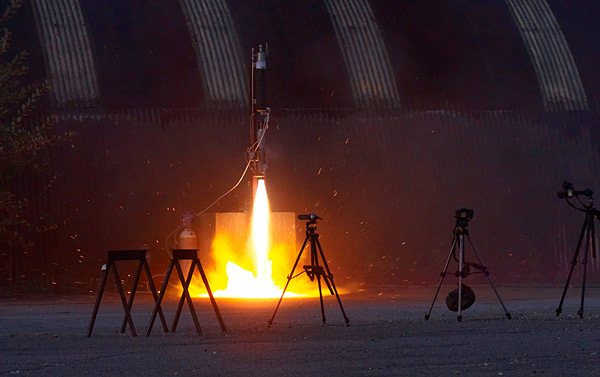
"We're building a rocket. We're building it bigger" - Copenhagen Suborbital.
"We've got the biggest balls of them all" - AC/DC
I'll steal
UniverseToday's summary, then tell you to skip reading everyone else's coverage of it (even mine):
Is cosmic inflation faster than the speed of light?
An introduction: in the online autism community, there are a lot of heated debates. One of them is related to the nature of autism research. Some are insistent that more research focus on vaccines. Others push for more research on treatments. Still others insist that autism research is skewed because studies, especially brain imaging studies, have narrow parameters and exclude intellectual disability. The following post is a response to this last argument and an explanation as to why studies are conducted as they are.
On Friday evening I was in Tesero, where a crowd of 150 interested laypersons attended my talk on particle physics, organized by the very active
Gruppo Astrofili Fiemme. There, among other things, I discussed the challenge that is on between the Fermilab experiments in the United States and the CERN experiments in Europe. I will discuss elsewhere the successful evening; here I just want to show the status of data collection by the two challengers.
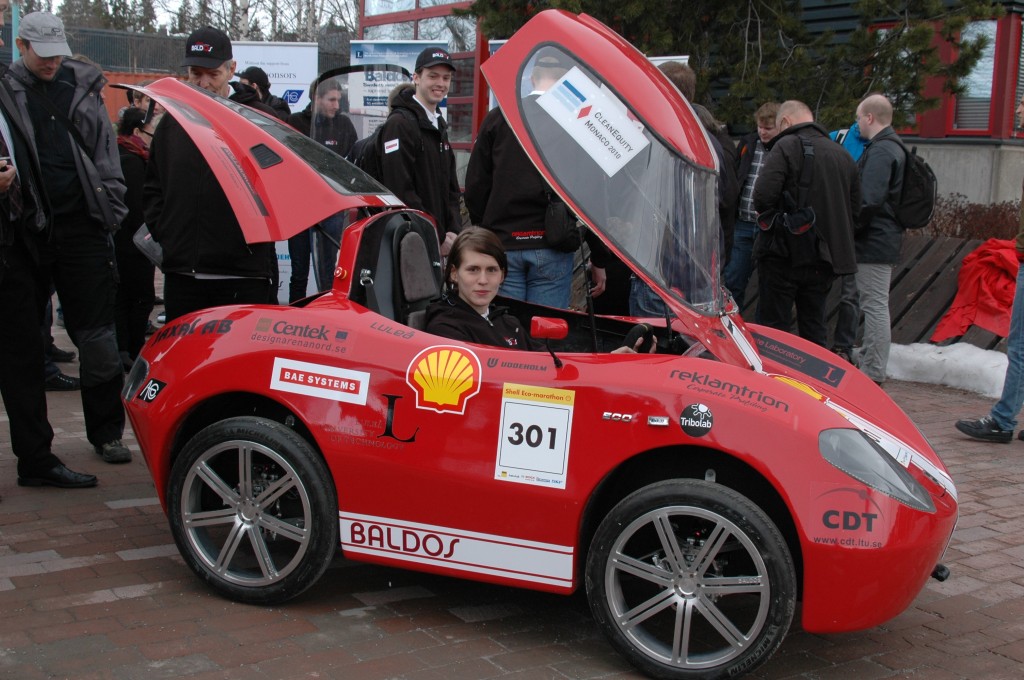
Should you happen to be in Washington, D.C. in October and at House of Sweden, the Swedish Embassy, you will get a chance to see a fireball red colored car that delighted Europeans who like tiny red cars earlier this year.
It's called the Baldos II and it is a hybrid auto built by engineering students at Luleå University of Technology in Sweden. So what?
The fuel tests show it can run 152.2 kilometers on a liter of fuel, whatever that means - in Sweden, they use some primitive system invented during the French Revolution to stick it to the English, so I am not certain but that sounds like 357 MPG. Or approximately 12X my tiny convertible's mileage!
M.A.D. 2.0
The greatest fear of mankind after World War 2 was the real possibility of a World War 3.
It was a rational fear of a very real threat: the global destruction of civilization.
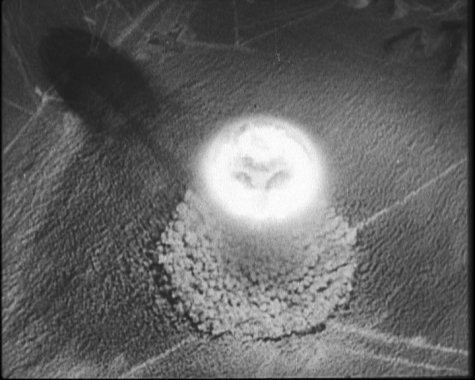
Nations, most especially the USA and the former USSR, found themselves in a mad race to build more bombs, more powerful bombs, megadeath bombs.
The military theory behind this madness was that if a nation had weapons enough to utterly destroy any enemy then it would not be attacked. But a first strike might reduce the ability to launch a counterstrike powerful enough to utterly destroy the enemy, so it was thought necessary to keep in constant readiness far more than enough weapons to destroy any enemy.