The Real Scuttlebutt On Sailing Slang
There are plenty of sites around the web which will give you the origins and meanings of nautical slang. Mostly the wrong ones. Etymology is a science: you can't just make stuff up.
What's the scuttlebutt?
Just a reminder, the deadline to enter our spring University Science Writing Competition is tomorrow, March 15th at 11:59 p.m. Pacific Time. (and thanks to daylight savings time, you just lost an hour this morning!)
The competition is open to all graduate students.
What Is Science?
Some time ago I was visiting a college in Pakistan. I thought I was just there as an observer. My mistake. I was introduced to a physics class with final words that filled my soul with dread:
" ... from England who is going to give a talk on the topic What is science? ".
Now, when you are put on the spot like that, what do you do? Well - it's science, so you can't just make stuff up. You have to tell it like it is. Fortunately, my bottom line for what constitutes science is all a matter of questions and answers. Purely from memory, here is my little talk.
What is science?
Don't Say CheeseFollowing a thorough scientific assessment of the risks involved in an experiment in the effects of gravity on round cheeses, a 200 year long experiment has been brought to a premature close.
Said a spokesmouthpiece for Tewkesbury Borough Council:
"We did some sums on the back of an envelope and it looks like all those cheeses rolling down the hill are creating a local gravitational anomaly. It's sucking in people from the other side of the world."

The council claims that the following picture in their press release shows architectural distortions due to local gravitational anomalies.
I was delighted to receive news this afternoon of three new interesting results produced by the DZERO collaboration in the analysis of Quantum Chromodynamics (QCD) processes.
QCD, the theory of strong interactions between quarks and gluons, is the "boring" part of the physics of high-energy hadron-hadron collisions. It used to be more more exciting twenty years ago, when the theoretical calculations were not as refined as they are now, and there was still a lot to understand in the physics of strong interactions between quarks and gluons. But nowadays, things are much more clear.
The first cases of Electromagnetic Hypersensitivity (often referred to as electro-hypersensitivity or even EHS) were studied in the 1970s and yet decades later few people are even aware of the condition. We living human beings are more than just flesh and blood; we are also a highly complex electromagnetic system. This also means that we interact with external electromagnetic radiation (EMR). But try switching off every single electrical device in your home and work and ponder on how dependent we now are on these devices. The problem is that no importance is given to how detrimental all this EMR is to human health.
Who says science journalism is dying when it seems to be gloating about slaying one sacred cow after another: chiropractic, homoeopathy and now... dieting.
The internet is bursting to the seams with weight loss programs, slimming advice, nutrition counselling, fitness regimes, low fat, low carb, low salt, low sugar, low motivation diets. It's enough to drive one to drink, except that it would also make you fatter...or would it?
I've been pondering this for some time and have just now been fired into action by a comment I made in another article “
Building Smarter Artificial Intelligence By... Shrinking the Body?” One approach to artificial intelligence is to model the activities of neurons as electrical circuits with multiple inputs and multiple outputs. The model assumes that each individual neuron affects only those other neurons with which it has direct contact at the synapses. But, we also know that an electrical signal will also generate an electromagnetic field.
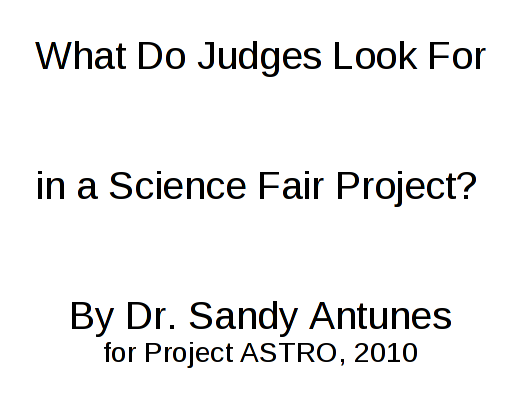
After judging my fifth science fair (for this year), I've decided to share my secrets of a science-fair-judging scientist. Appropriately, I made this as a Science Fair 3-fold poster. At the risk of alienating Hank, the much put upon ScientificBlogging editor, I'm going to see if my poster breaks this article software.
But then again, I did say these were secrets. So making them hard to blog about sort of fits!
.... oh, but I do put a pure-text version at the end. Enjoy!
Alex
Researchers writihg in Proceedings of the Royal Society B say they have made a discovery in understanding the origins of human vision. They say they have determined which genetic 'gateway,' or ion channel, in the hydra is involved in light sensitivity. Hydra are simple animals that, along with jellyfish, belong to the phylum cnidaria. Cnidarians first emerged 600 million years ago.
Complex traits with components of individual evolutionary histories are always more difficult to understand but a gene called opsin is present in vision among vertebrate animals and is responsible for a different way of seeing than that of animals like flies. The vision of insects emerged later than the visual machinery found in hydra and vertebrate animals.