A reader was aghast-- outraged, I say-- at my suggestion that this precious music satellite, Project Calliope, might launch a few months late.
Now, the rocket people at
InterOrbital Systems are rock-solid and haven't had any reason to announce a delay. Their testing is on track. Certainly (as this blog shows) my satellite construction in proceeding in a timely fashion. So why do I think we won't launch until 2011?
The answer is just about everything launches late. Late is the new early. The launch industry is predicated on being absolutely perfect with engineering details, and wildly inaccurate about when you actually launch.
How do we fix science journalism ? Simple: we don't. We let it sink, and be reborn in a different form.
It is rather utopic to insist that in a world of changing means of communications, a world where printed matter is losing ground to the advantage of electronic media, the diffusion of scientific information may or shall stay the same.
Having once been an environmental activist, one thing that bothers me about modern day environmental activists (*) is their insistence, despite any evidence, that jamming people into cities and going to Farmer's Markets and having governments buy huge swaths of land that can't be used by anyone is a good thing. Emotional arguments mobilize zealots who are already convinced but do very little for the undecided. But common sense and data do.
If most people were going to predict which city would instead have a common sense plan to get greener without more bloated government employment or a bigger deficit or laws, very few people would have said Detroit.
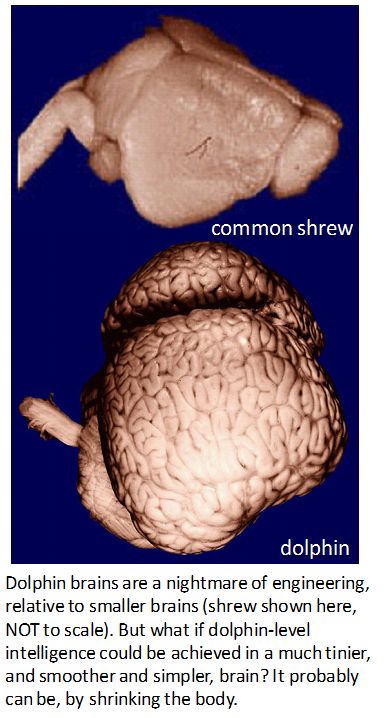
There are currently two ambitious projects straddling artificial intelligence and neuroscience, each with the aim of building big brains that work. One is The Blue Brain Project, and it describes its aim in the following one-liner:
Avalon, "Isle of the Blessed", is a legendary island famous for its beautiful apples, featured in the Arthurian legend described by Geoffrey of Monmouth in the Historia Regum Britanniae (History of the Kings of Britain).
Geoffrey of Monmouth (1100-1135) wrote several works in latin being this the used language of learning and literature in Europe during the medieval period.
A Classic Waste Of Breath
An argument that a thing is natural, therefore not a cause of concern, is used greatly in modern times, most especially in connection with the arguments over whether or not we puny humans can interfere with natural environmental cycles. Such arguments can look good on the face of things.
The naturalistic argument goes back at least to Ancient Greece.
In the art of misleading an audience with a seemingly open-and-shut case it really is a classic.
The 'war on cancer' has led to a reduction in the rate of cancer deaths whether measured against baseline rates in 1970 or in 1990, reports a new study by the American Cancer Society.
According to the study, the downturn in cancer deaths since 1990 is due mostly to reductions in tobacco use, increased screening allowing early detection of several cancers, and modest to large improvements in treatment for specific cancers. The study was published today in PLoS One.
Researchers used nationwide cancer mortality data for the years 1970 through 2006 from the SEER*Stat database, which defines major cancer sites consistently over time in order to facilitate reporting of long term mortality trends.
Spring training is just getting underway for Major League Baseball, and that means it's time for Bruce Bukiet, associate professor of Mathematics at the New Jersey Institute of Technology, to make his annual predictions about the outcome of the season.
Bukiet bases his predictions on a mathematical model he developed in 2000. His model computes the probability of a team winning a game against another team with given hitters, bench, starting pitcher, relievers and home field advantage. For this season, he incorporated a more realistic runner advancement model into the algorithm. Operations Research published Bukiet's mathematical model several years ago.
Researchers studying populations of numerous moth and butterfly species across Papua New Guinea have developed a new technique to study the spread and diet of insect pests--DNA barcoding, which involves the identification of species from a short DNA sequence.
DNA barcodes showed that migratory patterns and caterpillar diets are very dynamic. In one case, a tiny moth that is distributed from Taiwan to Australia, had recently crossed thousands of miles of Pacific Ocean.
The research is detailed in this week's edition of PNAS.
Sonic hedgehog, a gene that plays a crucial rule in the positioning and growth of limbs, fingers and toes, has been found in the ectoderm - the cell layer that gives rise to the skin - in the embryos of developing mice. The gene was previously thought to be exclusively present in the cell layer that builds bone and muscle, called the mesoderm.
The discovery, detailed in PNAS, suggests that Sonic hedgehog's role in the growth of appendages is far more complex than originally thought. Developmental biologists may have to rethink established theories about how limbs are patterned in vertebrates — an effort that could provide insight into human birth defects.