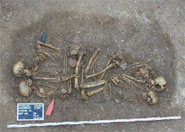
Researchers dated remains from four multiple burials discovered in Germany in 2005 and found that the 4,600-year-old graves contained groups of adults and children buried facing each other – an unusual practice in Neolithic culture. One of the graves was found to contain a female, a male and two children. Using DNA analysis, the researchers established that the group consisted of a mother, father and their two sons aged 8-9 and 4-5 years: the oldest molecular genetic evidence of a nuclear family in the world (so far).
The burials, discovered and excavated at Eulau, Saxony-Anhalt, were also unusual for the great care taken in the treatment of the dead. The remains of thirteen individuals were found in total, all of whom had been interned simultaneously.
150 years ago it was discovered that the speech center is in the left cortex and since then functional differences between left and right hemisphere have become well known; language is mainly handled by the left hemisphere while spatial recognition is more specialized to the right hemisphere.
However, the structural differences of synapses underlying left-right difference of the brain have remained unknown. Now a research team led by Prof Ryuichi Shigemoto at the National Institute for Physiological Sciences in Japan, and colleagues have found that synaptic size and shape in the center of the spatial memory (i.e. hippocampus) were asymmetrical between synapses receiving input from the left and right hemisphere.
Water vapor is known to be Earth's most abundant greenhouse gas, but the extent of its contribution to global warming has been diminished by attention on the economic/political millstone of western civilization carbon dioxide. Using recent NASA satellite data, researchers have estimated more precisely than ever the heat-trapping effect of water in the air, validating the role of the gas as a critical component of climate change.
Andrew Dessler and colleagues from Texas A&M University in College Station confirmed that the heat-amplifying effect of water vapor is potent enough to double the climate warming caused by increased levels of
carbon dioxide in the atmosphere.
Asthma may be overdiagnosed in countries like Canada, suggests a longitudinal study of 540 obese and non-obese adults (
http://www.cmaj.ca/press/pg1121.pdf)that found approximately one third of Canadians with physician-diagnosed asthma do not have asthma when objectively tested.
Why do so many people give up on those New Year's resolutions to lose weight or curb luxury spending? A new study in the Journal of Consumer Research says it has to do with the way our goals intersect with our natures and it uncovers some important differences in the way people categorize "necessities" and "luxuries.".
The study by authors Cait Poynor (University of Pittsburgh) and Kelly L. Haws (Texas A&M University) is one of the first to try to understand why some people have more trouble than others regulating behaviors.
In a study to be published next week in the Proceedings of the National Academy of Sciences, scientists show that forests may influence the Earth's climate in important ways that have not previously been recognized.
When sunlight reaches the Earth's surface it can either be absorbed and converted to heat or reflected back to outer space, where it doesn't influence the Earth's temperature. Scott Ollinger, a professor at the University of New Hampshire Institute for the Study of Earth, Oceans, and Space and the department of Natural Resources and the Environment and colleagues have discovered that, of the total amount of sunlight that falls on forests, the fraction that gets reflected back to space is directly related to levels of nitrogen in their foliage.
Across Europe, we are transforming into a continent of content-craving 'connect-aholics', according to the findings of the AMD European Connectivity Study of over 5,000 online respondents. Sponsored by AMD, in conjunction with independent research company, YouGov, 77% of respondents said they could not live without daily access to the internet.
This was higher than any other item including access to a car (54%) and to a washing machine (61%).
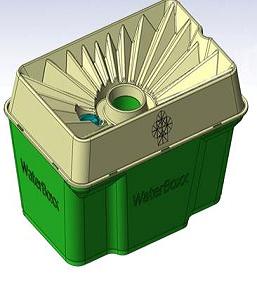
A new Dutch invention makes it possible to reforest large desert and rocky areas in the coming years, they say. Experiments in the Sahara desert have shown that the WaterBoxx allows trees to grow under harsh conditions and can provide them with sufficient water.
The invention of the Dutch businessman and inventor Pieter Hoff has won the prestigious Beta Dragons Award during the annual Flying Dutchman 2008, Science Technology Summit in Amsterdam. A board of scientists and captains of industry proclaimed his design to be the most promising and innovative project.
A new study finds that breast cancer patients who participate in intervention sessions focusing on improving mood, coping effectively, and altering health behaviors live longer than patients who do not receive such psychological support. Published in the December 15, 2008 issue of CANCER, a peer-reviewed journal of the American Cancer Society, the study indicates that reducing the stress that can accompany cancer diagnosis and treatment can have a significant impact on patients' survival.
Researchers at the University of Utah are enrolling people in a new clinical trial that uses a patient's own
stem cells to treat ischemic and non-ischemic heart failure. The one-year Cardiac Repair Cell Treatment of Patients with Dilated Cardiomyopathy (IMPACT-DCM) study will look at the safety of injecting Cardiac Repair Cells (CRC) and their ability to improve heart function.