The temperature might not be the only thing plummeting this winter. Many people also will experience a decrease in their vitamin D levels, which can play a role in heart disease, according to a new review article in Circulation.
Vitamin D deficiency results in part from reduced exposure to sunlight, which is common during cold weather months when days are shorter and more time is spent indoors.
"Chronic vitamin D deficiency may be a culprit in heart disease, high blood pressure and metabolic syndrome," said Sue Penckofer, PhD, RN, study author and professor, Marcella Niehoff School of Nursing, Loyola University Chicago.
A study published today in the online advance edition of
The American Journal of Psychiatry for the first time reveals shape differences in the brains of children with
ADHD, which could help pinpoint the specific neural circuits involved in the disorder.
Did you go to basic training for the military? If so, it is a special memory and you remember it vividly but you don't want to repeat it. On the opposite end of the spectrum, the truly special positive experiences are not something we want to repeat either - we want to keep them as memories.
So most people are unlikely to return to the place of their Honeymoon because they can't repeat it and don't want to diminish the memory.
A new study in the Journal of Consumer Research says people tend to treat their memories of previous special experiences as assets to be protected.
According to the Centers for Disease Control and Prevention, more people die from
lung cancer than any other cancer type. In fact, according to 2004 data, more people died from lung cancer than breast, prostate and colon cancers combined.
Smoking is the biggest risk factor for developing lung cancer, even after quitting for long periods of time. But only 10% of smokers get lung cancer and almost 50% of lung cancer cases involve former smokers.
Construction of new coal-fired power plants in the United States is in danger of coming to a standstill, partly due to the high cost of the requirement, whether existing or anticipated, to capture all emissions of carbon dioxide, an important greenhouse gas. But an MIT analysis suggests an intermediate step that could get construction moving again, allowing the nation to fend off growing electricity shortages using our most-abundant, least-expensive fuel while also reducing emissions.
Instead of capturing all of its CO2 emissions, plants could capture a significant fraction of those emissions with less costly changes in plant design and operation, the MIT analysis shows.
You wouldn't ordinarily think of soil as a non-renewable resource, but it is. Healing damage to soil takes geologic time, not human time. And increasing levels of nitrogen deposition that are associated with industry and agriculture are driving soils toward a toxic level of acidification, reducing plant growth and polluting surface waters, according to a new study published online in Nature Geoscience.
Oppenheimer: The Tragic IntellectCharles Thorpe, University of Chicago 2006
For decades, there was a dearth of comprehensive Oppenheimer biographies. As Thomas Powers noted in the
New York Review of Books, biographies of other major Manhattan Project figures came out long before adequate Oppenheimer biographies: "Oppenheimer, the truly central figure, seemed to resist the attempt to write his life on the grand scale." That is no longer the case, and a shelf of very good biographies makes it difficult to know where to start reading.
A new approach to calibrating quantum mechanical measurement has been developed with particular applications in optics and super-secure quantum communication.Scientists have used the approach to directly calibrate a detector that can sense the presence of multiple individual photons, it is revealed in research published today in Nature Physics.
Being able to sense the presence of individual photons is an important requirement for the development of future long-distance quantum communication devices and networks. One of the potential applications of this new detector is in devices for secret communications, which could allow information to be exchanged in total security guaranteed by the laws of physics, with no possibility of interception, or eavesdropping.
One of the most important developments in human civilization was the practice of
sustainable agriculture, but we were not the first - ants have been doing it for over 50 million years. Just as farming helped humans become a dominant species, it has also helped leaf-cutter ants become dominant herbivores, and one of the most successful social insects in nature. According to an article in the November issue of Microbiology Today, leaf-cutter ants have developed a system to try and keep their gardens pest-free; an impressive feat which has evaded even human agriculturalists.
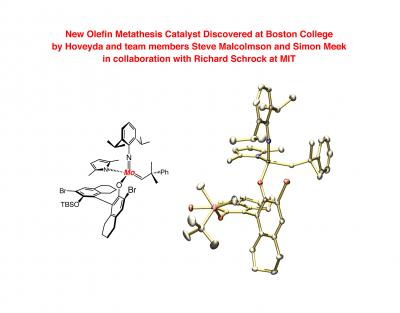
A new class of exceptionally effective catalysts that promote the powerful olefin metathesis reaction has been discovered by a team of Boston College and MIT scientists, opening up a vast new scientific platform to researchers in medicine, biology and materials.
The new catalysts can be easily prepared and possess unique features never before utilized by chemists, according to findings from a team led by Boston College Prof. Amir H. Hoveyda and MIT Prof. and Nobel laureate Richard Schrock, who shared the 2005 prize in Chemistry for early discoveries of catalytic olefin metathesis. The team's findings are reported in the current online edition of the journal Nature.