We have many great anti-tumor drugs that can do a fantastic job destroying the molecular insides of tumor cells. There is, however, a major catch: tumors have a nasty habit of become drug resistant. Such is the case with the breast cancer chemotherapeutic agent docetaxel. This drug can be effective at stopping breast cancer, but unfortunately many tumors are docetaxel-resistant. 50% of breast cancer patients receiving their initial course of chemotherapy are resistant to docetaxel, and it gets worse for patients who have already had chemotherapy - 70-80% of patients who have already received chemotherapy don't respond to this drug.

Administering docetaxel to resistant patients obviously wastes time that could be spent on other treatments. It also causes needless suffering of side effects. But is there some way to predict in advance who is going to be resistant? Or better yet, is there something we can do to eliminate docetaxel resistance altogether?

A Japanese group from the Japanese National Cancer Research Institute set out to tackle this problem, and their encouraging results have been reported in Nature Medicine. These researchers discovered a gene that makes breast cancer cells resistant to docetaxel, and they used that knowledge to knock out the source of docetaxel resistance. Although this study was largely confined to petri dishes and mice, cancer researchers can now use this result to identify patients who won't respond to docetaxel, and they are ready to test this new therapy target in real human cancers.

We read a lot about kids not being as good in science as we were back in the day. And we read a lot about women being missing from science too. You wouldn't know it by these outstanding young scientists in this year's EU contest for Young Scientists, which was held in Copenhagen, Denmark and rewarded contestants aged 14 - 19 who shared a €46,500 prize pot.

The contestants represented 39 countries across Europe - as well as special guests Brazil, Canada, China, Mexico, New Zealand and the USA - and they presented 87 winning projects from national competitions covering a wide range of scientific disciplines; from engineering and earth sciences to biology, mathematics, chemistry, physics, medicine, computer and social sciences. The standard of entries was consistently high and several past participants have achieved major scientific breakthroughs or set up businesses to market the ideas developed for the Contest.

"The EU Contest for Young Scientists is about supporting the rising stars of tomorrow's European science.” says European Science and Research Commissioner Janez Potocnik. It shows that Europe is a real reservoir of talents which is crucial at a time of global competition for knowledge. It also makes young people enjoy the experience of working together, beyond national borders, in the spirit of the European Research Area we strive to build.
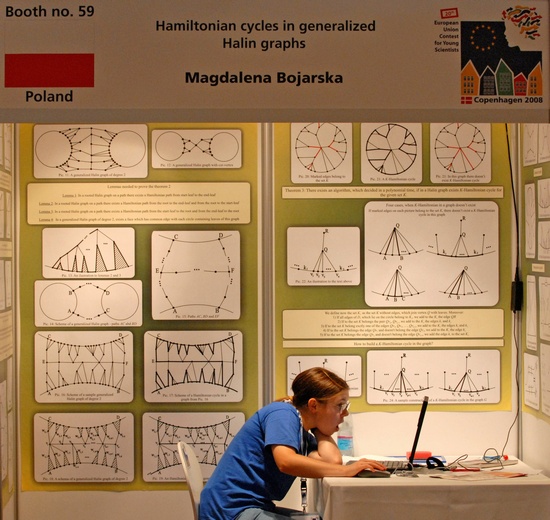

Magdalena Bojarska from Poland - “Hamiltonian cycles in generalized Halin graphs”

For decades now, cigarette makers have marketed light cigarettes, which contain less nicotine than regular smokes, with the implication that they are less harmful to smokers' health. A new UCLA study shows, however, that they deliver nearly as much nicotine to the brain.

The basic numbers would seem to bear that out the less harmful claim. Light cigarettes have nicotine levels of 0.6 to 1 milligrams, while regular cigarettes contain between 1.2 and 1.4 milligrams.

In the brain, nicotine binds to specific molecules on nerve cells called nicotinic acetylcholine receptors, or nAChRs. When nerve cells communicate, nerve impulses jump chemically across gaps between cells called synapses by means of neurotransmitters. The neurotransmitters then bind to the receptor sites on nerve cells — in the case acetylcholine resulting in the release of a pleasure-inducing chemical called dopamine. Nicotine mimics acetylcholine, but it lasts longer, releasing more dopamine. Most scientists believe that's one key reason why nicotine is so addictive.

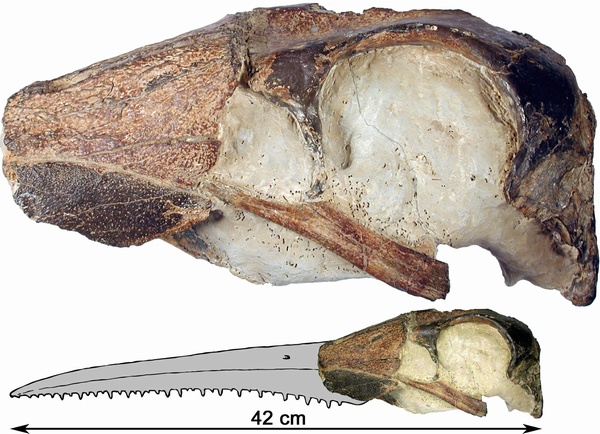
This kind of Mother Goose is no fairy tale. A 50 million year old skull reveals that huge birds with a 5 meter wingspan once skimmed across the waters that covered what is now London, Essex and Kent. These giant ocean-going relatives of ducks and geese also had a rather bizarre attribute for a bird: their beaks were lined with bony-teeth.

Described today in the journal Palaeontology, the skull belongs to Dasornis, a bony-toothed bird, or pelagornithid, and was discovered in the London Clay, which lies under much of London, Essex and northern Kent in SE England. The occurrence of bony-toothed birds in these deposits has been known for a long time, but the new fossil is one the best skulls ever found, and preserves previously unknown details of the anatomy of these strange creatures.

<

Wile E. Coyote has nothing on this guy.

Yves Rossy, aka Jet Man, zoomed into the record books this morning, flying across the English Channel strapped to a single jet-powered wing, with only a helmet and flight suit for protection.

The 22-mile (35-kilometer) France-to-England journey took 13 minutes. Bad weather had twice postponed the event this week. But this morning—with clear blue skies and a nice tailwind—turned out to be an ideal flight day for the Swiss airline pilot.

Around 2 p.m., local time, Rossy leaped from a plane abound 8,200 feet (2,500 meters) above a beach near Calais. Within seconds he had opened his wing, fired up his four miniature jet turbines, and pointed his nose toward Britain.

Scientific happenings, big and small, on this day in history

But first: today’s quiz. What inventor, who died on this day in 1902, developed and patented a highly popular (and much beloved) item of clothing in 1873? Trust me, you most likely have this item of clothing in your wardrobe, and in fact may be wearing it right now – especially since it’s Friday. The answer can be found at the end of this article.

On to other historic happenings…

17 years ago, September 26, 1991, 8 brave souls locked themselves inside a sealed dome to simulate what it would be like to live in an artificial closed ecological system.

It was called Biosphere 2 (the original 'biosphere' being Ma Earth here) and was made in Oracle, Arizona by Space Biosphere Ventures.

The idea was to learn about ecology but it ended up being about anthropology as well - as fellow Scientific Blogging scribe Jane Poynter says, they discovered that even in tiny groups, and much as they might have protested the notion in advance, they broke into factions.

Roses (genus Rosa) encompass over 100 known species. Cultivated for their fragrance and beauty, roses historically have been the center of much praise. Poets have dedicated odes to their beauty,  they have been desired by centuries of gardeners and are one of the most universal symbols, often representing love and life. As the phrase goes, sometimes you do have to “stop and smell the roses.”


Although you may think that this is just a fancy way of saying take some time to enjoy life, perhaps we have dismissed roses for too long. Seriously, you should pay more attention to those roses. They could greatly improve your life. That is, if you are one of the millions of people in the US who suffer from arthritis diseases such as Osteoarthritis and Rheumatoid Arthritis.


Results from two different arthritis studies have confirmed that an active ingredient of rose hips has been shown to protect and possibly rebuild joint tissue broken down by arthritis. The latest results, presented at the Osteoarthritis Research Society International (ORSI) World Conference in Rome, explained the mechanism of protein GOPO(R) found in rose hips. This extract, has demonstrated the ability to protect vulnerable cartilage and possibly stimulate its regeneration. GOPO(R) has also been shown to improve mood, increased energy and sleep quality of those affected by arthritis.

 pink rose

Cities are unfairly blamed for greenhouse gas emissions by misguided politicians and well-meaning people who listen to them, and this threatens efforts to truly impact climate change, warns a study in the October 2008 issue of the journal Environment and Urbanization. The paper says cities are commonly blamed for 75 to 80 percent of emissions but that the true value is around half that and the potential for cities to help address climate change is being overlooked because of this error.

United Nations agencies, former US President Bill Clinton’s climate change initiative and New York Mayor Michael Bloomberg have all claimed that between 75 and 80 per cent of emissions come from cities even though data from the Intergovernmental Panel on Climate Change (IPCC) shows that only 40 percent of all greenhouse gases are from human activities generated within cities.

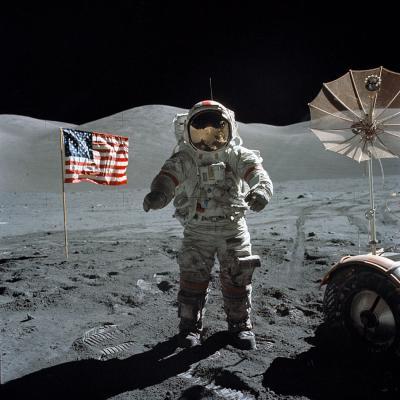
The Apollo Moon missions of 1969-1972 all share a dirty secret. "The major issue the Apollo astronauts pointed out was dust, dust, dust," says Professor Larry Taylor, Director of the Planetary Geosciences Institute at the University of Tennessee. Fine as flour and rough as sandpaper, Moon dust caused 'lunar hay fever,' problems with space suits, and dust storms in the crew cabin upon returning to space.

The trouble with moon dust stems from the strange properties of lunar soil. The powdery grey dirt is formed by micrometeorite impacts which pulverize local rocks into fine particles. The energy from these collisions melts the dirt into vapor that cools and condenses on soil particles, coating them in a glassy shell.