








Froghoppers, also known as spittlebugs, are the champion insect jumpers, capable of reaching heights of 700 mm - more than 100 times their own body length. Research published today in BMC Biology reveals that they achieve their prowess by flexing bow-like structures between their hind legs and wings and releasing the energy in one giant leap in a catapult-like action.

Images of the insects flexing and jumping are described in the research carried out by Malcolm Burrows from the University of Cambridge and his colleagues. Burrows' research focused on determining how the energy generated by the insects' muscles is stored before powering a jump.

He said, "A froghopper stores energy by bending a paired bow-shaped part of its internal skeleton called a 'pleural arch' which is a composite structure made of layers of hard cuticle and a rubbery protein called resilin. When the froghopper contracts its muscles to jump, these arches flex like a composite archery bow, and then on recoil catapult it forwards with a force that can be over 400 times its body mass."

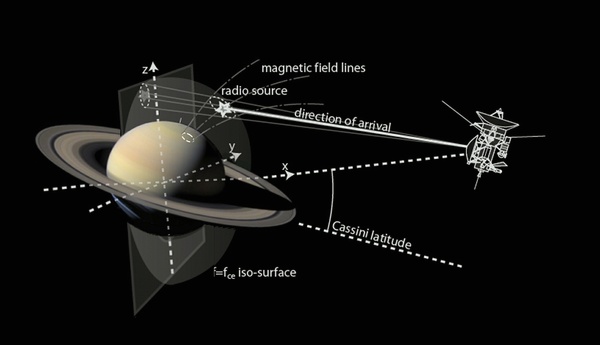
Observations from NASA’s Cassini spacecraft have been used to build, for the first time, a 3-D picture of the sources of intense radio emissions in Saturn’s magnetic field, known as the Saturn Kilometric Radiation (SKR).

Saturn Kilometric Radiation is the most intense component of radio emissions from Saturn. It was discovered by NASA’s Voyager spacecraft in 1980. The radio emissions have frequencies between about 10 kilohertz and 1.2 megahertz. This corresponds to the Long Wave and Medium Wave broadcasting bands.

The results were presented by Dr Baptist Cecconi, of LESIA, Observatoire de Paris, at the European Planetary Science Congress on Tuesday 23rd September.

The SKR radio emissions are generated by high-energy electrons spiralling around magnetic field lines threaded through Saturn’s auroras. Previous Cassini observations have shown that the SKR is closely correlated with the intensity of Saturn’s UV aurora and the pressure of the solar wind.

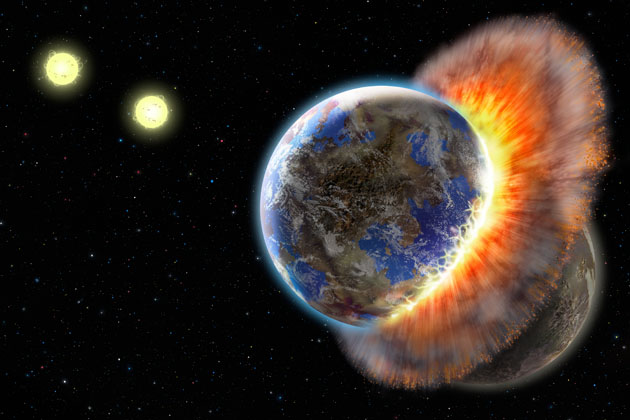
Two terrestrial planets in orbit around a sun-like star, BD +20 307, recently suffered a violent collision, astronomers at University of California Los Angeles, Tennessee State University, and California Institute of Technology will report in a December issue of the Astrophysical Journal, the premier journal of astronomy and astrophysics.

“It’s as if Earth and Venus collided with each other,” said Benjamin Zuckerman, UCLA professor of physics and astronomy and a co-author on the paper. “Astronomers have never seen anything like this before; apparently major, catastrophic, collisions can take place in a fully mature planetary system.”

After several years of detective work, philologists at the University of Stavanger in Norway have collected a unique collection of texts online and they're about to start the most comprehensive analysis of middle English ever.

During the last few years, associate professor Merja Stenroos and post doctor Martti Mäkinen at the University of Stavanger have travelled around Britain and read original handwritten leather manuscripts from the 1300s–1500s.

"It is as natural for us in Stavanger to research Middle English as it is for English researchers. None of us have this language as our mother tongue anyway, says Merja Stenroos, who is managing the project titled MEG - Middle English Grammar.

 Merja Stenroos Martti Mäkinen  15th century Book of Hours Folio

Whether young people get drunk as a purposeful behavior or as an unintended consequence depends on what country they live in, according to new research on young people in seven countries. The research finds that young people's views on alcohol and drunkenness were influenced more by culture than by factors such as age and sex.

The research, sponsored by the International Center for Alcohol Policies (ICAP), also finds striking similarities about drinking among young people in different parts of the world including:

A nesting behavior study has detailed some previously unconsidered effects of biodiversity loss and climate change - changing seabird biodiversity is resulting in more ammonia in the atmosphere.

Ammonia emissions from seabirds have been shown to be a significant source of nitrogen in remote coastal ecosystems, contributing to nutrient enrichment (eutrophication) and acidification. While most ammonia emissions originate from domesticated animals such as poultry and pigs, seabirds are the most significant emitters of ammonia to the atmosphere in remote regions.

Emerson looked forward to the day when America would be self-reliant and not second rate in its scholarship. In science, the U.S. has fulfilled Emerson's ambition, but at what cost to religion?

Physicist Steven Weinberg muses on religion's fate in the West as science has come to dominate our culture:

Let's grant that science and religion are not incompatible—there are after all some (though not many) excellent scientists, like Charles Townes and Francis Collins, who have strong religious beliefs. Still, I think that between science and religion there is, if not an incompatibility, at least what the philosopher Susan Haack has called a tension, that has been gradually weakening serious religious belief, especially in the West, where science has been most advanced. Here I would like to trace out some of the sources of this tension, and then offer a few remarks about the very difficult question raised by the consequent decline of belief, the question of how it will be possible to live without God.

The nation’s economy is in deep trouble, which means financial woes all over the world, with millions of people affected. President Bush is hardly appearing in the news, as apparently “the Decider” has nothing to say about a disaster whose slow but sure build-up his so called administration has presided over for the last eight years. To compound disaster with disaster, the Treasury Department isn’t just trying to help by saddling the taxpayers with the sins of Wall Street; no, in perfect Bush style, Secretary Paulson is seeking to obtain from Congress -- and retain in perpetuity for his successors -- unfettered authority to intervene in the markets with essentially no oversight by the legislative branch.

Throughout all this, David Sloan Wilson and Larry Arnhart have been debating whether evolutionary theory favors government regulation or not. What on earth does evolutionary theory have to do with the global economy, one might reasonably ask?

This story caught my eye because of the 'ew' factor, so naturally I wanted to share my newfound fear of catheters (which already took up a healthy amount of time during my daily phobia-pondering) with you all. Misery loves company, so I assume that stands true for other negatively connotated emotions like disgust, fear of microbes, etc.

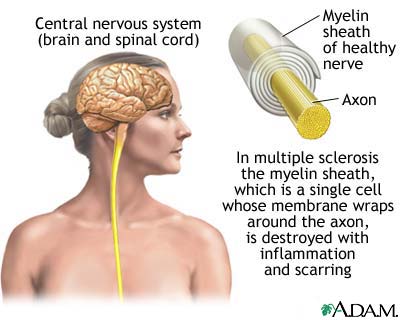
Imagine waking up but not being able to get out of bed. One day you are enjoying life to the fullest, but within a couple of years, you cannot walk unassisted.  You lose track of where you are and what you are doing while your muscles refuse to cooperate with your brain.

This is a likely scenario if you are one of the millions of people worldwide that suffer from Multiple Sclerosis (MS). Characterized by the destruction of insulation (myelin) around the nervous system, MS is one of the world’s most debilitating diseases.

