



No collisions and no beams either next week at the Large Hadron Collider (LHC). The BBC reported a quench of about 100 superconducting magnets yesterday that heated up as much as 100 Celsius. A ton of liquid helium spilled into the tunnel and the CERN fire brigade went in. Cause of the quenching has not been announced, nor have any injuries been reported.

The fault does not pose any longer-term threat to the LHC. The quench occurred during final testing of the last of the LHC's electrical circuits. Liquid helium leaks vaporize back to a gas almost instantly and would freeze or choke personnel present but no workers were at risk, according to CERN, the European Organization for Nuclear Research, which runs the LHC.

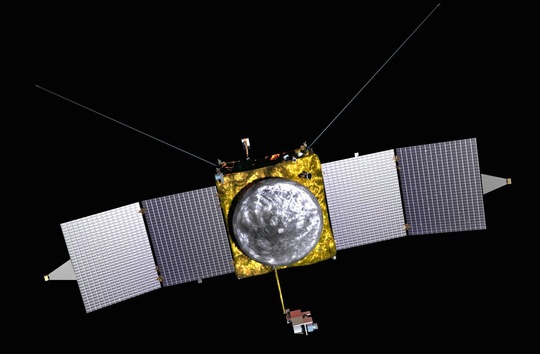
A new proposed spacecraft named MAVEN (Mars Atmosphere and Volatile EvolutioN) is expected to be launched in 2013, a $485 million mission to collect atmospheric data on Mars. The purpose of the NASA’s Mars Exploration Program is to gain further knowledge on the history of the planet’s climate and atmosphere, as well as the planet’s availability of water and its future habitability.

Chemical clues from a comet’s halo are challenging common views about the history and evolution of the solar system and showing it may be more mixed-up than previously thought. A new analysis of dust from the comet Wild 2, collected in 2004 by NASA’s Stardust mission, has revealed an oxygen isotope signature that suggests an unexpected mingling of rocky material between the center and edges of the solar system. Despite the comet’s birth in the icy reaches of outer space beyond Pluto, tiny crystals collected from its halo appear to have been forged in the hotter interior, much closer to the sun.

The result counters the idea that the material that formed the solar system billions of years ago has remained trapped in orbits around the sun. Instead, the new study in Science suggests that cosmic material from asteroid belts between Mars and Jupiter can migrate outward in the solar system and mix with the more primitive materials found at the fringes.

For a long time scientists have been puzzled by the fact that the immune system in the gut is capable of fighting toxic bacterial infection while staying, at the same time, tolerant to its resident “friendly” bacteria. But an article now published in the journal Cell Host & Microbe(1) is starting to open the door to this mystery by revealing how a recently discovered gene - pims – is activated by the gut immune response against friendly bacteria to rapidly suppress it, effectively creating tolerance to the gut microbiota. In the same way pims is also shown to control the magnitude of immune responses against toxic bacteria by suppressing immuno-reactivity when a certain activation threshold is achieved, assuring, in this way, that the response stays restricted to the infection site and is proportional to the extent of the infection. These results suggest that the balance tolerance/immuno-reaction in the gut is achieved through self-regulatory cycles where suppression by negative regulators, such as pims, is triggered as soon as a specific threshold of immuno activation is reached.

High blood pressure (hypertension) is one of the most prevalent diseases in the United States. The American Heart Association estimates that high blood pressure affects approximately one in three adults in the US. Genetics and a diet of foods high in fat and saturated with salt underlie the resulting 73 million people suffering from hypertension in the US. As a result, they have a greatly increased risk of heart disease, kidney disease, atherosclerosis, eye damage and stroke. These complications can result in permanent organ damage and death.

Blood pressure is intricately linked to salt and water balance in the body, which is controlled by the kidneys. More salt equals more water and fluid in the kidneys and therefore in the arteries. This causes an increase in overall blood pressure due to increased fluid mass. Furthermore, certain salt ions are linked in cells. Sodium and potassium are commonly linked ions which travel in and out of cells conducted by specific ion channels. The ion charges inside or outside of the cell create a electrical charge which then control physiological outcomes including neuronal impulses and hormonal and muscle controlling cells.

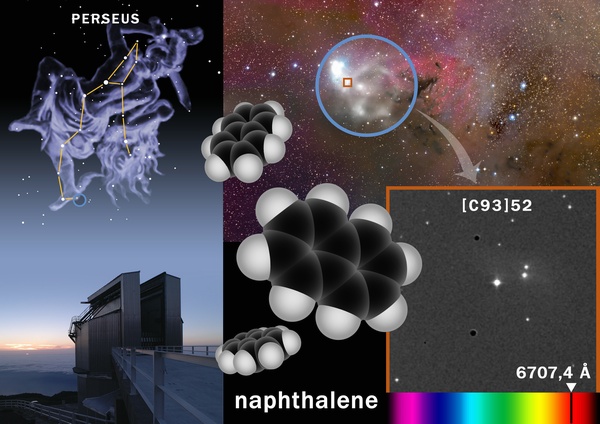
Naphthalene molecules, in combination with water, ammonia and ultraviolet radiation, produce many of the amino acids fundamental to the development of life.

A team of scientists led by researchers from the Instituto Astrofísica de Canarias (IAC) has succeeded in identifying naphthalene in a star formation region in the constellation Perseus, in the direction of the star Cernis 52.

This means a large number of the key components in prebiotic terrestrial chemistry could have been present in the interstellar matter from which the Solar System was formed.


Using various telescopes in La Palma and Texas, IAC researchers have detected the pr

Pirates, like gangsters, highwayman, and other colorful outlaws, have always carried a certain romantic appeal and, thanks to "Pirates of the Caribbean", they are the most appealing of the outlaws at this moment.

In a swashbuckling article for the Journal of Political Economy, Peter Leeson explored the fascinating “golden age” of piracy during the late seventeenth and early eighteenth centuries and finds that these criminal organizations were able to establish a remarkably stable form of self-government.

Identity thieves can learn a lot about you from your trash and so it goes that a cell's "trash" can yield treasures for biologists.

Using a new technique they developed, scientists at University of Delaware's Delaware Biotechnology Institute analyzed the cellular waste of one of the world's most-studied plants and discovered formerly hidden relationships between genes and the small molecules that can turn them off.

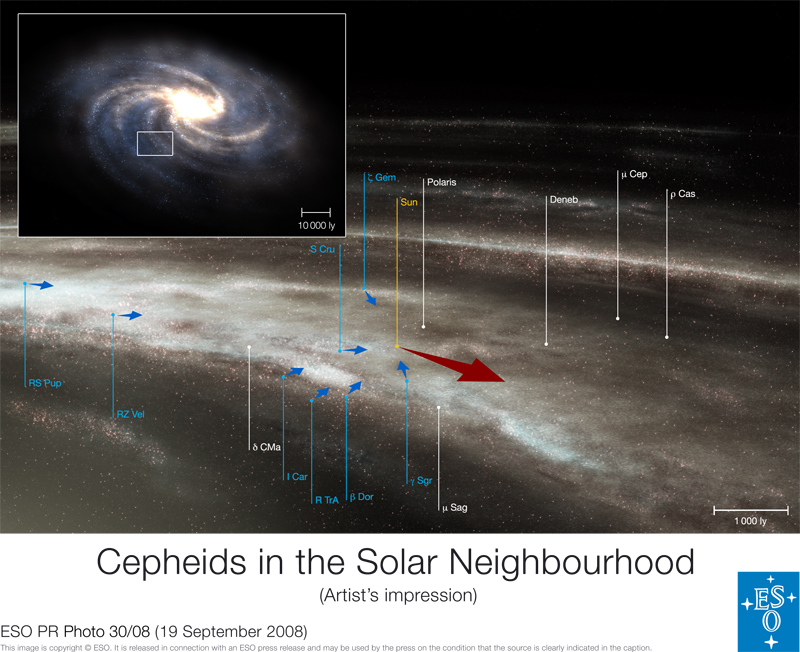
Precise measurements by the ESO instrument HARPS now show that the rotation of the Milky Way is simpler than previously thought - the much debated, apparent 'fall' of neighborhood Cepheid stars towards our Sun stems from an intrinsic property of the Cepheids themselves, say a group of astrophysicists led by Nicolas Nardetto in a Astronomy & Astrophysics article.

Since Henrietta Leavitt's discovery of their unique properties in 1912, the class of bright, pulsating stars known as Cepheids has been used as a distance indicator. Combined with velocity measurements, the properties of Cepheids are also an extremely valuable tool in investigations of how our galaxy, the Milky Way, rotates.

"The motion of Milky Way Cepheids is confusing and has led to disagreement among researchers," says Nardetto. "If the rotation of the Galaxy is taken into account, the Cepheids appear to 'fall' towards the Sun with a mean velocity of about 2 km/s."

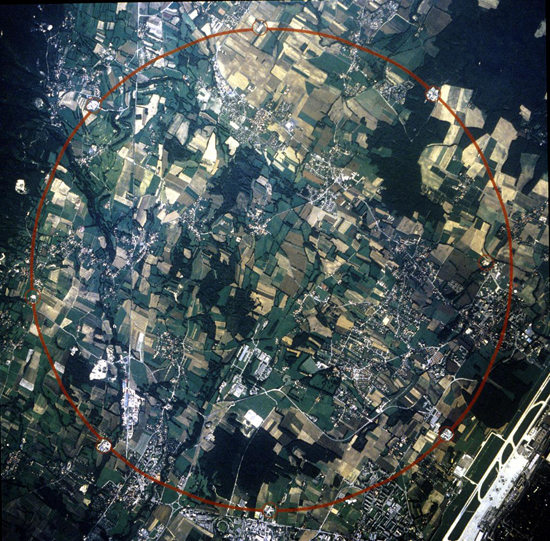
Nature had her own ideas about testing the Large Hadron Collider(LHC) near Geneva last Friday. A thunderstorm knocked out some transformers that are part of the helium cooling system, which cools the magnets that keep the proton beams travelling at near light speed on a circular path through the collider. Technicians have been scrambling to fix the problems, but not before some magnets warmed well above standard operating temperatures, some reaching almost 7K from the usual ultra-cold 1.9K . Electromagnets at the LHC need to be this cold to be superconducting, or at peak efficiency, in order to deliver extremely high magnetic fields in the 27 km ring of 1200 giant magnets and thousands of smaller ones, at 8.33 Teslas or about 200,000 times the earth's magnetic field strength.

