The F-35 is a supersonic, multi-role, 5th generation stealth fighter. Three F-35 variants derived from a common design, developed together and using the same sustainment infrastructure worldwide, will replace at least 13 types of aircraft for 11 nations initially, making the Lightning II the most economical fighter program in history.

The program is on schedule to deliver aircraft to the U.S. military services beginning in 2010. The first test aircraft has completed 35 flights and has exceeded performance expectations. The inaugural flight of the first short takeoff/vertical landing F-35B is on schedule for mid-2008. All 19 test aircraft are in production flow or on the flightline, and assembly has begun on the first two production F-35s.

You thought psychological counselling for pets was the last word in over-indulgent animal concern?

Not so. Thanks to Dr. Susan Nelson, a veterinarian at Kansas State University, you can get a blood test, "Wisdom panel MX", that can determine the heritage of the family dog.

That's right, your dog could turn out to be related to William Wallace's dog.

A few days ago the internet was abuzz with shocking headlines because the gentleman behind 'virtual water', professor John Anthony Allan of King’s College London, got an award from a water conservation group, the Stockholm International Water Institute (SIWI) for his work on advocating water conservation. Reading the news clippings about it, you'd have thought it was a Nobel prize for perpetual motion.

Perpetual motion is a good analogy. Generally, if you see something too ridiculous to be true, it's probably not true. A few weeks ago, for example, a VA Tech grad student got a prize for a 'gravity lamp' that was just the kind of alcohol-and-magic-fueled hocus-pocus that sets the internet on fire. It was green energy and cool tech all rolled into one. Except it didn't exist. Rather than being able to power a household bulb for hours, even an unsuitably-large one could only power a tiny 0.1-watt LED for 45 minutes. It's just physics.

So a few days ago people were aghast and outraged when they saw a number stating that 34 gallons of 'virtual water' went into a cup of coffee. I understand their panic. That means we only have about 9,588,235,294,117,647 cups of coffee left before all the water is gone.(1)
A few days ago the internet was abuzz with shocking headlines because the gentleman behind 'virtual water', professor John Anthony Allan of King’s College London, got an award from a water conservation group, the Stockholm International Water Institute (SIWI) for his work on advocating water conservation. Reading the news clippings about it, you'd have thought it was a Nobel prize for perpetual motion.

Perpetual motion is a good analogy. Generally, if you see something too ridiculous to be true, it's probably not true. A few weeks ago, for example, a VA Tech grad student got a prize for a 'gravity lamp' that was just the kind of alcohol-and-magic-fueled hocus-pocus that sets the internet on fire. It was green energy and cool tech all rolled into one. Except it didn't exist. Rather than being able to power a household bulb for hours, even an unsuitably-large one could only power a tiny 0.1-watt LED for 45 minutes. It's just physics.

So a few days ago people were aghast and outraged when they saw a number stating that 34 gallons of 'virtual water' went into a cup of coffee. I understand their panic. That means we only have about 9,588,235,294,117,647 cups of coffee left before all the water is gone.(1)

The tests for testosterone doping used in professional and amateur sports may routinely be confounded by a common genetic variation, according to a new study. Unless this variation is accounted for, current testing methods could implicate innocent athletes and allow cheaters to go undetected.

“Genetic factors may play an important role in the accuracy and sensitivity of testosterone doping tests,” said Jenny J. Schulze, Ph.D, of the Karolinska University Hospital in Stockholm, and lead author of the study. “This is of interest not only for combating androgen doping in sports, but also for detecting and preventing androgen abuse in society.”

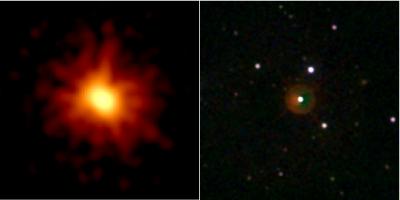
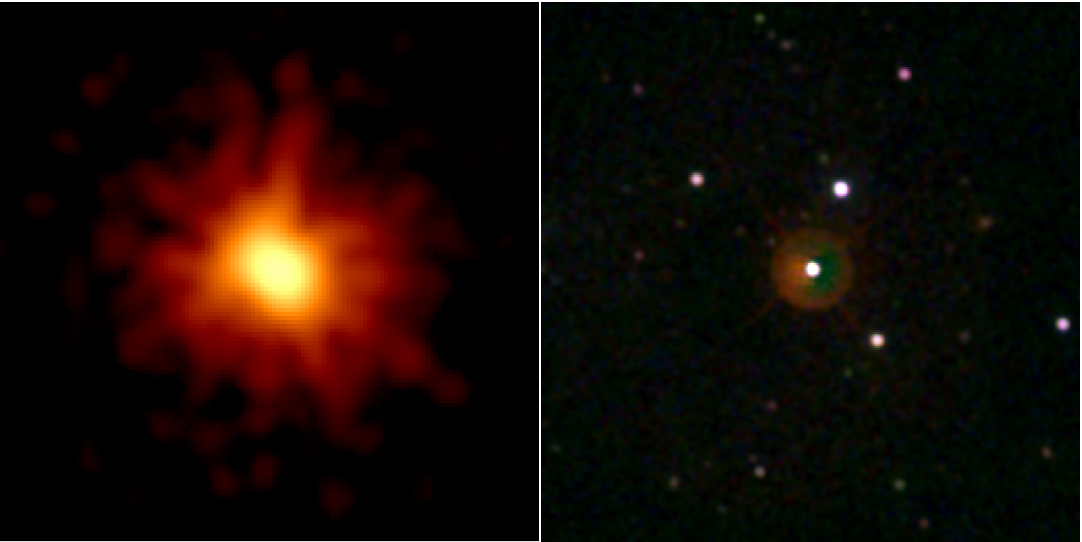
As Georg von Hippel wrote about here, a powerful stellar explosion detected March 19 by NASA's Swift satellite has shattered the record for the most distant object that could be seen with the naked eye.

The explosion was a gamma ray burst. The Very Large Telescope in Chile and the Hobby-Eberly Telescope in Texas measured the burst's redshift at 0.94. A redshift is a measure of the distance to an object. A redshift of 0.94 translates into a distance of 7.5 billion light years, meaning the explosion took place 7.5 billion years ago, a time when the universe was less than half its current age and Earth had yet to form. This is more than halfway across the visible universe.


CLICK ABOVE FOR LARGER IMAGE. The extremely luminous afterglow of GRB 080319B was imaged by Swift's X-ray Telescope (left) and Optical/Ultraviolet Telescope (right). This was by far the brightest gamma-ray burst afterglow ever seen - and from 7.5 billion light years away. Credit: NASA/Swift/Stefan Immler, et al.

Located at the University of Utah, the High Resolution Fly's Eye (HiRes) is an experiment to study the highest energy cosmic rays to determine the energy, direction, and chemical composition of the incident particle.

Final results show that the most energetic particles in the universe rarely reach Earth at full strength because they come from great distances, so most of them collide with radiation left over from the birth of the universe.

The findings are based on nine years of observations at the now-shuttered observatory on the U.S. Army’s Dugway Proving Ground. They confirm a 42-year-old prediction – known as the Greisen-Zatsepin-Kuzmin (GZK) “cutoff,” “limit” or “suppression” – about the behavior of ultrahigh-energy cosmic rays, which carry more energy than any other known particle.

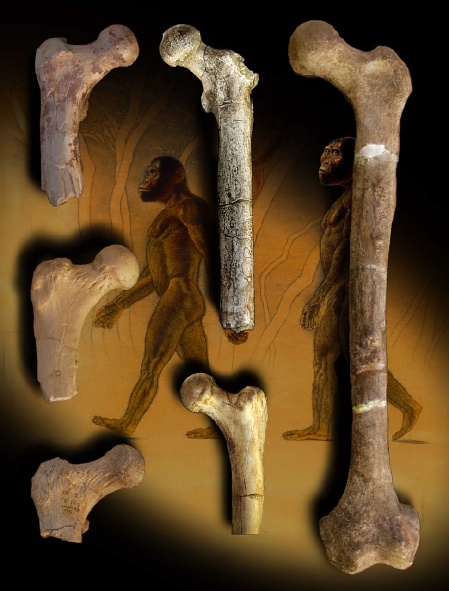
A shape comparison of the most complete fossil femur (thigh bone) of one of the earliest known pre-humans, or hominins, with the femora of living apes, modern humans and other fossils, indicates the earliest form of bipedalism occurred at least six million years ago and persisted for at least four million years.

William Jungers, Ph.D., of Stony Brook University, and Brian Richmond, Ph.D., of George Washington University, say their finding indicates that the fossil belongs to very early human ancestors, and that upright walking is one of the first human characteristics to appear in our lineage, right after the split between human and chimpanzee lineages.


Early human upright walking. A 6 million-yea- old thighbone, or femur (center), represents an upright walker of one of the earliest human ancestors (Orrorin), and resembles 2-3 million year old thighbones of australopiths (left, bottom). Thighbones of Homo (right) mark a transition toward a more modern gait about 2 million years ago. Credit: artwork and composite byJohn Gurche, photograph by Brian Richmond.

A cheap alternative to silicon solar cells can be found in dye-sensitized solar cells. This type of cell imitates the natural conversion of sunlight into energy by plants and light-sensitive bacteria. Annemarie Huijser has succeeded in substantially improving a process in this type of solar cell, which is similar to Grätzel cells.

The use of solar cells is increasing very slowly. One of the reasons is that the most commonly used type, made from silicon, is quite expensive to manufacture. That is why there has been a great deal of research into alternative solar cells over the past few years.

MANCHESTER, England, March 20 /PRNewswire/ --

- ATTN: Northern Region Editors

Two leading skincare experts will be alerting adults in and around Manchester to the signs and symptoms of rosacea and how to regain control of their skin as part of an evening event called 'Beyond the Red Face - Positive ways of living with rosacea' at the Manchester Conference Centre.

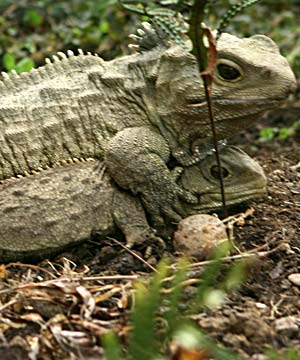
The tuatara, Sphendon punctatus, is found only in New Zealand and is the only surviving member of a distinct reptilian order Sphehodontia that lived alongside early dinosaurs and separated from other reptiles 200 million years ago in the Upper Triassic period.

In a study of New Zealand’s “living dinosaur”, evolutionary biologist David Lambert and his team recovered DNA sequences from the bones of ancient tuatara, which are up to 8000 years old. They found that, although tuatara have remained largely physically unchanged over very long periods of evolution, they are evolving - at a DNA level - faster than any other animal yet examined.


My 200 million years here proves that this is the oldest pasttime.