




When did rabbits and hares diverge in evolution? The answer just got a little clearer. Last spring, Johns Hopkins anatomy professor Kenneth Rose was displaying the bones of a jackrabbit’s foot as part of a seminar when he noticed something familiar about the shape of the bones.

That led to the discovery of the oldest known record of rabbits. The fossil evidence in hand, found in west-central India, predates the oldest previously known rabbits by several million years and extends the record of the whole category of the animal on the Indian subcontinent by 35 million years.

A lemur is a monkey-like animal with a long tail and large eyes. Analysis of the first hand bones belonging to an ancient lemur has revealed a mysterious joint structure that has scientists puzzled.

Pierre Lemelin, an assistant professor of anatomy at the University of Alberta in Edmonton, Canada, and a team of fellow American researchers have analyzed the first hand bones ever found of Hadropithecus stenognathus, a lemur that lived 2,000 years ago.

The bones were discovered in 2003 in a cave in southeastern Madagascar, an island nation off the coast of Africa in the Indian Ocean. Hadropithecus is related to the modern-day sifaka, a type of lemur with acrobatic leaping skills.


The first handbones found of the ancient Hadropithecus lemur reveal a mystery arch by the little finger. Credit: Photo by Dr. Pierre Lemelin, University of Alberta.

LAUSANNE, Switzerland, March 19 /PRNewswire/ --

Galderma Pharma S.A., a global specialty pharmaceutical company focused on dermatology, today announced that its U.S. holding company, Galderma Laboratories, Inc., has received clearance from the U.S. Federal Trade Commission, through the expiration of the required waiting period under the Hart-Scott-Rodino Antitrust Improvements Act, for its proposed acquisition of CollaGenex (Nasdaq: CGPI).

Life on another planet? No, it's far too hot on HD 189733b for that, but the Hubble Space Telescope's first ever detection of an organic molecule in the atmosphere of a planet orbiting another star is big news. It's an important step in eventually identifying signs of life on a planet outside our Solar System.

Hubble found the tell-tale signature of methane in the atmosphere of the Jupiter-sized extrasolar planet HD 189733b. Under the right circumstances, methane can play a key role in prebiotic chemistry – the chemical reactions considered necessary to form life as we know it. Although methane has been detected on most of the planets in our Solar System, this is the first time any organic molecule has been detected on a world orbiting another star.

LONDON, March 19 /PRNewswire/ -- NHS Choices (http://www.nhs.uk), the digital 'front door' to the NHS launches a new Good Food package aimed to help people achieve a healthy, tasty and satisfying diet, and an improved knowledge of the nutritional content of the food we eat.

Based on NHS accredited information, the Live Well package (http://www.nhs.uk/Livewell/loseweight/Pages/Goodfoodhomehome.aspx) enables users to access reliable and information on good food and healthy diet in seconds, and provides them with clinically approved guidance on achieving a healthy and satisfying diet via informed nutritional choices. This Live Well bundle is one among a range of new additions to the NHS Choices' extensive Live Well section.

In oceanography studies, the iron needed to fertilize infrequent plankton blooms in High Nutrient, Low Chlorophyll (HNLC) regions was assumed to come almost entirely from wind-blown dust.

That's not the case in the North Pacific, say Phoebe Lam and James Bishop of the Earth Sciences Division at the Department of Energy's Lawrence Berkeley National Laboratory

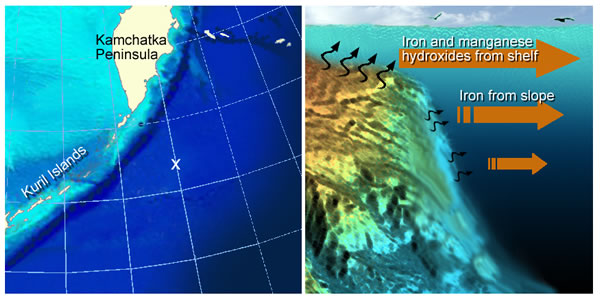
They report that the key source of iron in the Western North Pacific is not dust but the volcanic continental margins of the Kamchatka Peninsula and the Kuril Islands.


From a site at 47 degrees north latitude and 160 degrees east longitude in the Western North Pacific (marked X), iron and manganese found at depths of 100-200 meters originated hundreds of miles away, from the continental shelves of the Kamchatka Peninsula and Kuril Islands. Particulate and dissolved iron and manganese hydroxides came from the upper shelf, and, after further processing, more iron (now poor in manganese) came from deeper on the slopes.

GAINESVILLE, Florida, March 19 /PRNewswire/ --

The Institute for Public Relations today introduced the Essential Knowledge Project, an online guide to the best research into how organizations build and manage relationships with customers, communities, employees and other stakeholders.

"There is science beneath the art of public relations -- a tremendous amount of research conducted over the years on all aspects of creating and sustaining public opinion, attitudes and relationships," said Frank Ovaitt, Institute president and CEO. "Our goal is to make that knowledge more accessible not only to public relations professionals, but also to the stakeholders they serve."

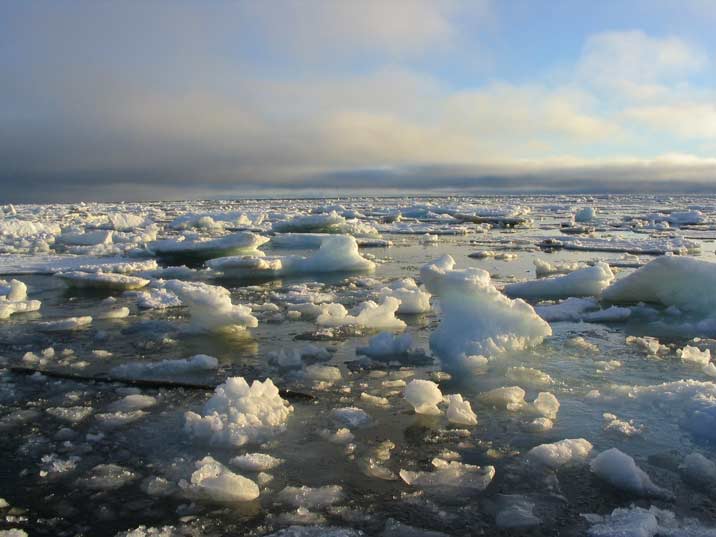
The Arctic - pristine natural wilderness, unmolested by human touch? Not really. While early explorers claimed they could see 200 KM mountain peaks that certainly isn't the case today. In winter months, the Arctic actually has some of the dirtiest air in the world. It turns out even those early explorers may have been romanticizing the cleanliness a bit.

Scientists know that air pollution particles from mid-latitude cities migrate to the Arctic and form an ugly haze, but a new University of Utah study finds surprising evidence that polar explorers saw the same phenomenon as early as 1870.

“The reaction from some colleagues – when we first mentioned that people had seen haze in the late 1800s – was that it was crazy,” says Tim Garrett, assistant professor of meteorology and senior author of the study. “Who would have thought the Arctic could be so polluted back then? Our instinctive reaction is to believe the world was a cleaner place 130 years ago.”


Arctic haze. The most visible sign of Arctic pollution was documented over a century ago by both explorers and natives. Source: unknown. Credit: Columbia university

OAK PARK, Michigan, March 19 /PRNewswire/ -- Azure Dynamics Corporation (TSX: AZD) (LSE: ADC) ("Azure") a leading developer of hybrid electric and electric powertrains for commercial vehicles, today announced it has signed a Memorandum of Understanding (MOU) with a leading manufacturer of aerial boom trucks for the electric utility, telecommunications and contractor markets. The MOU includes the branding, marketing and sale of Azure's Low Emission Electric Power ("LEEP") systems within the electric utility and telecom markets.

LONDON, March 19 /PRNewswire/ -- Solcara, the market-leading provider of software for the control, management and searching of digital information, has been helping AstraZeneca manage its interactions with the media through the use of Solcara Communications Centre.

AstraZeneca, one of the world's leading pharmaceutical companies, is a truly international company, and is active in over 100 countries, with its corporate office in London and major Research & Development (R&D) sites in Sweden, the UK and US. AstraZeneca's media relations team wanted a system that would create an accessible international benchmark for consistent media relations across all continents.

