


A new study published in The Journal of Finance explores the economic significance of “smart money” in the U.S. and U.K. mutual fund marketplaces.

The “Smart Money” hypothesis states that investor money is “smart” enough to flow to funds that will outperform in the future, and that investors have genuine fund selection ability. The current study employs a British data set of monthly fund information differentiated between individual and institutional investors.

Research by Aneel Keswani at the Cass Business School in London, England, and David Stolin at the Toulouse Business School in Toulouse, France, documented a smart money effect in the United Kingdom using monthly data available from 1991 to 2000. Inflows, not outflows, gave rise to the smart money effect in the U.K.

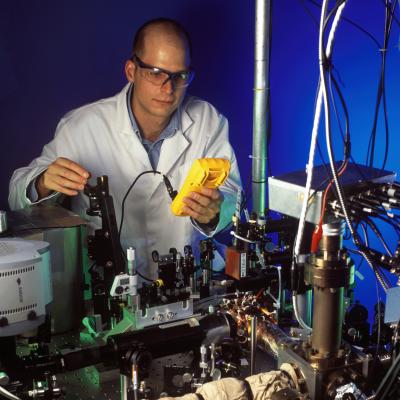
An atomic clock that uses an aluminum atom to apply the logic of computers to the peculiarities of the quantum world now rivals the world's most accurate clock, based on a single mercury atom. Both clocks are at least 10 times more accurate than the current U.S. time standard.

The measurements were made in a yearlong comparison of the two next-generation clocks, both designed and built at the Commerce Department's National Institute of Standards and Technology (NIST). The clocks were compared with record precision, allowing scientists to measure the relative frequencies of the two clocks to 17 digits-the most accurate measurement of this type ever made.

The method to the madness of quasicrystals has been a mystery to scientists. Quasicrystals are solids whose atoms aren't arranged in a repeating pattern, as they are in ordinary crystals. Yet they form intricate patterns that are technologically useful.

A computer simulation performed by University of Michigan scientists has given new insights into how this unique class of solids forms. Quasicrystals incorporate clusters of atoms as they are, without rearranging them as regular crystals do, said Sharon Glotzer, a professor in the Department of Chemical Engineering.

SAO PAULO, Brazil, March 6 /PRNewswire/ --

- Increase in installed capacity resulted in growth of 62.1% in generation EBITDA, which reached R$ 442.0 million

EDP - ENERGIAS DO BRASIL S.A. ("Energias do Brasil" or "Group") (Bovespa: ENBR3), a holding company in the electric utilities sector trading on Bovespa's Novo Mercado, today announces its results for the fiscal year 2007. The information is presented on a consolidated basis in accordance with Brazilian Corporate Law and is based on reviewed financial information. The independent auditors did not review the operating information. Amounts are expressed in thousands of Reais, except where otherwise stated.

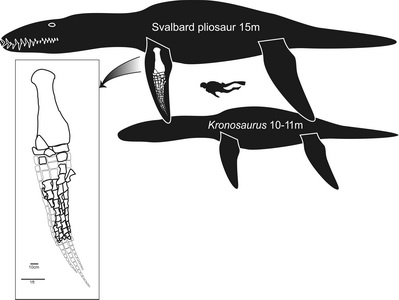
A pliosaur is a type of plesiosaur, a group of extinct reptiles that lived in the world's oceans 205-65 million years ago. Pliosaurs are characterized by tear-drop shaped bodies with two pairs of powerful flippers used to propel them through the water. They were top predators during their day, preying upon fish, squid-like animals and other marine reptiles. They averaged 16-20 feet in length with flippers 3-4 feet long.

One of the largest known pliosaurs, the Australian Kronosaurus, measures 33-36 feet long with 6-foot-long flippers. By comparison, the the 150-million-year-old Svalbard specimen discovered in 2006 and analyzed at the Natural History Museum at the University of Oslo has been nicknamed "The Monster" because it is perhaps the largest ever found.

Scientists have solved a 40-year-old puzzle by identifying the origin of the intense radio waves in the Earth's upper atmosphere that control the dynamics of the Van Allen radiation belts — belts consisting of high-energy electrons that can damage satellites and spacecraft and pose a risk to astronauts performing activities outside their spacecraft.

The source of these low-frequency radio waves, which are known as plasmaspheric hiss, turns out to be not lightning or instabilities from a plasma, as previously proposed, but an intense electromagnetic wave type called "chorus," which energizes electrons and was initially thought to be unrelated to hiss, said Jacob Bortnik, a researcher with the UCLA Department of Atmospheric and Oceanic Sciences.

A destructive spring freeze that chilled the eastern United States almost a year ago illustrates the threat a warming climate poses to plants and crops, according to a paper just published in the journal BioScience. The study was led by a team from the Department of Energy's Oak Ridge National Laboratory.

The "Easter freeze" of April 5-9, 2007, blew in on an ill wind. Plants had been sending out young and tender sprouts two to three weeks earlier than normal during an unusually warm March. Plant ecologists, as well as farmers and gardeners, took note of the particularly harsh turn of the weather in early April.

"The warm weather was as much a culprit for the damage as the cold," said lead author Lianhong Gu of ORNL's Environmental Sciences Division.

Plant leaves are photosynthetic organs. Their main job is to harvest energy from sunlight, and use that energy to convert carbon dioxide and water into carbohydrates. In addition to capturing sunlight, leaves need to be good at doing two other things - taking up carbon dioxide and conserving water. These requirements conflict - anything that lets carbon dioxide in also lets water out. To deal with these conflicting requirements, plants produce a waterproof cuticle and regulate carbon dioxide uptake by opening and closing their stomata.

Modern diesel cars are quieter than their predecessors but also release considerably fewer exhaust fumes into the atmosphere.

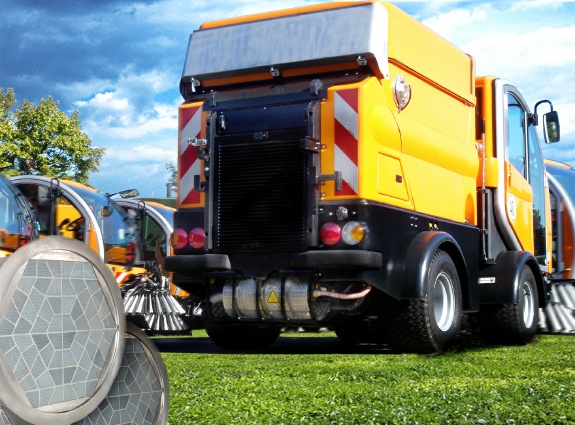
But the real culprit in diesel are heavy-duty, construction and off-road vehicles - they're often special vehicles made in small batches and each requires a different filter geometry. The filters for are not yet state-of-the-art. A new diesel particulate filter technology will soon teach even these vehicles to give up smoking.

Conventional diesel soot filters usually consist of cylindrical ceramic blocks crisscrossed by numerous channels. A block of this kind cannot be made in one piece. Instead, individual quadratic honeycomb segments are bonded together to form a large block.

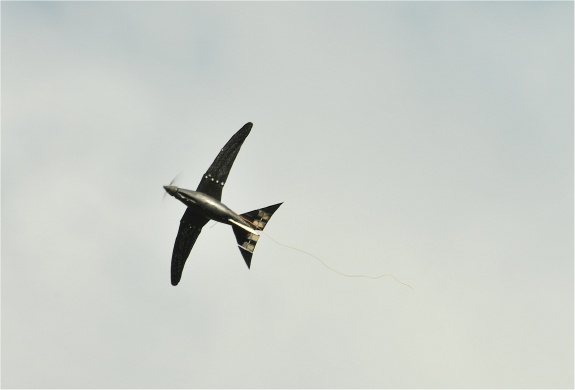
The RoboSwift micro-aircraft has made its first flight. The small, quiet plane is equipped with observation cameras that can be used in the future to study birds or to conduct surveillance of groups of people or vehicles.

The RoboSwift is characterised by the continuously variable shape of its wings, known as ‘morphing' wings, which are modelled on the wings of the swift bird. These wings make the aircraft, like its living model, very maneuverable and efficient. As a result, the RoboSwift is the first aircraft in the world to have the wing properties of living birds. Wind tunnel tests have shown that it can come remarkably close to the exceptional flying ability of the swift.

