





Eight-year-old boys dream of being superheroes - flying high above the clouds with nothing to limit themselves but their imaginations - and Danner Cronise got his dream, courtesy of his dad, Ray, co-founder of Zero Gravity Corporation. In the process he set the record as the youngest person to experience zero-gravity flight.

Danner was joined by his father Ray, and older sisters Erin (10) and Alex (12). A NASA engineer for more than 15 years, Ray Cronise had a unique and personal reason for wanting to see his children enjoy weightlessness first hand. "It is awe inspiring to be able to take your kids on such a memorable experience. Being exposed to these kinds of adventures kindles curiosity and keeps them dreaming," said Ray.

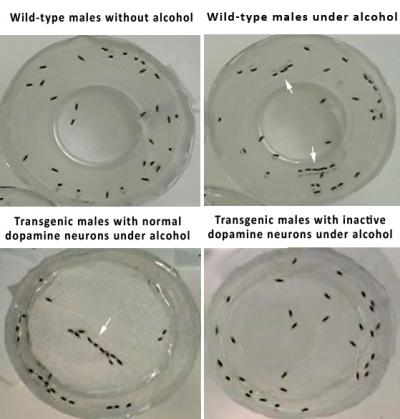
A team of researchers at Penn Sate has used an animal model to reveal, for the first time, a physiological basis for the effect of alcohol on male sexual behavior, including increased sexual arousal and decreased sexual inhibition.

The research in PLoS ONE resulted in four novel findings with broad importance for further addiction research. It is the first study to characterize the effects of chronic alcohol exposure in fruit flies. "Physiological evidence supporting various theories about the effect of alcoholic drinks has been lacking, so our now having a suitable animal model makes it possible to conduct much-needed laboratory research on this issue," explains research-team-leader Kyung-An Han, associate professor of biology and a neuroscientist at Penn State.

A glitch in the mechanism by which cells recycle damaged components may trigger Parkinson’s disease, according to a study by scientists at the Albert Einstein College of Medicine of Yeshiva University. The research appears in The Journal of Clinical Investigation and could lead to new strategies for treating Parkinson’s and other neurodegenerative diseases.

All cells depend on a surveillance system known as autophagy (which literally means “self eating”) to digest and recycle the damaged molecules that arise as cells age. In autophagy, defective proteins and other molecules are transported to membrane-bound sacs called lysosomes. After attaching to the lysosomal membrane, the molecules enter the lysosome, where they are digested by enzymes.

A diagnosis of childhood cancer 50 years ago meant almost certain death. Now, because of scientific advances, the majority of newly diagnosed children can expect to survive.

Continued from Part 1:
I interviewed Gary Taubes by phone a few weeks ago, shortly after he gave a talk about the main ideas of his new book — Good Calories, Bad Calories — at UC Berkeley. The interview lasted about 2 hours. This is part 2. SETH: What do you think about prions? GARY TAUBES: Here’s the problem with prions: the claim is that here’s a radical discovery — an infectious agent that doesn’t have nucleic acid — and it’s based fundamentally on a negative result, which is that when researchers have gone looking for the nucleic acids they failed to find them. Therefore, so the logic goes, they must not be there.

You may not think of oceanography when it comes to cancer research but an unexpected discovery in marine biomedical laboratories at the Scripps Institution of Oceanography has led to information on how a marine organism creates a natural product currently being tested to treat cancer in humans.

What are the United States presidential candidates’ positions on scientific topics ranging from evolution to global warming? A special news report in the January 4th issue of Science addresses these questions and profiles the nine leading candidates on where they stand on important scientific issues.

The 10-page special report, Science and the Next U.S. President profiles Hillary Clinton, John Edwards, Rudy Giuliani, Mike Huckabee, John McCain, Barack Obama, Bill Richardson, Mitt Romney, and Fred Thompson and offers voters a glimpse at each candidate’s views on science.

Hydrogen peroxide, the same mild acid that many people use to disinfectant their kitchens or treat cuts and abrasions, is also produced by the body to keep cells healthy. Now, researchers at Wake Forest University School of Medicine have solved how part of this complex process works.

Reporting in the January 3 issue of Nature, a team led by W. Todd Lowther, Ph.D., developed a three-dimensional snapshot of how two proteins produced by cells interact to regulate the levels of hydrogen peroxide.

For example, when the immune system is activated in response to bacteria, large amounts of hydrogen peroxide are produced by certain cells to fight the infection. Lowther and colleagues studied how a molecule known as peroxiredoxin (Prx) helps control levels of the agent.

TORONTO, January 5 /PRNewswire/ --

President of cbm, Prof. Allen Foster announces that cbm has expanded its areas of work to include all persons with disability, not just persons with visual loss.

For the past 100 years, cbm previously known as Christoffel Blinden Mission, and Christian Blind Mission, has worked to prevent and treat blindness and provide education and rehabilitation services for persons with visual loss.

"The organization has decided that its purpose and work is to improve the quality of life of all persons with disability, which includes those with hearing or physical impairment and mental ill health as well as those with visual loss," says Prof. Foster.

A group of scientists in Princeton's Department of Ecology and Evolutionary Biology has uncovered a new biological mechanism that could provide a clearer window into a cell's inner workings.

What's more, this mechanism could represent an "epigenetic" pathway -- a route that bypasses an organism's normal DNA genetic program -- for so-called Lamarckian evolution, enabling an organism to pass on to its offspring characteristics acquired during its lifetime to improve their chances for survival. Lamarckian evolution is the notion, for example, that the giraffe's long neck evolved by its continually stretching higher and higher in order to munch on the more plentiful top tree leaves and gain a better shot at surviving.

