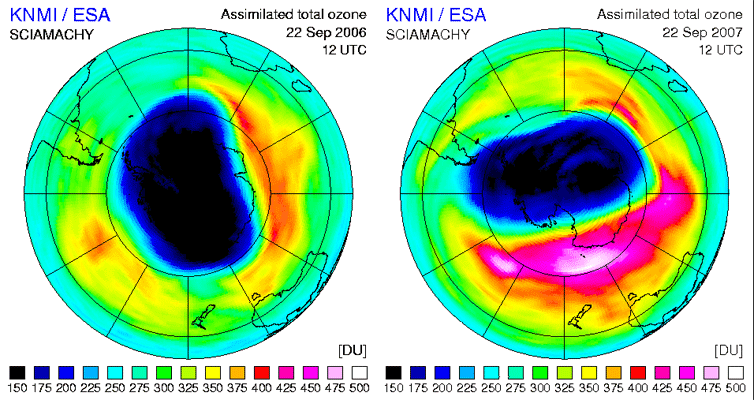




The ozone hole over Antarctica has shrunk 30 percent as compared to last year's record size. According to measurements, this year’s ozone loss peaked at 27.7 million tons, compared to the 2006 record ozone loss of 40 million tons.

Ozone is a protective layer found about 15 miles above us, mostly in the stratospheric stratum of the atmosphere that acts as a sunlight filter shielding life on Earth from harmful ultraviolet rays. Over the last decade the ozone layer has thinned by about 0.3% per year on a global scale, increasing the risk of skin cancer, cataracts and harm to marine life.

Researchers at UCLA have developed a model that could help engineers and scientists speed up the development of hydrogen-fueled vehicles by identifying promising hydrogen-storage materials and predicting favored thermodynamic chemical reactions through which hydrogen can be reversibly stored and extracted.

The new method, published in Advanced Materials, was developed by Alireza Akbarzadeh, a UCLA postdoctoral researcher in the department of materials science and engineering; Vidvuds Ozolins, UCLA associate professor of materials science and engineering; and Christopher Wolverton, professor of materials science and engineering at Northwestern University in Illinois.

Einstein's Theory Of General Relativity has been under assault for the better part of a century. No one can really prove it wrong but it's commonly assumed to be wrong.

Neural prosthetic devices represent an engineer's approach to treating paralysis and amputation. Electronics are used to monitor the neural signals that reflect an individual's intentions for the prosthesis or computer they are trying to use.

With atoms and molecules in a gas moving at thousands of kilometres per hour, physicists have long sought a way to slow them down to a few kilometres per hour to trap them.

A group of physicists from The University of Texas at Austin have found a way to slow down, stop and explore a much wider range of atoms than ever before.

Inspired by the coilgun that was developed by the University’s Center for Electromechanics, the group has developed an "atomic coilgun" that slows and gradually stops atoms with a sequence of pulsed magnetic fields.

Scientists at the University of Missouri-St. Louis used DNA sequences from feather lice to study how island populations of their host, the Galápagos Hawk might have colonized the Galápagos islands, home to the endangered and declining raptor.

The study, focuses on genes from three parasite species restricted to the Galápagos Hawk. The scientists also sequenced the same genes in the hawk to compare levels of genetic variation across these distantly related species.

New York City’s infant mortality rate – widely regarded as a barometer of a population’s general health – fell slightly in 2006, the Health Department reported today. The rate in 2006 was 5.9 infant deaths for every 1,000 births, down from 6.0 the previous year. The City has made major progress in reducing infant deaths since the early 1990s, when the rate was double what it is today, but the decline has leveled off in recent years. The Health Department also reported that in poorer sectors of the city, infant mortality rates are still double the citywide rate.

In 2006, there were 740 infant deaths (defined as deaths of infants less than a year old) out of 125,506 New York City births.

If one spouse exercises, quits smoking, stops drinking alcohol, receives a flu shot, or undergoes a cholesterol screening, the other spouse is more likely to do the same, according to a new study in Health Services Research.

“We found that when one spouse improves his or her health behavior, the other spouse was likely to do so as well,” said co-author Jody Sindelar, health economist and public health professor in the Yale School of Public Health. “This was consistent across all the behaviors analyzed and was similar among both males and females.”

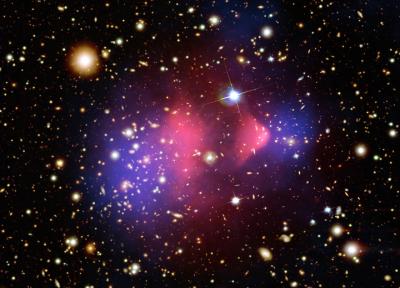
Dark matter is believed to exist in the form of tiny particles that do not interact with light. Because they don’t emit or reflect electromagnetic radiation the way atomic, or baryonic, matter does, these dark matter particles haven’t been directly observed. However, scientists have long theorized their existence based on their gravitational effects on visible matter throughout the universe.

“The evidence for dark matter is now overwhelming, and the required amount of dark matter is becoming precisely known," says Howard Baer, Professor of Physics at Florida State University.

“For example, the gravitational effect of dark matter makes galaxies spin faster than one would otherwise expect,” Baer said.

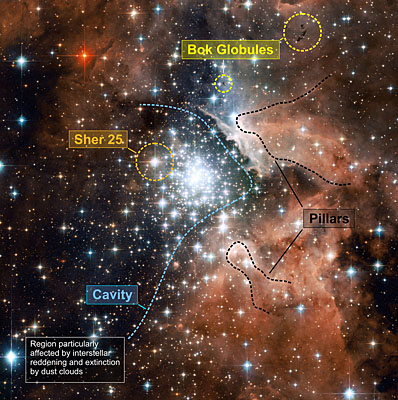
Discovered by Sir John Herschel in 1834, NGC 3603 is known to harbour a blue supergiant star called Sher 25, believed to be on the verge of exploding as a supernova. It is often known as the Milky Way counterpart of the predecessor of the now-famous supernova SN 1987A in the Large Magellanic Cloud.

It is located in the Carina spiral arm of the Milky Way, about 20,000 light-years from the Solar System.

The swirling nebula of NGC 3603 contains around 400,000 solar masses of gas. Lurking within this vast cloud are a few Bok globules, named after Bart Bok who first observed them in the 1940s.

Bok globules are dark clouds of dense dust and gas with masses of about ten to fifty times that of the Sun.

