




The Model Institutions for Excellence Program (MIE) funded by the National Science Foundation (NSF) and the National Aeronautics and Space Administration (NASA) has developed a body of work over the past 11 years demonstrating successful strategies for recruiting underrepresented minority students to science and engineering fields and supporting their successful completion of science degrees.

Five minority-serving institutions--Bowie State University in Maryland, Spelman College in Atlanta, Universidad Metropolitana in Puerto Rico, the University of Texas at El Paso, and Xavier University of Louisiana in New Orleans--plus the Oyate Consortium, representing three tribal colleges in the Midwest, are MIE's participating institutions.

Two major steps toward putting quantum computers into real practice — sending a photon signal on demand from a qubit onto wires and transmitting the signal to a second, distant qubit — have been brought about by a team of scientists at Yale.

Over the past several years, the research team of Professors Robert Schoelkopf in applied physics and Steven Girvin in physics has explored the use of solid-state devices resembling microchips as the basic building blocks in the design of a quantum computer. Now, for the first time, they report that superconducting qubits, or artificial atoms, have been able to communicate information not only to their nearest neighbor, but also to a distant qubit on the chip.

Growing inside the caves of the tropical Pacific island of Borneo are some of the keys to understanding how the Earth's climate suddenly changed - several times - over the last 25,000 years. By analyzing stalagmites, the pilar-like rock formations that stem from the ground in caves, they were able to produce a high-resolution and continuous record of the climate over this equatorial rainforest.

"These stalagmites are, in essence, tropical ice cores forming over thousands of years," said Partin.

Jane Jacobs tells a story about a handed-down meatloaf recipe: After the loaf is made, the end is cut off. “Why?” she asked. “We’ve always done it that way,” she was told. The original recipe was for a smaller oven, it turned out; the end was cut off to make the loaf fit in the oven.

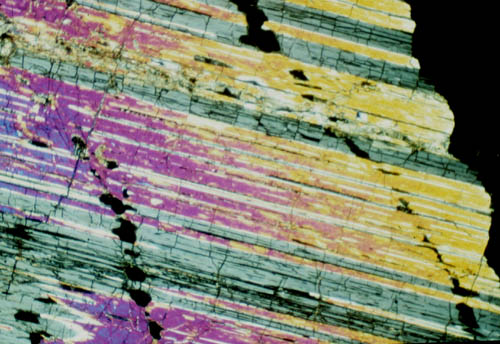
If our planet did not have the ability to store oxygen in the deep reaches of its mantle there would probably be no life on its surface, according to scientists at the University of Bonn who have subjected the mineral majorite to close laboratory examination.

Majorite normally occurs only at a depth of several hundred kilometres under very high pressures and temperatures. The Bonn researchers have now succeeded in demonstrating that, under these conditions, the mineral stores oxygen and performs an important function as an oxygen reservoir. Near the earth's surface the structure breaks down, releasing oxygen, which then binds with hydrogen from the earth's interior to form water. Without this mechanism our "Blue Planet" might well be as dry and inhospitable as Mars.

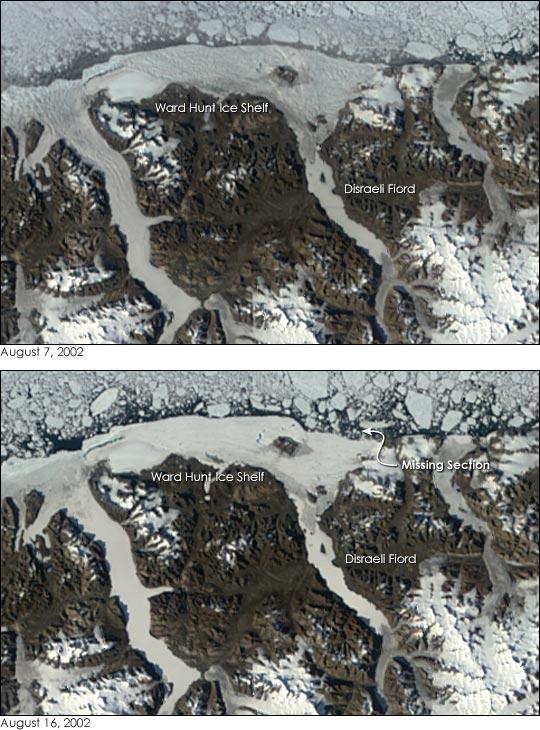
Analyses conducted by researchers from Université Laval’s Center for Northern Studies reveal that aquatic life in Ward Hunt Lake, the continent’s northernmost lake, is affected by climate change.

Ward Hunt Lake is a body of water located on a small island north of Ellesmere Island in the Canadian Arctic, has undergone major transformations within the last two centuries. The speed and range of these transformations—unprecedented in the lake’s last 8,000 years—suggest that climate change related to human activity could be at the source of this phenomenon.

The researchers’ conclusions are based on the analysis of a sediment core extracted in the center of Ward Hunt Lake in August 2003.

World Wildlife Fund scientists said today that the discovery of 11 new animal and plant species in a remote area in central Vietnam underscores the importance of conservation efforts in the ancient tropical forests of the region.

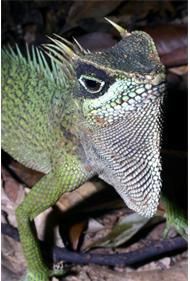
Within the ancient tropical forests of a region known as Vietnam's "Green Corridor," scientists found a snake, five orchids, and two butterflies as well as three other plants new to science and exclusive to the Annamites Mountain Range. Ten other plant species, including four orchids, are still under examination but also appear to be new species.


Acanthosaurus lizard (C) Leonid Averyanov

'Quitting' in the face of insurmountable obstacles is the antithesis of American culture. John Henry died rather than give up against a machine trying to lay railroad track faster than him. Few successful businessmen have denied they worked their way through doubt and financial peril to succeed.

It would seem that persistence would be mentally beneficial over the long haul; hanging in there should increase the odds of personal success and personal success is closely linked to well-being. But what if the goal is extremely unlikely?

Melting icecaps and ‘climate chaos’ have put climate change at the top of the agenda for the UN General Assembly’s meeting this week. The meeting is a precursor to the November meeting in Bali where leaders will try to agree on a successor to the Kyoto Protocol.

A new Institute of Physics’ (IOP) report, Climate change prediction: A robust or flawed process?, published today reveals that while there is general consensus on the underlying causes of the changes in our atmosphere, there is not unanimity.

World leaders have been influenced by one very important document that drew its conclusions after wide consultation in the international science community, the IPCC Summary for Policymakers of the Scientific Assessment.

Engineers at Ohio State University have found a way to turn discarded chicken eggshells into an alternative energy resource.

The patented process uses eggshells to soak up carbon dioxide from a reaction that produces hydrogen fuel. It also includes a unique method for peeling the collagen-containing membrane from the inside of the shells, so that the collagen can be used commercially.

L.S. Fan, Distinguished University Professor of chemical and biomolecular engineering at Ohio State, said that he and former Ohio State doctoral student, Mahesh Iyer, hit upon the idea when they were trying to improve a method of hydrogen production called the water-gas-shift reaction.

