
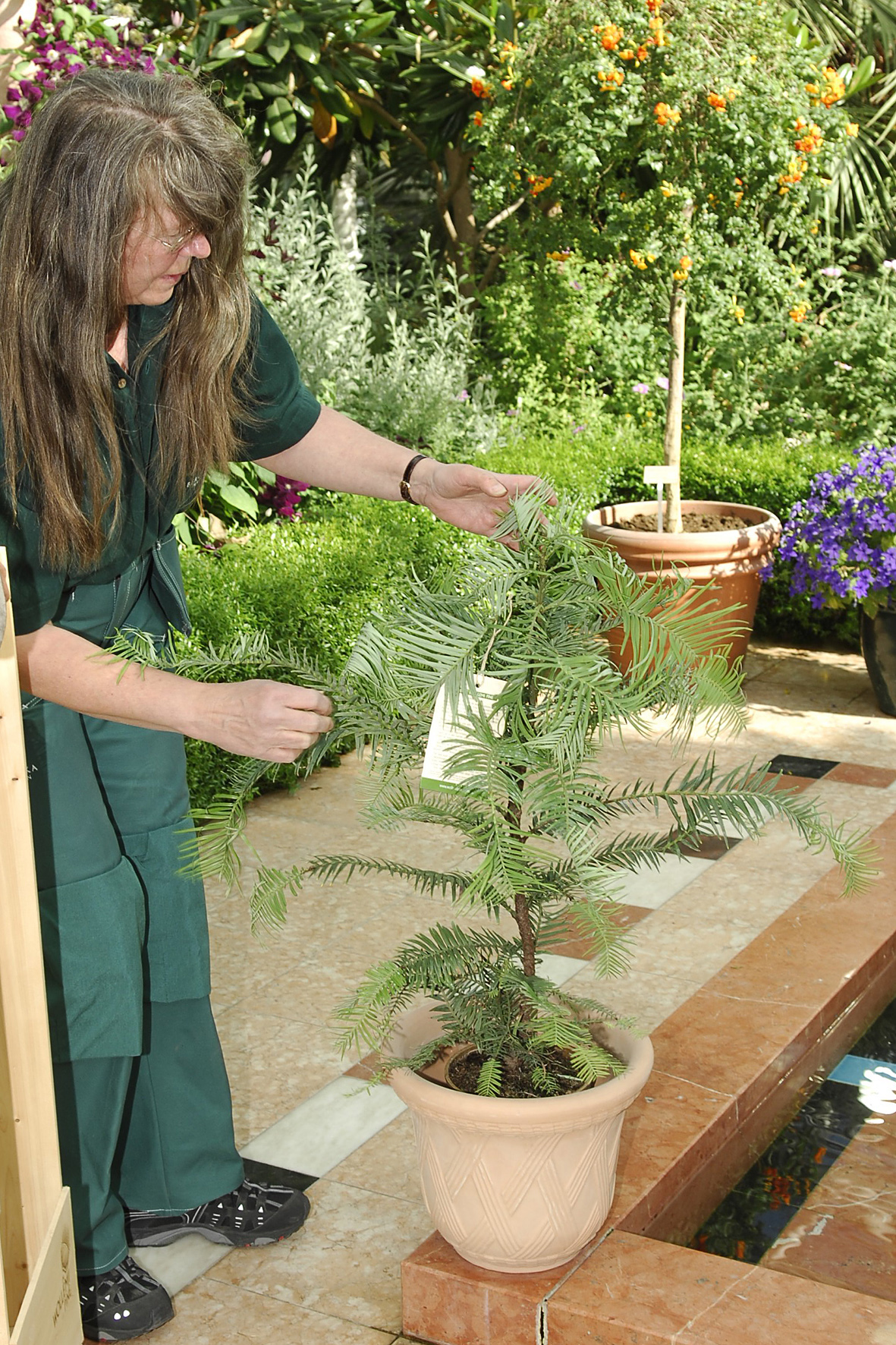








A specimen of the Wollemi pine, an Australian conifer and one of the world's oldest tree species, has been donated to Bergianska Garden at Stockholm University in Sweden.

The Wollemi was discovered on September 10, 1994, in an isolated valley in Wollemi National Park in New South Wales, about 150 km northwest of Sydney. It is estimated to be about 200 million years old, from earth's Jurassic Period, so it was around even before the Australian continent was formed.


Wollemi Pine sample

Humans have yet to see Earth's center, as did the characters in Jules Verne's science fiction classic, "Journey to the Center of the Earth." But a new NASA study proposes a novel technique to pinpoint more precisely the location of Earth's center of mass and how it moves through space.

Knowing the location of the center of mass, determined using measurements from sites on Earth's surface, is important because it provides the reference frame through which scientists determine the relative motions of positions on Earth's surface, in its atmosphere and in space.

Rare, previously undetectable drug-resistant forms of HIV have been identified by Yale School of Medicine researcher Michael Kozal, M.D., using an innovative genome sequencing technology that quickly detects rare viral mutations.

Kozal, associate professor of medicine at Yale and senior author of the retrospective study that used samples from an earlier clinical trial, presented the findings today at the 16th International HIV Drug Resistance Workshop in Barbados. “We found that the fraction of HIV patients that harbored resistance mutations is at least twice as high as previously thought,” said Kozal, who also directs the HIV Program at the VA Connecticut Healthcare System.

A tiny single-celled organism that plays a key role in the carbon cycle of cold-water oceans may be a lot smarter than scientists had suspected.

Researchers report the first evidence that a common species of saltwater algae – also known as phytoplankton – can change form to protect itself against attack by predators that have very different feeding habits. To boost its survival chances, Phaeocystis globosa will enhance or suppress the formation of colonies based on whether nearby grazers prefer eating large or small particles.


Suppressing colony formation is a useful strategy against copepods because they prefer to eat colonies of phytoplankton.

If you have bad kids, it may not be your fault.

Well, it could still be your fault, because it's biology and genetics is part of biology, but you can't control genetics. At least you then you wouldn't have to feel guilty about being a lousy parent.

Either way there's a real effort on to blame everything except the actual delinquent kids and a new study in Psychological Science advances that cause. Rutgers University psychologist Daniel Hart and colleagues write that they can use a a Skin Conductance Response (SCR) test, along with some family history, to predict delinquency.

Great news for imbibers. A new study suggests that alcohol may protect against rheumatoid arthritis and more of it is better than less. The study says three glasses of wine, for example, has positive effects but 10 glasses a week is even better.

Mixotrophs are species of algae that act as "plants" when they produce their own food and as “animals” when they eat other plants.

Wanderson Carvalho from the University of Kalmar is studying these algae to understand their potential impact on the environment, the economy and public health issues.

In terrestrial ecosystems, plants are the only living beings capable of producing their own food, thanks to the chlorophyll and other pigments which can capture sunlight energy. With this energy and nutrients (e.g. nitrogen and phosphorus) from land and carbon dioxide from the atmosphere they produce organic material.

Plants are thus producers and belong to the base of the food chain.

Is it possible to scientifically measure someone’s sense of humor? Are there universally good or bad jokes that make people laugh no matter their gender, profession or cultural background?

These are some of the questions answered by the doctoral thesis Sentido del humor: construcción de la escala de apreciación del humor (Sense of humor: building of the appreciation of humor scale), carried out by Hugo Carretero Dios, researcher in the department of Social Psychology and Methodology of Behavioural Science at the University of Granada.


A whole generation of Americans thought Red Skelton was funny but you can't give away his DVDs to young people. How does science explain that?

A new Mayo Clinic study provides evidence that DNA variations largely explain why some persons get Parkinson’s disease while others don’t, and even predict with great accuracy at what age people might develop their first symptoms.

“This represents a major paradigm shift from single gene studies to genomic pathway studies of complex diseases,” says Demetrius Maraganore, M.D., the Mayo Clinic neurologist and Parkinson’s disease specialist who led the study.


Goodness-of-Fit of Final Model Using Axon Guidance Genes to Predict Susceptibility to PD

New research from Colorado State University shows that the function of all genes in mammals is based on circadian – or daily – rhythms. The study refutes the current theory that only 10 percent to 15 percent of all genes were affected by nature’s clock.

While scientists have long known that circadian rhythms regulate the behavior of the living, the study shows that daily rhythm dominates all life functions and particularly metabolism. The new study presents oscillation as a basic property of all genes in the organism as opposed to special function of some genes as previously believed.

