




A new vaccine aimed at preventing cervical cancer is nearly 100 percent effective against the two types of the human papillomavirus (HPV) responsible for most cases of cervical cancer. Results of a nationwide study of the vaccine will be published in the May 9 issue of the New England Journal of Medicine.

Cervical cancer is the second most common cause of cancer deaths in women worldwide, resulting in nearly half a million diagnoses and 240,000 deaths each year. Every day in the United States ten women die from cervical cancer, according to Kevin Ault MD, associate professor of obstetrics and gynecology at Emory University School of Medicine, and one of the study authors.

Researchers at the Johns Hopkins Kimmel Cancer Center have conclusive evidence that human papillomavirus (HPV) causes some throat cancers in both men and women. Reporting in the May 10 issue of the New England Journal of Medicine, the researchers found that oral HPV infection is the strongest risk factor for the disease, regardless of tobacco and alcohol use, and having multiple oral sex partners tops the list of sex practices that boost risk for the HPV-linked cancer.

An international team, led by researchers at the Broad Institute of MIT and Harvard, and supported by the National Institutes of Health (NIH), today announced the publication of the first genome of a marsupial, belonging to a South American species of opossum. In a comparison of the marsupial genome to genomes of non-marsupials, including human, published in the May 10 issue of the journal Nature, the team found that most innovations leading to the human genome sequence lie not in protein-coding genes, but in areas that until recently were referred to as "junk" DNA.

Using an innovative statistical approach, a research team from Washington University School of Medicine in St. Louis and the University of California, Los Angeles, has identified two regions of DNA linked to autism. They found the suspicious DNA with a much smaller sample of people than has been used traditionally in searches for autism genes.

Researchers have known for decades that certain neurodegenerative diseases, such as mad cow disease or its human equivalent, Cruetzfeldt-Jakob disease, result from a kind of infectious protein called a prion. Remarkably, in recent years researchers also have discovered non-pathogenic prions that play beneficial roles in biology, and prions even may act as essential elements in learning and memory.

The presence of ecologically distinct males and females greatly increases a species' niche, say researchers.

Some Caribbean lizards' strong sexual dimorphism allows them to colonize much larger niches and habitats than they might otherwise occupy, allowing males and females to avoid competing with each other for resources and setting the stage for the population as a whole to thrive. The finding, reported this week in the journal Nature, suggests sex differences may have fueled the evolutionary flourishing of the Earth's wildly diverse fauna in a way not previously appreciated by scientists.

A plateau on Mars known as Home Plate shows evidence of long-past explosive volcanic activity, say scientists on NASA's Mars Exploration Rover mission. And data collected during the rover Spirit's initial pass across the 90-meter (295 feet) wide plateau also supports earlier findings indicating that water once existed at or beneath the planet's surface.

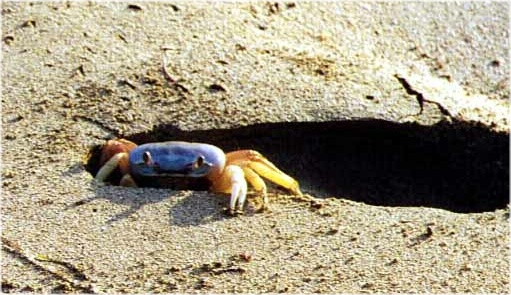
In suspicious environments, like bars and math study groups, females are at greater risk. Scientists from Seoul National University, in Korea, and the Smithsonian Tropical Research Institute in Panama have recently done a study to determine how females avoid the bad males while assessing the good ones.

The males peacock’s showy plumage, for example, is thought to attract females with the promise of better offspring. Showy male peacocks also escape from predators despite their annoyingly conspicuous ornaments and behavior — proof of their superiority.


Need a place to hide? I have a big claw

Call it sperm competition.

According to a study appearing in Current Directions in Psychological Science, sexual characteristics exhibited by human males indicate that men have evolved to deliver their sperm more effectively to females who have multiple partners to choose from.

Temple University School of Medicine researchers have developed a new biosensor that sniffs out explosives and could one day be used to detect landmines and deadly agents, such as sarin gas.

To create the biosensor, Danny Dhanasekaran and colleagues genetically engineered a yeast strain with mammalian (rat) olfactory signaling machinery and genetically linked it to the expression of green fluorescent protein. Into these yeast cells, they cloned individual rat olfactory receptors. When the olfactory receptor "smells" the odor of DNT, an ingredient in the explosive TNT, the biosensor turns fluorescent green. The research team is the first to identify, clone and sequence this novel olfactory receptor.

