






There is bad news for those planning to go to Mars in the near future: a study in mice has suggested that radiation in space could cause cognitive decline in astronauts. However, we know from past research that mental, social and physical exercise can boost cognitive functions. With planned Mars missions moving ever closer, it might be be worth exploring activity as a way to counter radiation damage.

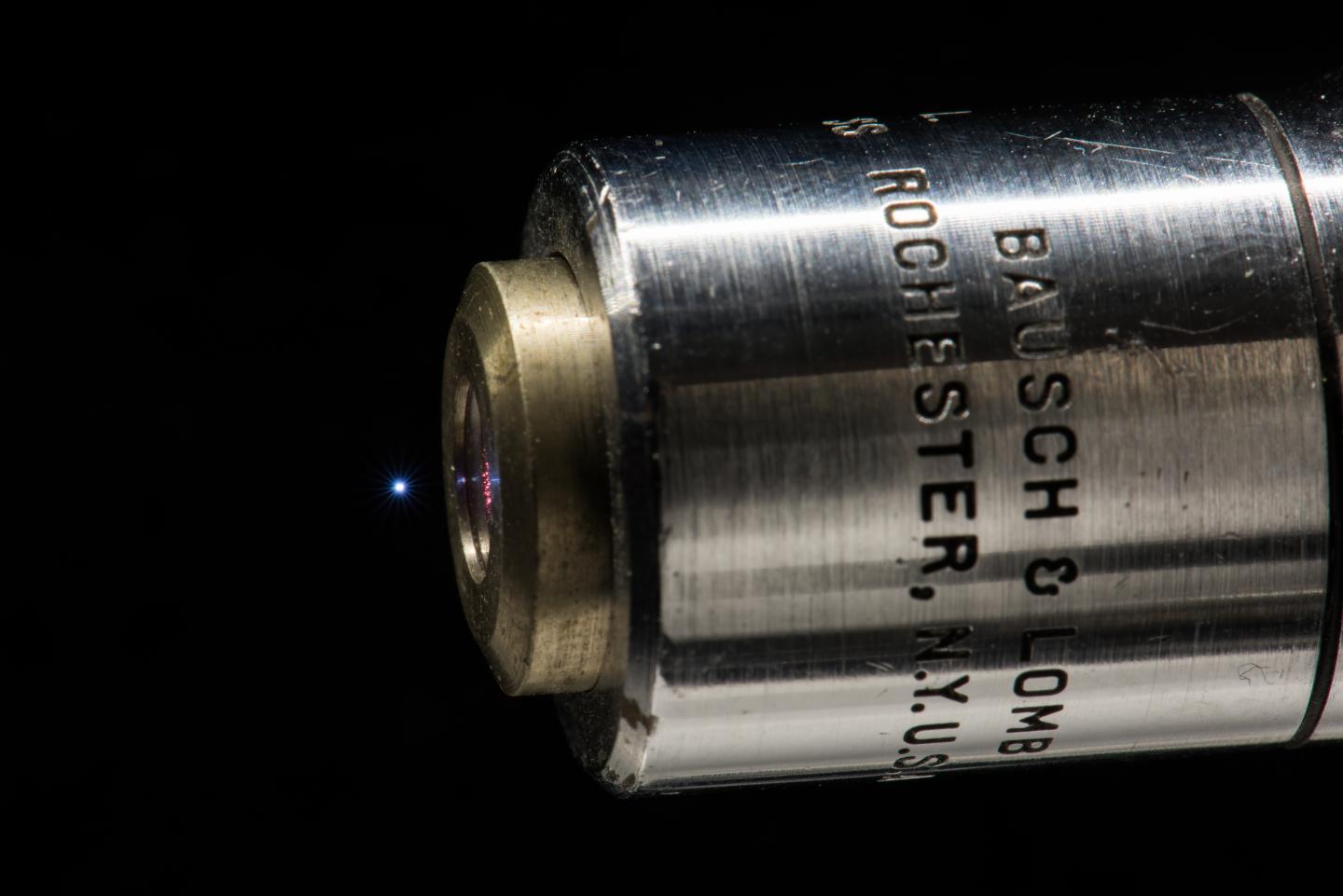
Researchers have shown that a laser-generated microplasma in air can be used as a source of broadband terahertz radiation.

In a paper published this week in Optica, Fabrizio Buccheri and Xi-Cheng Zhang demonstrate that an approach for generating terahertz waves using intense laser pulses in air - first pioneered in 1993 - can be done with much lower power lasers, a major challenge until now. Ph.D. student and lead author Buccheri explains that they exploited the underlying physics to reduce the necessary laser power for plasma generation. He adds that it could potentially be improved for applications in the monitoring of explosives or drugs.

Marsha Lewis, Inside Science TV – There are about 60,000 different vertebrates on this planet.

Mammals, birds, reptiles, amphibians, fish, even you are a vertebrate. And now for the first time, scientists from around the world are coming together to study them on a molecular level.

"The Genome 10k Project is our first look at vertebrate animal life," said David Haussler, a biomolecular engineer at the University of California, Santa Cruz. "We're trying to get at least 10,000 species represented in our genome collection," he said.

The first large international study to investigate the late side-effects of a combination of two forms of brachytherapy to treat cervical cancer has shown that the technique successfully delivers higher radiation doses to the tumour without an increase in treatment-related problems afterwards.

It's not a surprise that in a modern materialistic society, the desire to buy the latest iGimmick will lead to sadness if the money to do so is not available but we fortunately have the statistics to back that up. The recent Great Recession was accompanied by a significant and sustained  major depression claims by U.S. adults, according to a study published in the Journal of Clinical Psychiatry.

A research team has provided ground-truth for a method of measuring plant photosynthesis on a global scale: from low-Earth orbit.

There is discussion of a U.S. manned mission to Mars but if recent history is any indication, the next president will undo the space program of the current one, just as the current one undid the manned space program of the last.

It may be for the best, at least as far astronaut safety is concerned. The destructive particles in galactic cosmic ray exposure can forever impair cognition, according to an oncology paper in Science Advances.

As yesterday in Italy was the equivalent of Labor Day, and today is a Saturday, with people around me exploiting the three-day rest for a recreational trip, I do not feel in a very productive mood, so rather than writing something original here I will exploit other people's work, pointing at what I found interesting or anyway worth my attention among the papers appeared on the Cornell Arxiv in the last few days, and other assorted material.

Antarctica's massive ice sheet has recently lost twice the amount of ice in the west as what it  accumulated in the east, and the southern continent's ice cap is melting ever faster, according to a new study in which researchers "weighed" Antarctica's ice sheet using gravitational satellite data and found that from 2003 to 2014, the ice sheet lost 92 billion tons of ice per year.

If stacked on the island of Manhattan, that amount of ice would be a mile high, more than five times the height of the Empire State Building.


Everyone loves vampire squid, right? Their monstrous name belies their gentle nature as graceful underwater flyers who eat poop.

